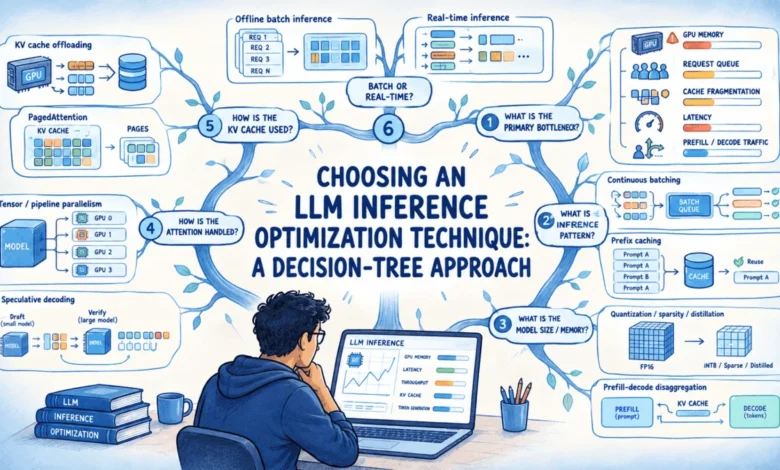
As Large Language Models (LLMs) transition from experimental research projects to the backbone of enterprise software, the engineering challenge has shifted from model training to efficient deployment. In production environments, LLM inference is frequently bottlenecked by hardware limitations, leading to high latency and exorbitant operational costs. To navigate these constraints, engineers must match specific optimization techniques to the precise nature of their workload. By systematically working through a six-question decision tree, developers can diagnose whether their performance issues stem from memory bandwidth, compute overhead, or inefficient request scheduling.
The Anatomy of an Inference Bottleneck
The current landscape of generative AI deployment is defined by a paradox: models are becoming more capable, yet the underlying GPU infrastructure is struggling to keep pace with the demand for real-time responses. When traffic scales, requests inevitably queue behind long-form generation tasks. During this process, GPU memory often becomes saturated with cached attention states—specifically the Key-Value (KV) cache—and the hardware experiences significant downtime waiting for memory reads.
This state of "memory wall" is the primary driver of modern inference optimization. Optimization is not a monolithic endeavor; it is a multi-layered process that targets specific hardware behaviors. Some techniques aim to reduce the footprint of the model itself, others attempt to optimize the flow of data through the GPU, and a final category focuses on how multiple requests are interleaved. Choosing the incorrect optimization path often introduces unnecessary complexity, which can lead to diminishing returns or even performance regressions.
A Chronological Evolution of Serving Techniques
The evolution of inference optimization has moved in tandem with the scaling of transformer architectures. In the early stages, "static batching"—the practice of processing requests in rigid groups—was the standard. However, this proved inefficient as models grew, leading to the development of "continuous batching" around 2022-2023, which allowed for the injection of new requests into the stream without waiting for previous ones to finish.
This was followed by the introduction of PagedAttention, a critical breakthrough that mirrored operating system virtual memory management. By treating the KV cache as a collection of non-contiguous pages, researchers effectively solved the memory fragmentation issue that had previously capped batch sizes. More recently, the industry has shifted toward disaggregated architectures, where prefill (prompt processing) and decode (token generation) are handled by separate specialized nodes to better utilize hardware resources.
The Six-Question Diagnostic Decision Tree
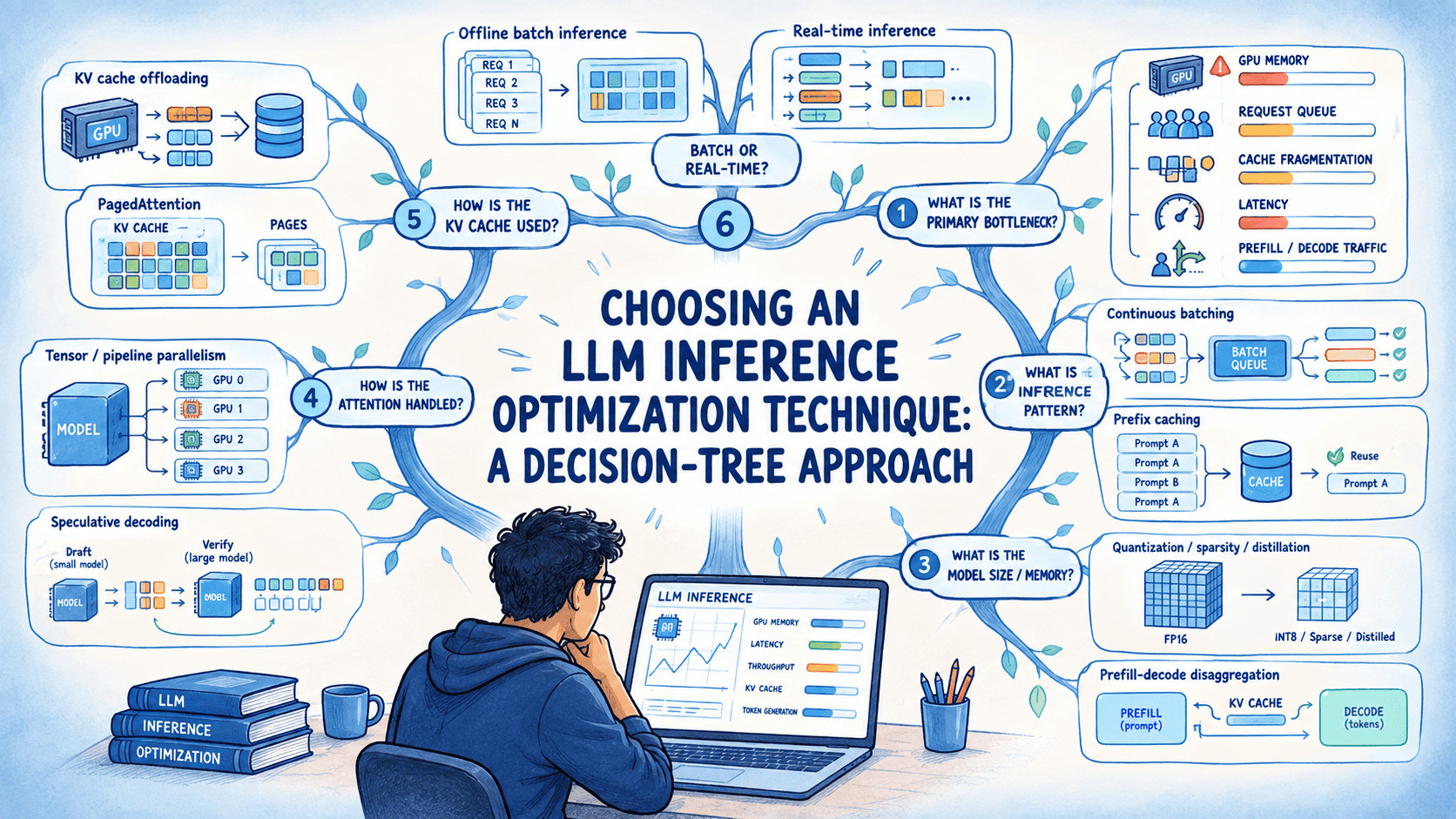
To effectively optimize a production workload, engineers should apply the following diagnostic framework to identify the root cause of performance degradation.
1. Assessing Model-to-Hardware Fit
Before altering the serving stack, one must determine if the model occupies too much of the available VRAM. If a model consumes 90% of the GPU memory, there is no room for the KV cache to expand during generation, leading to an immediate bottleneck at the hardware level. In such cases, model-level compression techniques—such as post-training quantization, weight pruning, or distillation—are mandatory. These techniques trade off a marginal amount of model accuracy for significant gains in memory efficiency and compute throughput.
2. Identifying Prompt Structure and Prefix Caching
For many applications, such as RAG (Retrieval-Augmented Generation) or persistent chat sessions, the prompt is highly redundant. If a system prompt or a long conversation history is sent with every request, the model redundantly computes the same tokens. Prefix caching allows the system to store the KV cache of these repeated segments, essentially "skipping" the recomputation of the prompt. When implemented correctly, this can reduce time-to-first-token by orders of magnitude for long-context applications.
3. Analyzing Concurrent Request Variance
If a workload mixes short, single-sentence queries with long code-generation tasks, naive scheduling will result in the entire batch waiting for the longest request to complete. Continuous batching mitigates this by treating requests as independent flows. As soon as one request generates its final token, the GPU is immediately available to begin a new prompt, ensuring high hardware utilization.
4. Managing KV Cache Fragmentation
Even with efficient scheduling, memory fragmentation remains a persistent issue. When using static memory allocation, the system reserves space for the worst-case scenario (the maximum context length). This wastes significant VRAM. PagedAttention addresses this by allocating cache memory in small, fixed-size chunks. It is highly recommended that teams verify whether their serving engine (e.g., vLLM, TGI, or TensorRT-LLM) has PagedAttention enabled, as it is often the single most effective way to increase throughput in memory-constrained environments.
5. Optimizing Per-Token Latency with Speculative Decoding
When the primary KPI is the "human-perceived speed" of streaming text, speculative decoding is the industry-standard solution. By using a smaller "draft" model to predict a sequence of tokens and a larger "target" model to verify them in parallel, the system can generate multiple tokens in a single forward pass. This technique is particularly effective for latency-sensitive applications, provided the draft model has a high enough acceptance rate to avoid the overhead of constant re-verification.
6. Disaggregation for Large-Scale Production
For massive, enterprise-grade deployments, the prefill phase (which is compute-intensive) and the decode phase (which is memory-bandwidth-intensive) can compete for the same resources. Prefill-decode disaggregation physically separates these two tasks onto different hardware clusters. This allows for fine-tuned scaling, where prefill nodes handle prompt bursts and decode nodes maintain steady-state generation. This should only be considered for high-scale workloads, as the cost of network overhead and KV cache serialization is non-trivial.
Strategic Implications and Industry Standards
The decision to implement these optimizations carries significant operational weight. For instance, while quantization is highly effective, it requires rigorous testing to ensure that the loss in precision does not degrade the model’s logical reasoning or safety guardrails. Similarly, while speculative decoding can improve user experience, it effectively doubles the memory requirement by requiring two models to reside on the same device.
According to industry performance benchmarks, the combination of continuous batching and PagedAttention has become the "baseline" for modern production environments, typically yielding a 2x to 5x increase in throughput compared to legacy implementations. However, the path to further optimization is rarely linear.
Common Pitfalls and Troubleshooting
Engineers frequently encounter scenarios where an optimization technique fails to deliver the expected results. A common symptom is a "zero hit rate" for prefix caching, which is usually caused by non-deterministic serialization where small changes in the prompt (such as timestamps or session IDs) break the cache key. Another frequent issue is the failure to see throughput gains from quantization; this often occurs when only the weights are quantized, but the GPU still performs internal computations at higher precision, creating a hidden bottleneck.
The most effective approach is to maintain a rigorous profiling cycle. Before introducing a new optimization, teams should measure the "time-to-first-token" (TTFT) and "tokens-per-second" (TPS) metrics. If a technique does not move these needles, it is likely adding unnecessary complexity to the stack.
Conclusion
Mastering LLM inference is less about selecting a "magic" optimization and more about understanding the constraints of the specific workload. Whether a system is constrained by memory, compute, or latency, there is a clear, evidence-based path to improvement. As the industry matures, the focus will continue to shift toward these modular, specialized optimizations, ensuring that the next generation of AI applications remains both performant and sustainable at scale. By adhering to a structured decision-tree approach, organizations can navigate the complexities of LLM deployment with greater technical precision and fiscal responsibility.