China-nexus cyber espionage group Volt Typhoon utilizes sophisticated Silent Train network for strategic zero-day exploitation

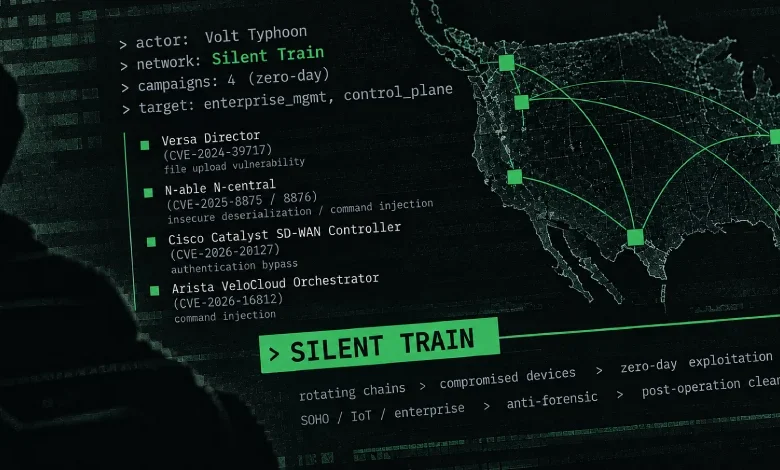
The sophisticated China-linked state-sponsored threat actor known as Volt Typhoon has been identified as the operator behind a covert, highly resilient cyber espionage network dubbed Silent Train. This infrastructure, which emerged in late 2023, has served as a primary conduit for the group’s strategic efforts to gain, maintain, and expand access to critical infrastructure within the United States. According to a comprehensive analysis released by Lumen Technologies’ Black Lotus Labs, Silent Train represents a significant evolution in operational security, utilizing ephemeral, rotating chains of compromised small office/home office (SOHO) routers, Internet of Things (IoT) devices, and enterprise-grade hardware to obfuscate the origins of malicious activity.
The Genesis and Evolution of Silent Train
The development of Silent Train appears to be a direct tactical response to the increased scrutiny and disruption of previous Chinese-linked botnets. In early 2023, the cybersecurity community and government agencies, including the FBI and CISA, successfully dismantled the "KV-botnet," which had been extensively leveraged by state-sponsored actors to target critical infrastructure. Rather than retreating, the operators behind Volt Typhoon—also tracked as Bronze Silhouette, Insidious Taurus, and Voltzite—pivoted to a more clandestine model.
By November 2023, the foundational architecture of Silent Train began to take shape. While the initial iteration was highly ephemeral, designed to vanish after a single operation, the framework underwent a maturation process. By early 2025, the infrastructure shifted into a hybrid architecture. This new model retained high-value enterprise devices for extended periods—ranging from one to three months—rather than discarding them after each engagement. This shift allowed the group to sustain longer-term surveillance and lateral movement capabilities while still masking their footprint through a complex, multi-hop relay system.
Operational Methodology: The "Living off the Land" Approach
Silent Train functions as a layered, multi-hop proxy network. The primary objective is to hide the malicious traffic’s true origin by routing it through a series of compromised nodes before it ever reaches the intended target. The infrastructure utilizes at least 27 distinct device classes, including hardware from major manufacturers such as TP-Link, Intelbras, Ruckus Wireless, SATO, NETGEAR, Zyxel, and Cambium.

The group demonstrates high operational discipline. Once a target is selected, operators exploit exposed web interfaces on these devices to establish temporary SSH connections. They deploy only the minimal tooling required for the specific task—often relying on "living off the land" utilities—and, crucially, perform a "cleanup" phase at the end of each session. During this phase, they remove SSH keys, configuration files, and temporary artifacts, leaving virtually no trace of their presence for traditional forensic tools to detect.
This compartmentalization is a hallmark of the operation. For example, researchers observed that specific devices, such as Intelbras modems, were used exclusively as relay nodes, while more robust appliances like Netgear Orbi or Fortinet FortiGate routers were reserved for intermediary and exit-point roles within the U.S. By creating these functional silos, the threat actors ensure that even if one node is compromised or analyzed, the larger structure remains intact and its operators remain hidden.
Targeted Sectors and Geographic Focus
The scope of the victims impacted by Silent Train is extensive, spanning sectors essential to national security and public safety. These include, but are not limited to, telecommunications providers, defense contractors, government entities, satellite and mission-critical communication services, academic institutions, and critical infrastructure such as water, energy, transportation, and emergency services.
Geographically, the activity is heavily concentrated in the United States, with a particular focus on Hawaii, California, and Texas. This concentration is not coincidental; these regions host the majority of the nation’s key military installations, major logistics hubs, and critical telecommunications infrastructure. The targeting of these specific sectors suggests that Volt Typhoon is not merely conducting traditional industrial espionage, but is actively positioning itself to disrupt or disable vital services during periods of geopolitical tension, particularly in the Indo-Pacific region.
A Chronology of Zero-Day Exploitation
Volt Typhoon has demonstrated a consistent ability to identify and exploit zero-day vulnerabilities in enterprise software to gain initial access. A notable example occurred in August 2024, when the group exploited a file upload vulnerability in the Versa Director platform (CVE-2024-39717). This exploit was used to deliver "VersaMem," a bespoke web shell specifically engineered to harvest credentials and facilitate entry into the downstream networks of Versa’s customers.

Beyond the Versa incident, the group’s history of exploitation includes:
- Late 2023: Initial development of the Silent Train framework as a response to the KV-botnet takedown.
- August 2024: Deployment of VersaMem via a zero-day exploit to target service providers.
- October 2025: Suspected exploitation of a zero-day in Quest KACE, impacting over 30 victims before a patch was issued.
The use of these zero-day exploits, combined with the Silent Train infrastructure, highlights the group’s sophisticated supply-chain approach. By compromising a single service provider or management platform, the attackers can potentially gain access to hundreds of downstream organizations simultaneously.
Security Implications and Strategic Analysis
The existence and evolution of Silent Train present a profound challenge to traditional network defense. Because the infrastructure relies on legitimate, albeit compromised, consumer and enterprise hardware, it is difficult to block based on reputation or simple IP blacklisting. The ephemeral nature of the network—where connections may last only minutes—means that threat hunters are often chasing ghosts, attempting to analyze a chain of devices that has already been dismantled by the time an alert is triggered.
Security experts emphasize that the threat posed by Volt Typhoon is one of "pre-positioning." The goal is not immediate theft of data, but rather the establishment of a persistent, "dormant" presence that can be activated in a time of crisis. By targeting the management plane of critical systems—the administrative consoles that control entire networks—the threat actor ensures that they can exert maximum impact if they choose to transition from espionage to sabotage.
Official Responses and Mitigation
While federal agencies like CISA and the FBI have not released a single, unified policy statement specifically on "Silent Train" as of the latest reporting, the broader strategy remains consistent with their "Shields Up" guidance. The government has repeatedly urged critical infrastructure operators to move away from legacy management systems and to implement robust, multi-factor authentication (MFA) on all internet-facing hardware.

Industry analysts suggest that the most effective countermeasure against Silent Train is the implementation of rigorous network segmentation and the strict limitation of remote management interfaces. If a router or enterprise appliance does not absolutely require a web-based management interface accessible from the open internet, that access should be disabled or restricted behind a VPN. Furthermore, organizations are advised to prioritize the patching of edge devices, as these are the primary targets for the group’s initial ingress.
Conclusion
The Silent Train campaign serves as a stark reminder of the current state of state-sponsored cyber operations. It is no longer sufficient to monitor for known malware signatures or static C2 (command and control) servers. As Volt Typhoon has demonstrated, the threat is increasingly focused on the "living off the land" methodology, where the tools of the trade are legitimate administrative functions and the infrastructure is a transient, self-healing web of compromised consumer devices.
As global tensions persist, the ability of state actors to maintain deep, long-term access to critical infrastructure remains one of the most significant risks to national security. The evolution of Silent Train from an ephemeral relay network to a sophisticated, hybrid architecture suggests that the threat actors are continuously learning, adapting, and refining their techniques to evade detection. For organizations operating within the defense, communications, and critical infrastructure sectors, the message is clear: the threat is not just at the perimeter—it is already embedded in the hardware that sustains the modern world.
Related posts: