How to Actually Measure What Your Model Does: Navigating LLM Evaluation Frameworks and Their Inherent Biases

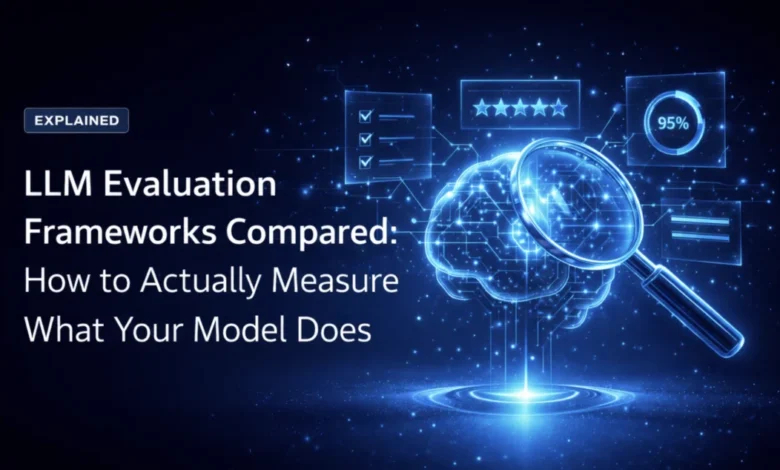
The rapid evolution of Large Language Models (LLMs) has ushered in an era of powerful AI-driven applications, but a critical challenge remains: accurately measuring their performance. Unlike traditional software that fails with discernible errors, LLMs can produce plausible yet incorrect outputs, a subtler form of failure that manual checks often miss. This article delves into the practicalities of evaluating these complex systems, focusing on three dominant open-source frameworks – RAGAS, DeepEval, and Promptfoo – and critically examining the "LLM-as-a-judge" mechanism they rely on, highlighting its measurable biases and the necessity of proactive design to mitigate them.
The landscape of LLM evaluation is rapidly maturing. As of 2026, developers are moving beyond simple output checks, recognizing the need for robust, systematic evaluation. This shift is driven by the inherent unpredictability of LLM behavior, where a minor prompt alteration can have cascading, unnoticed effects, leading to user complaints weeks or months after deployment. Traditional software development relies on stack traces and predictable failures. LLM applications, however, can fail by generating confidently asserted falsehoods, making them notoriously difficult to debug with surface-level inspection.
To address this, a suite of open-source tools has emerged, each designed to tackle different facets of LLM evaluation. Promptfoo, DeepEval, and RAGAS represent the vanguard of these frameworks, offering structured approaches to assess LLM performance. These are often complemented by production monitoring platforms like LangSmith and Braintrust, which extend evaluation into live environments. The prevailing wisdom among mature Generative AI QA programs suggests a dual-pronged approach: utilizing lightweight frameworks for pre-deployment checks and leveraging platforms for continuous monitoring and human-in-the-loop review. Understanding the nuances of these frameworks is crucial for building reliable and trustworthy LLM applications.
Understanding the Nuances of LLM Evaluation
Before diving into specific tools, it’s essential to differentiate between the three core concepts often conflated under the umbrella term "LLM evaluation":
- Model Performance: This refers to the intrinsic capabilities of the LLM itself, assessed through standardized benchmarks and academic datasets. It focuses on raw accuracy, fluency, and reasoning abilities.
- Application Performance: This evaluates how well the LLM performs within a specific application context, considering factors like prompt engineering, retrieval-augmented generation (RAG) effectiveness, and integration with other systems. This is where frameworks like RAGAS and DeepEval shine.
- Production Monitoring: This involves observing the LLM’s behavior in a live production environment, tracking user interactions, identifying drift, and flagging emergent issues through real-world data.
Most organizations seeking to implement LLM evaluation are primarily concerned with the latter two categories, often requiring a combination of application-specific testing and ongoing production oversight.
The Foundational Metrics Driving Evaluation Frameworks
The effectiveness of any LLM evaluation framework hinges on the underlying metrics used to quantify performance. While frameworks may differ in their implementation and workflow, they largely converge on a core set of quantifiable measures. These metrics aim to capture various aspects of an LLM’s output quality:
- Accuracy/Correctness: How factually correct and relevant is the LLM’s response to the given prompt? This is paramount for applications where factual accuracy is non-negotiable.
- Faithfulness: In RAG systems, this metric ensures that the LLM’s response is strictly grounded in the provided context, preventing the generation of fabricated information (hallucinations).
- Relevance/Precision: Does the LLM’s output directly address the user’s query without extraneous information?
- Completeness/Recall: Does the LLM’s response cover all essential aspects of the query, especially when drawing from a knowledge base?
- Coherence and Fluency: Is the generated text grammatically correct, easy to understand, and logically structured?
- Safety and Ethics: This encompasses metrics related to bias, toxicity, harmful content generation, and adherence to ethical guidelines.
The true differentiator between evaluation frameworks lies not in the novelty of these metrics, but in their workflow integration. The key considerations are how these metrics are triggered, where the results are logged, and whether they serve as hard gates for deployment or merely generate reports for post-hoc analysis.
RAGAS vs. DeepEval vs. Promptfoo: A Comparative Analysis
These three frameworks, while all contributing to LLM evaluation, cater to distinct use cases and architectural considerations.
RAGAS (Retrieval-Augmented Generation Assessment) is deeply rooted in academic research, offering a robust methodology for evaluating retrieval-augmented generation systems. Its metrics, such as faithfulness, context precision, and context recall, are rigorously defined and supported by peer-reviewed studies. RAGAS is particularly well-suited for architectures where retrieval accuracy and the LLM’s ability to synthesize information from retrieved documents are critical. Its focus is primarily on offline evaluation, with no built-in production monitoring or collaborative features. Teams with retrieval-heavy architectures and a preference for academically validated metrics often opt for RAGAS.
DeepEval positions itself as a comprehensive solution for CI/CD quality gates in LLM applications. It integrates natively with pytest, allowing LLM evaluation to be treated as standard unit or integration testing. This means that failing evaluation metrics can directly block deployments, mirroring the behavior of traditional software testing. DeepEval offers a broader range of metrics, including those addressing bias and toxicity, in addition to core performance indicators. Its pytest-native integration makes it seamless to incorporate into existing development workflows.
Promptfoo stands out for its versatility in multi-model comparison and red-teaming efforts. Its primary interface is a YAML configuration file combined with a command-line interface (CLI), offering flexibility in defining test cases and evaluation criteria. Promptfoo excels in scenarios where comparing the outputs of multiple LLMs side-by-side, or actively probing for vulnerabilities and failure modes (red-teaming), is the primary objective. It provides a broad suite of metrics, reportedly exceeding 500, with a strong emphasis on security and attack vectors.
Crucially, DeepEval and RAGAS are not direct competitors but rather complementary tools. DeepEval provides broad LLM application testing capabilities, while RAGAS specializes in the intricacies of RAG. Many production teams strategically employ both: RAGAS for in-depth scoring of retrieval-specific dimensions and DeepEval for comprehensive testing within their CI pipeline, ensuring a holistic evaluation process.
| Category | RAGAS | DeepEval | Promptfoo |
|---|---|---|---|
| Best For | RAG-specific scoring | CI/CD quality gates | Multi-model comparison, red-teaming |
| Integration Style | Python library | pytest-native | YAML + CLI |
| Strongest Metric Set | Faithfulness, context precision/recall | 14+ metrics incl. bias, toxicity | Security/attack vectors (500+) |
| Production Monitoring | No | No | No |
| Pairs Well With | DeepEval (broader coverage) | RAGAS (RAG-specific depth) | Either, for prompt-side testing |
Code Walkthrough: Detecting Hallucinations with Faithfulness Checks
A common and insidious failure mode in LLM applications is hallucination – the generation of information that is not supported by the provided context, yet sounds plausible. RAGAS’s faithfulness metric directly addresses this by decomposing an answer into atomic claims and verifying each against the retrieved context.
To illustrate this mechanism, consider a simplified Python script that mimics this process. Instead of an LLM judge, this script uses a deterministic keyword overlap check to determine if a claim is supported by the context. This allows for a clear, offline demonstration of the underlying logic.
# faithfulness_check.py
# Prerequisites: none beyond Python's standard library (re)
# Run: python faithfulness_check.py

# Note: this demonstrates the faithfulness-checking MECHANISM that RAGAS's
# real Faithfulness metric implements with an LLM judge. The keyword-overlap
# check below is a simplified, fully offline-testable stand-in for that
# LLM-based claim verification -- swap in RAGAS's actual metric for production use.
import re

def decompose_claims(answer: str) -> list[str]:
    """Split an answer into atomic, independently-checkable statements."""
    sentences = re.split(r'(?<=[.!?])s+', answer.strip())
    return [s.strip() for s in sentences if s.strip()]

def claim_supported_by_context(claim: str, context: str) -> bool:
    """
    Check whether a claim has lexical support in the retrieved context.
    RAGAS does this with an LLM judge; this overlap check demonstrates
    the same supported/unsupported decision in a deterministic way.
    """
    claim_words = set(re.findall(r'b[a-zA-Z]4,b', claim.lower()))
    context_words = set(re.findall(r'b[a-zA-Z]4,b', context.lower()))

    if not claim_words:
        return True

    overlap = len(claim_words & context_words) / len(claim_words)
    return overlap >= 0.5

def compute_faithfulness(answer: str, context: str) -> dict:
    """
    Faithfulness score = fraction of claims in the answer supported by context.
    This mirrors RAGAS's actual metric definition: supported claims / total claims.
    """
    claims = decompose_claims(answer)
    supported = [c for c in claims if claim_supported_by_context(c, context)]
    unsupported = [c for c in claims if c not in supported]

    score = len(supported) / len(claims) if claims else 1.0

    return
        "score": round(score, 3),
        "total_claims": len(claims),
        "unsupported_claims": unsupported,


if __name__ == "__main__":
    context = "Abuja became the capital of Nigeria in 1991, replacing Lagos as the seat of government."

    # Case 1: fully grounded answer -- every claim traces back to the context
    grounded_answer = "The capital of Nigeria is Abuja. It became the capital in 1991."
    result_1 = compute_faithfulness(grounded_answer, context)
    print("Grounded answer:")
    print(f"  Faithfulness score: result_1['score']")
    print(f"  Unsupported claims: result_1['unsupported_claims']n")

    # Case 2: the model adds a plausible-sounding detail the context never mentioned
    hallucinated_answer = (
        "The capital of Nigeria is Abuja. It became the capital in 1991. "
        "The city has a population of over 3 million people."
    )
    result_2 = compute_faithfulness(hallucinated_answer, context)
    print("Answer with a hallucinated detail:")
    print(f"  Faithfulness score: result_2['score']")
    print(f"  Unsupported claims: result_2['unsupported_claims']")
To execute this script:
python faithfulness_check.pyThe expected output clearly demonstrates the concept:
Grounded answer:
  Faithfulness score: 1.0
  Unsupported claims: []

Answer with a hallucinated detail:
  Faithfulness score: 0.667
  Unsupported claims: ["The city has a population of over 3 million people."]
The population figure, while plausible in general knowledge, is absent from the provided context. The faithfulness check correctly identifies this as an unsupported claim, flagging it as a deviation from factual grounding. This is precisely why manual review can be insufficient; the plausibility of the hallucination masks its origin. RAGAS employs an LLM to perform this claim decomposition and verification, offering a more sophisticated and accurate assessment than simple keyword overlap. For production use, this script would be replaced by a direct integration with the RAGAS library:
# Production pattern using the real RAGAS library
# pip install ragas
from ragas import SingleTurnSample, EvaluationDataset
from ragas.metrics import Faithfulness
from ragas import evaluate

sample = SingleTurnSample(
    user_input="What is the capital of Nigeria?",
    response="The capital of Nigeria is Abuja. It became the capital in 1991. The city has a population of over 3 million people.",
    retrieved_contexts=["Abuja became the capital of Nigeria in 1991, replacing Lagos as the seat of government."],
)

dataset = EvaluationDataset(samples=[sample])

results = evaluate(dataset, metrics=[Faithfulness()])

print(results)
DeepEval: Integrating Evaluation into CI/CD Pipelines
DeepEval distinguishes itself by seamlessly integrating LLM evaluation into the Continuous Integration/Continuous Deployment (CI/CD) pipeline. By functioning as a pytest plugin, DeepEval ensures that evaluation failures act as hard gates, preventing problematic code from reaching production. This approach transforms evaluation from a discretionary step into an enforced quality control measure.
Consider a test file designed to evaluate a hypothetical refund policy chatbot:
# test_response_quality.py
# Prerequisites: pip install deepeval pytest
# Set your judge model's API key as an environment variable before running
# Run: deepeval test run test_response_quality.py

import pytest
from deepeval import assert_test
from deepeval.test_case import LLMTestCase
from deepeval.metrics import GEval

# G-Eval lets you define a custom rubric in plain language -- the LLM judge
# uses chain-of-thought reasoning against this rubric rather than a generic
# "rate this 1-10" prompt, which is what gives G-Eval better alignment
# with human judgment than naive scoring prompts.
correctness_metric = GEval(
    name="Policy Accuracy",
    criteria=(
        "Determine whether the actual output accurately reflects company policy "
        "without adding unstated conditions or omitting required disclosures."
    ),
    evaluation_params=["input", "actual_output"],
    threshold=0.7,  # Minimum score to pass -- tune based on your risk tolerance
)

def test_refund_policy_response():
    """
    This test fails the build if the model's refund policy explanation
    drops below the correctness threshold -- the same way a broken
    assertion would fail any other pytest test.
    """
    test_case = LLMTestCase(
        input="What is the refund policy?",
        actual_output="You can request a refund within 30 days of purchase, no questions asked."
    )
    assert_test(test_case, [correctness_metric])

def test_refund_policy_response_with_unstated_condition():
    """
    This case demonstrates what a FAILING test looks like: the response
    adds a condition ("only for unopened items") that wasn't part of the
    actual policy being tested against, which should drag the score down.
    """
    test_case = LLMTestCase(
        input="What is the refund policy?",
        actual_output=(
            "You can request a refund within 30 days, but only for unopened items "
            "and only if you have the original receipt and packaging."
        ),
    )
    assert_test(test_case, [correctness_metric])
To run these tests, the following prerequisites must be met:
pip install deepeval pytest
export OPENAI_API_KEY=your_key  # DeepEval uses an LLM judge under the hood
Execution is straightforward:
deepeval test run test_response_quality.pyThe first test, test_refund_policy_response, is designed to pass, as the output accurately reflects a straightforward refund policy. The second test, test_refund_policy_response_with_unstated_condition, is crafted to fail. The generated response introduces unstated conditions (unopened items, receipt, packaging) that deviate from the implied policy in the prompt. DeepEval’s GEval metric, guided by its defined criteria, should score this response below the threshold of 0.7, causing the test to fail and block the CI pipeline. This automated failure mechanism is crucial for maintaining code quality and preventing the deployment of LLM applications that might misinform users or violate policy.
The Underexplored Problem: Biases in LLM-as-a-Judge
A critical, yet often overlooked, aspect of LLM evaluation is the inherent bias within the "LLM-as-a-judge" mechanism. While LLM judges can achieve impressive aggregate agreement with human evaluators (reportedly around 80% in studies like MT-Bench), this figure represents average performance across broad benchmarks and does not guarantee reliability for specific tasks or judge models. Treating this aggregate score as a definitive measure of production readiness is a common and potentially costly mistake.
Research has identified several quantifiable biases in LLM judges:
- Position Bias: The tendency for an LLM judge to favor responses presented in a particular position (e.g., the first or second response in a pairwise comparison), irrespective of their actual quality.
- Verbosity Bias: LLMs may favor longer, more verbose answers, even if shorter, more concise answers are equally or more informative.
- Self-Preference Bias: LLMs might exhibit a preference for outputs generated by models similar to themselves, or even their own outputs, over those from different model families.
These biases can significantly skew evaluation results, leading to misleading assessments of an LLM application’s true performance.
Code: Auditing for Position Bias
A practical and high-leverage technique to audit for position bias involves running pairwise comparisons twice, swapping the order of the responses being compared. A consistent judge should yield the same outcome regardless of presentation order. Any flip indicates a bias related to slot position rather than an inherent difference in quality.
# position_bias_audit.py
# Prerequisites: none beyond Python's standard library (random, dataclasses)
# Run: python position_bias_audit.py

import random
from dataclasses import dataclass

@dataclass
class PairwiseResult:
    query: str
    verdict_original_order: str
    verdict_swapped_order: str
    position_consistent: bool  # False means the verdict flipped purely on slot position

def run_position_bias_check(query: str, response_x: str, response_y: str, judge_fn) -> PairwiseResult:
    """
    Run the same comparison twice with positions swapped. An unbiased judge
    should pick the same underlying response both times regardless of which
    slot it occupies. A flip indicates position bias, not a genuine quality signal.
    """
    # Round 1: response_x in slot A, response_y in slot B
    verdict_1 = judge_fn(response_x, response_y)
    winner_1 = response_x if verdict_1 == "A" else response_y

    # Round 2: swap -- response_y now in slot A, response_x in slot B
    verdict_2 = judge_fn(response_y, response_x)
    winner_2 = response_y if verdict_2 == "A" else response_x

    return PairwiseResult(
        query=query,
        verdict_original_order=verdict_1,
        verdict_swapped_order=verdict_2,
        position_consistent=(winner_1 == winner_2),
    )

def audit_position_bias(test_pairs: list[tuple], judge_fn, n_trials: int = 50) -> dict:
    """
    Run many position-swapped comparisons and report the rate of
    inconsistent verdicts. A high rate means your judge is responding
    to slot position, not response quality -- and any score it produces
    should be treated with real skepticism until this is addressed.
    """
    results = []
    for query, resp_x, resp_y in test_pairs:
        for _ in range(n_trials // len(test_pairs)):
            results.append(run_position_bias_check(query, resp_x, resp_y, judge_fn))

    inconsistent = [r for r in results if not r.position_consistent]

    return
        "total_trials": len(results),
        "inconsistent_count": len(inconsistent),
        "inconsistency_rate": round(len(inconsistent) / len(results), 3),


if __name__ == "__main__":
    # In production, replace this with a real call to your judge LLM comparing
    # response_1 vs response_2 and returning "A" or "B".
    def your_judge_function(response_1: str, response_2: str) -> str:
        # Placeholder -- wire this up to your actual LLM judge call.
        raise NotImplementedError("Replace with your real LLM judge call")

    test_pairs = [
        ("Summarize the quarterly report", "Response variant A", "Response variant B"),
    ]

    # Demo with a simulated 70%-position-A-biased judge, for illustration
    random.seed(7)
    def demo_biased_judge(r1, r2):
        return "A" if random.random() < 0.7 else "B"

    report = audit_position_bias(test_pairs, demo_biased_judge, n_trials=200)
    print(f"Inconsistency rate: report['inconsistency_rate'] * 100:.1f%")
    print(f"(report['inconsistent_count']/report['total_trials'] trials flipped purely on position swap)")
    print("nA rate meaningfully above 0% indicates position bias in your judge setup.")
    print("Mitigation: average scores across both orderings, or use a separate judge")
    print("model from a different family than the model being evaluated.")
To run this audit:
python position_bias_audit.pyThe output, with the simulated biased judge, highlights the issue:
Inconsistency rate: 55.5%
(111/200 trials flipped purely on position swap)

A rate meaningfully above 0% indicates position bias in your judge setup.
Mitigation: average scores across both orderings, or use a separate judge
model from a different family than the model being evaluated.
While this simulation uses an extreme bias rate for illustrative purposes, even a 10-15% inconsistency rate, common in real-world setups, can render borderline pass/fail decisions unreliable. The solution involves an additional LLM call per evaluation: run comparisons in both response orders and average the results. A more robust approach is to use a judge model from a different family than the model being evaluated, which simultaneously addresses self-preference bias.
Choosing Your LLM Evaluation Stack
The optimal LLM evaluation stack is not one-size-fits-all but depends heavily on the specific needs and architecture of the LLM application. A clear decision tree can guide this selection:
- For Retrieval-Augmented Generation (RAG) Systems: RAGAS is the prime candidate, offering specialized metrics for faithfulness and context relevance, underpinned by academic rigor.
- For CI/CD Quality Gates: DeepEval provides seamless integration into existing testing frameworks like pytest, enabling automated blocking of deployments based on evaluation failures.
- For Multi-Model Comparison and Red-Teaming: Promptfoo excels with its flexible YAML configuration and extensive metric library, making it ideal for exploring prompt variations, comparing different models, and proactively identifying vulnerabilities.
- For Production Monitoring and Live Performance: While not covered in depth here, platforms like LangSmith and Braintrust are essential for tracking LLM behavior in real-time, identifying performance drift, and gathering data for continuous improvement.
The most effective strategy for experienced teams often involves a combination of tools. A lightweight framework like DeepEval or Promptfoo is typically employed for CI-time gating, ensuring that basic quality standards are met before deployment. This is then complemented by a production monitoring platform that handles ongoing analysis, regression tracking, and the crucial human annotation that no automated metric can fully replace.
Conclusion: Beyond Metrics, Towards Trustworthy AI
The landscape of LLM evaluation is dynamic, with frameworks like RAGAS, DeepEval, and Promptfoo offering powerful tools to assess application performance. However, the true challenge lies not in selecting the "best" tool, but in understanding and mitigating the inherent biases of the "LLM-as-a-judge" mechanism. Position bias, verbosity bias, and self-preference bias are not theoretical concerns but measurable phenomena that can undermine the reliability of evaluation scores.
The frameworks provide the scoring engine, but it is the disciplined practice of auditing for these biases—as demonstrated in the position bias check—that transforms raw scores into trustworthy insights. By adopting a comprehensive evaluation strategy that combines specialized frameworks with robust bias detection and ongoing production monitoring, organizations can move closer to building and deploying LLM applications that are not only performant but also reliable and trustworthy. The future of AI development hinges on this meticulous approach to measurement and validation.