AI-Driven Robotics Startup Gritt Secures $26 Million to Automate Solar Infrastructure and Address Labor Shortages in Renewable Energy Construction

The global transition toward renewable energy is currently facing a paradoxical bottleneck: while the demand for solar power is surging and capital is flowing into the sector at record levels, the physical capacity to build these projects is being constrained by a severe shortage of skilled labor. To address this critical gap, Gritt, a robotics and artificial intelligence startup founded by Carnegie Mellon-trained engineers, announced its exit from stealth on Tuesday with a $26 million Series A funding round. Led by Obvious Ventures, the investment aims to accelerate the deployment of AI-driven systems capable of handling the "dirty, dull, and dangerous" tasks of large-scale infrastructure construction.
The funding round saw significant participation from Union Square Ventures and Active Impact Investment, bringing Gritt’s total capital raised to $34 million. Previous backers from the company’s seed stage, including First Round Capital, Climactic, Congruent Ventures, and VSC Ventures, also joined the round. The capital infusion is earmarked for the scaling of Gritt’s proprietary "Physical AI" platform, which transforms standard construction machinery into autonomous workers capable of operating in the unpredictable, chaotic environments of outdoor worksites.
The Labor Crisis in the Renewable Energy Sector
The solar energy build-out is widely considered one of the most vital industrial shifts of the 21st century. According to the International Energy Agency (IEA), global renewable capacity must triple by 2030 to meet international climate goals. In the United States, the Inflation Reduction Act (IRA) has provided massive tax incentives for solar deployment, leading to a projected 40% increase in solar capacity over the next five years. However, the Solar Energy Industries Association (SEIA) has frequently warned that the industry requires hundreds of thousands of additional workers to meet these targets.
Solar installation is a labor-intensive process involving the repetitive movement and precise placement of heavy, fragile glass panels. These sites are often located in remote, arid, or high-heat environments, making recruitment and retention of workers a perpetual challenge. Gritt’s founders, CEO Puneet Puri and CTO Vishal Dugar, identified that while industrial robots have revolutionized factory floors, they have historically failed in the "unstructured" environments of construction sites. In a factory, every variable is controlled; on a solar farm, a robot must contend with uneven terrain, shifting weather, dust, and the presence of human workers.
"Our thesis is that if we truly want to speed up construction, you need an intelligence which can work in the outdoor, chaotic environments of these construction sites," Puri said. "It has to be generalizable enough that it can work in these varied environments."
A Software-First Approach to Heavy Machinery
Unlike many of its competitors who are designing bespoke robotic hardware from the ground up, Gritt has adopted a hardware-agnostic, software-first strategy. The company utilizes off-the-shelf machinery, such as rented skidders and industrial robotic arms manufactured by established firms like Kawasaki. By layering their AI models onto existing, proven hardware, Gritt reduces capital expenditure and speeds up the deployment cycle.
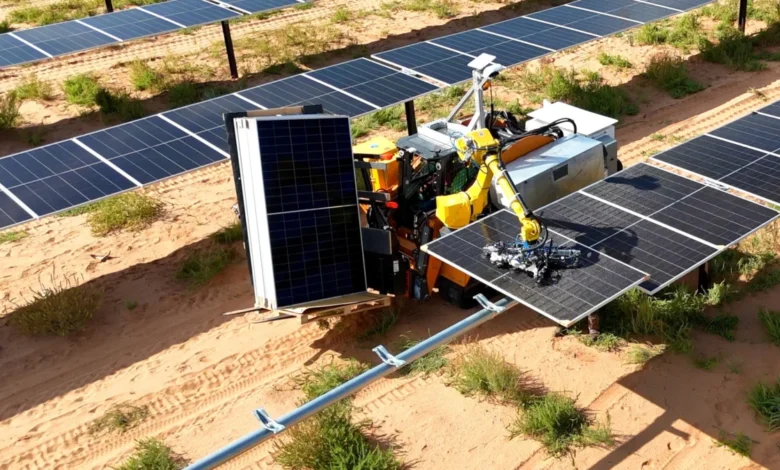
The current system focuses on the most physically demanding aspect of solar installation: the unloading, transport, and positioning of solar panels. A Gritt-enabled machine can identify a pallet of solar panels, lift a single 100-pound glass module, transport it to the mounting rack, and position it with sub-millimeter accuracy. Once the panel is held in place by the robot, human workers perform the final fastening. This collaborative approach—often referred to as "cobotics"—allows humans to focus on tasks requiring dexterity and judgment while the machines handle the heavy lifting.
The results of this integration are statistically significant. In traditional manual setups, a crew of eight workers typically installs approximately 800 panels per day. By integrating Gritt’s autonomous systems, that same eight-person crew can increase their output to between 3,000 and 4,000 panels per day—a nearly five-fold increase in productivity.
Operational Milestones and Market Competition
Gritt’s entry into the market comes at a time when the "Physical AI" sector is seeing a renaissance. The company has already secured contracts to assist in the installation of 2.8 gigawatts (GW) of solar capacity over the next 18 months. To put that figure in perspective, 2.8 GW is enough to power more than half a million homes. The company’s client roster already includes three of the top ten power construction firms in the United States.
The competitive landscape for solar robotics is tightening. Companies like Luminous Robotics, Cosmic, and China-based Trinabot are all vying for dominance in the automated construction space. However, many of these rivals are focused on building specialized, proprietary robots. Gritt’s reliance on off-the-shelf vehicles could provide a lean cost structure and a faster path to scale, as they do not need to build a global supply chain for hardware parts that already exist in the construction ecosystem.
Andrew Beebe, a partner at Obvious Ventures who led the Series A, highlighted the unique background of the founders as a key differentiator. "There are people who used to build rockets that went into space and had infinite budget for the smallest little part, and then there are people who know what it means to get into dirty, dull, and dangerous jobs and scale them like mad," Beebe noted. He placed Puri and Dugar firmly in the latter camp, praising their ability to combine high-level machine vision skills with a pragmatic understanding of the construction industry’s rigors.
Safety and Worker Retention in Remote Locations
One of the primary drivers for adoption, according to Gritt’s customers, is safety and site management. In interviews with industry stakeholders, one customer, who chose to remain anonymous for competitive reasons, expressed that the primary value of the system lies in its ability to reduce workplace injuries. Lifting 100-pound glass panels overhead for eight to ten hours a day in the sun leads to high rates of musculoskeletal injuries and heat exhaustion.
Furthermore, the remote nature of solar farms—often located in deserts or rural plains—makes it difficult to attract a consistent workforce. By automating the most grueling tasks, companies can offer higher-value roles to workers, such as system monitoring and technical maintenance, which are easier to recruit for than manual labor.
The Future of Physical AI: Beyond Solar Panels
While solar installation is the immediate focus, Gritt’s long-term vision involves a total transformation of how infrastructure is built. The underlying AI pipeline the company has developed is designed to be "generalizable." This means the same core intelligence used to place a solar panel can be retrained for other tasks with minimal effort.
Puri noted that the rise of new generative AI and transformer models has dramatically shortened the training time for new tasks. For example, while it initially took weeks to train the system to stack cinder blocks, a recent demonstration of tying rebar—the steel mesh used to reinforce concrete—took only a single day of software refinement. Rebar tying is one of the most tedious and physically taxing jobs in the entire construction industry, and automating it would represent a massive breakthrough for the building of bridges, tunnels, and skyscrapers.
Beyond manipulation, Gritt intends for its robots to serve as the "eyes and ears" of a construction site. Equipped with a suite of advanced sensors and computer vision, these machines can collect real-time data that project managers currently lack. The system can identify missing inventory, flag safety hazards such as open trenches during an approaching storm, and provide precise progress reports that allow for better resource allocation.
"Gritt becomes now this layer of physical AI, which is doing this dexterous, labor-intensive task, plus it can help you take decisions on the site," Puri explained.
Strategic Implications for the Energy Transition
The success of startups like Gritt may determine whether the United States and other nations can meet their 2050 net-zero targets. The transition to clean energy is no longer just a question of policy or financing; it is increasingly a question of logistics and physical execution. If the cost of installation remains high due to labor shortages and inefficiency, the "soft costs" of solar will continue to outweigh the falling costs of the panels themselves.
By 2025, Gritt aims to have 48 systems operating concurrently across the United States. If the company successfully expands into broader construction tasks like rebar tying and rack assembly, it could become a foundational player in the "industrial AI" movement.
The investment by Obvious Ventures and Union Square Ventures signals a shift in the venture capital landscape, moving away from purely digital SaaS (Software as a Service) models toward "Hard Tech" solutions that interact with the physical world. As the world races to build the infrastructure of the future, the integration of AI into the heavy machinery of today may be the only way to bridge the gap between climate ambition and reality.