Volkswagen Steps Up Its Advanced Driver Assistance Game with the New IQ.Drive Suite


Volkswagen has historically occupied a distinctive space in the global automotive market, often prioritizing core engineering, interior ergonomics, and accessible driving dynamics over cutting-edge autonomous technology. While pioneering brands like Tesla, General Motors, and Mercedes-Benz aggressively pushed the envelope with advanced driver assistance systems (ADAS) such as Full Self-Driving, Super Cruise, and Drive Pilot, Volkswagen owners largely remained responsible for fully piloting their vehicles. However, the automotive landscape is shifting rapidly, and Volkswagen is responding by introducing its most comprehensive and advanced driver assistance package to date: IQ.Drive.
Spearheaded by the rollout in the highly anticipated Volkswagen ID.Buzz, this sophisticated tech suite represents a meaningful technological leap forward for the German automaker. By integrating upgraded active safety infrastructure, cloud-connected mapping, and enhanced automation features, Volkswagen is bridging the gap between traditional driving and the increasingly automated future of transportation.
The Architecture of IQ.Drive: Platforms and Availability
The introduction of the IQ.Drive suite is not limited to a single halo vehicle; rather, Volkswagen is deploying this advanced technology across its core modern vehicle architectures. The package is fundamentally tied to vehicles built on Volkswagen Group’s modular platforms, specifically the MQB Evo platform—which underpins internal combustion engine and hybrid staples like the Tiguan, Golf, and Atlas family—and the MEB platform, which serves as the technological backbone for Volkswagen’s all-electric ID. lineup.
While the broader suite of features will be distributed across these high-volume models, certain advanced capabilities remain exclusive to specific vehicles. For instance, the ID.Buzz—Volkswagen’s nostalgic yet thoroughly modern electric microbus—receives the complete, uncompromised version of the IQ.Drive suite. This strategic rollout ensures that both traditional internal combustion engine buyers and early adopters of electric mobility benefit from the automaker’s latest safety and convenience innovations.
Breaking Down the Core Technologies
At the heart of the IQ.Drive package are four primary technological pillars: Travel Assist, Emergency Assist Plus, Predictive Active Cruise Control (pACC), and Road Experience Management (REM). Each system has been meticulously redesigned or upgraded to offer higher levels of autonomy, situational awareness, and driver reassurance.
Predictive Active Cruise Control (pACC) builds upon Volkswagen’s existing adaptive cruise infrastructure by introducing proactive intelligence. Traditional adaptive cruise control systems merely maintain a set distance from the vehicle ahead based on real-time radar and camera feedback. pACC, however, integrates navigation data to anticipate road geometry and upcoming traffic conditions.
Most notably, pACC is now capable of handling highway off-ramps independently. When approaching a designated exit, the system can autonomously initiate a lane change into the exit ramp and seamlessly decelerate to match the required exit speed. Furthermore, the system incorporates automated speed adjustments tied to live traffic flow. When a change in the posted speed limit is detected, pACC prompts the driver via the digital cockpit, requiring a simple confirmation to either accept or deny the speed adjustment, keeping the human driver firmly in the loop while reducing cognitive fatigue on long journeys.
Travel Assist: Hands-Free Lane Changing
Perhaps the most immediately impactful feature for everyday commuting is the upgraded Travel Assist function. Travel Assist is designed to manage longitudinal and lateral guidance simultaneously, keeping the vehicle centered in its lane while maintaining a safe distance from surrounding traffic.
The standout capability within the updated Travel Assist system is its semi-automated, turn-signal-initiated lane-changing function. When a driver wishes to change lanes while Travel Assist is active, they simply activate the turn signal in the desired direction. The vehicle’s suite of sensors then scans adjacent traffic for a safe opening.
Once the maneuver is initiated, a visual indicator—a flashing green arrow—appears in the Digital Cockpit, signaling that the vehicle is actively seeking a gap. The system allows a 12-second window to locate a safe opening in traffic. If surrounding congestion or approaching vehicles block the lane change, a red hash mark appears on the display, holding the position until a safe gap materializes. Once the path is clear, the indicator reverts to green, and the vehicle executes the lane change smoothly without requiring manual steering input.
Emergency Assist Plus: A Lifesaving Fail-Safe
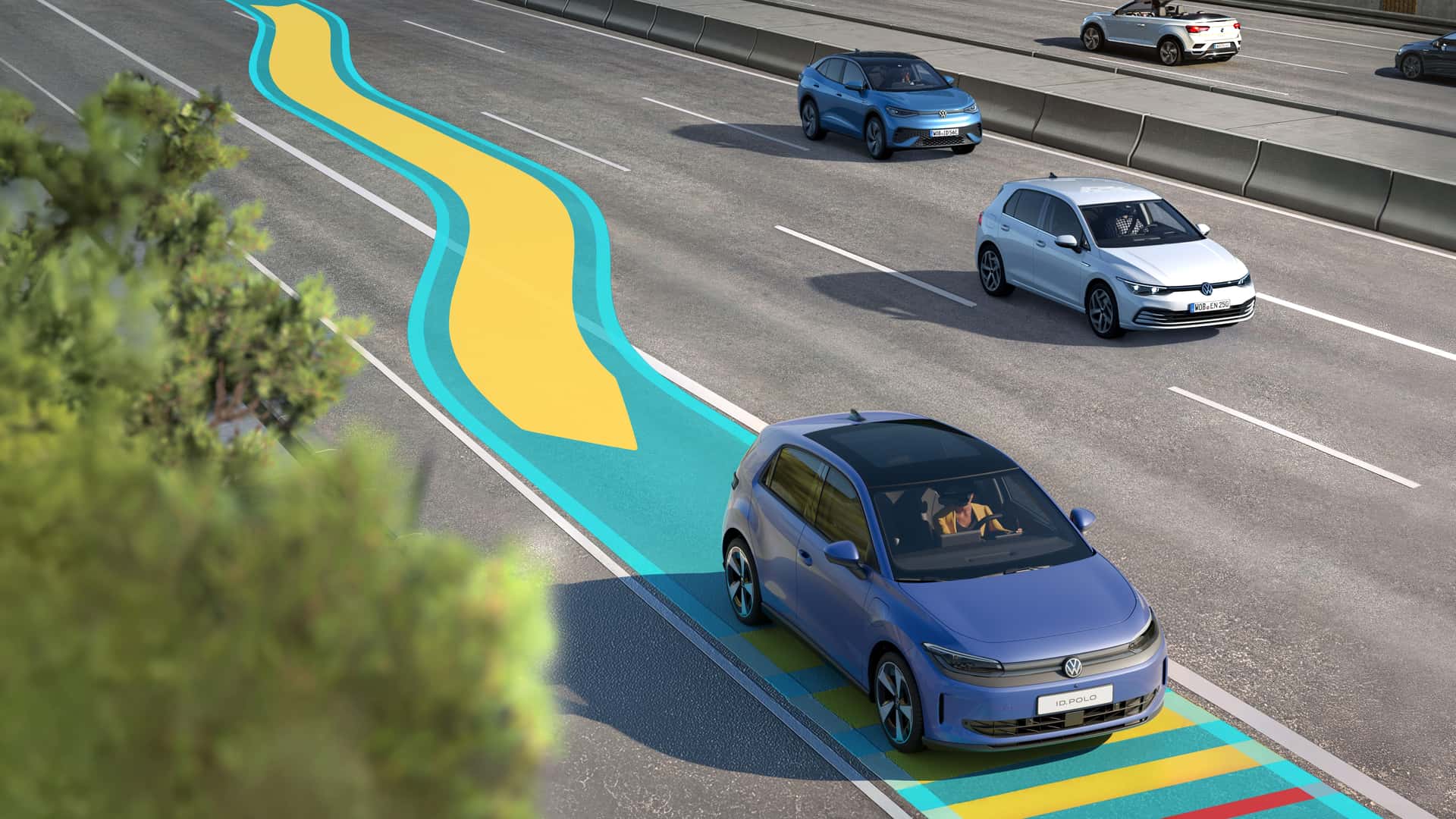
As vehicles incorporate higher levels of driver assistance, robust fail-safe mechanisms become critically important. Volkswagen has responded to this necessity by significantly upgrading its Emergency Assist system into Emergency Assist Plus.
The operational behavior of Emergency Assist Plus depends entirely on whether the vehicle is operating under basic Lane Assist or the more advanced Travel Assist. If the vehicle is relying on Lane Assist and detects multiple consecutive lane departure events without any corrective steering input from the driver, the system interprets this as a potential medical emergency or driver incapacitation. It immediately issues progressive visual and audible warnings. If the driver fails to respond or intervene, the vehicle takes control, actively pulling itself over to the shoulder of the road.
When operating under Travel Assist, the parameters are even more refined. If the system fails to detect any driver steering input for a duration of 25 seconds, it initiates a multi-stage escalation protocol. First, it sounds the horn. Next, it delivers three sharp brake jerks to physically startle and alert the driver. Simultaneously, it pretensions the seatbelt.
If the driver remains completely unresponsive after these escalating alerts, the vehicle determines that an emergency has occurred. Provided the surrounding environment is safe, the vehicle will autonomously maneuver itself to the shoulder of the road. Once safely parked, the system executes a comprehensive post-stop emergency routine: it shifts the transmission into Park, activates the hazard warning lights, sounds the horn continuously, unlocks the doors to allow emergency personnel access, switches on the interior cabin lights, and automatically places a call to emergency services.
Road Experience Management (REM): Cloud-Sourced Intelligence
Exclusive to the ID.Buzz within this initial rollout, Road Experience Management (REM) represents Volkswagen’s entry into crowdsourced, cloud-based mapping technology. REM requires Volkswagen’s In-Vehicle Premium subscription plan to function, leveraging aggregated, anonymized camera data gathered from real-world drivers traveling across the global road network.
Traditional ADAS cameras rely heavily on clear, highly visible lane markings, intact street signs, and favorable weather conditions. Heavy snowfall, torrential rain, sun glare, or severely worn asphalt can easily blind standard optical sensors, rendering advanced lane-keeping features temporarily useless. REM solves this vulnerability by continuously updating a cloud-based digital map using fleet-wide data.
When a Volkswagen vehicle traverses a stretch of road, its sensors map infrastructure elements such as precise lane boundaries, street light placements, and road signs. This data is anonymized, uploaded to the cloud, and synchronized with the vehicle fleet. Consequently, if an ID.Buzz encounters faded lane markers or a sudden blizzard that obscures camera vision, the vehicle does not lose its bearings. Instead, it cross-references its GPS coordinates with the cloud-based REM map, allowing it to maintain precise positioning based on historical fleet data.
Broader Industry Context and Implications
Volkswagen’s deployment of the IQ.Drive suite highlights a broader strategic pivot within the legacy automotive sector. For years, traditional automakers watched Silicon Valley-backed tech companies and pure-play electric vehicle manufacturers command consumer attention through aggressive, software-first approaches to autonomy. While companies like Tesla popularized polarizing terms like "Full Self-Driving" and GM expanded its geofenced Super Cruise network across hundreds of thousands of miles of divided highways, legacy giants like Volkswagen took a more measured, methodical approach focused on regulatory compliance, hardware validation, and incremental safety gains.
Industry analysts note that while IQ.Drive does not yet offer true point-to-point autonomous navigation or unrestricted hands-free highway driving comparable to the most advanced systems on the market, it closes a critical competitive gap. For consumers considering an electric vehicle like the ID.Buzz or a family SUV like the Atlas, the inclusion of robust, highly responsive safety nets like Emergency Assist Plus and pACC transforms these vehicles from traditional people-movers into technologically competitive modern alternatives.
Furthermore, the introduction of subscription-based features like Road Experience Management signals Volkswagen’s growing emphasis on recurring software revenue models. As automotive manufacturers transition away from a purely hardware-sales business model, software suites and cloud-connected enhancements are expected to play an increasingly vital role in long-term corporate profitability.
Looking Forward
The rollout of the IQ.Drive suite across MQB Evo and MEB platform vehicles marks a turning point for Volkswagen’s technological identity. By combining intelligent cruise control, automated lane-changing, proactive emergency interventions, and cloud-sourced spatial mapping, the automaker has successfully modernized its active safety offerings.
As these vehicles hit public roadways in larger numbers, consumer reception and real-world performance data will ultimately determine the success of Volkswagen’s new ADAS strategy. What remains clear, however, is that Volkswagen is no longer content to let competitors define the future of automotive safety. With IQ.Drive, the brand has firmly signaled its readiness to embrace the intelligent, connected era of driving.