Qilin Ransomware Affiliates Leverage Critical Palo Alto Networks PAN-OS Vulnerability for Widespread Network Intrusion


The Qilin ransomware collective has emerged as a primary threat actor exploiting a critical authentication bypass vulnerability within Palo Alto Networks’ PAN-OS GlobalProtect gateway, according to a detailed forensic analysis released by cybersecurity firm Arctic Wolf Labs. The flaw, tracked as CVE-2026-0257, has become a focal point for multiple ransomware-as-a-service (RaaS) affiliates, who are utilizing the security gap to gain unauthorized access to corporate environments, bypass perimeter defenses, and deploy devastating encryption payloads. This development underscores a growing trend where sophisticated cybercriminal syndicates rapidly weaponize N-day vulnerabilities in edge networking equipment to facilitate high-impact extortion campaigns.
Technical Overview of CVE-2026-0257
The vulnerability at the heart of these attacks, CVE-2026-0257, resides within the GlobalProtect portal and gateway components of Palo Alto Networks’ PAN-OS software. This specific flaw allows an unauthenticated remote attacker to bypass existing security restrictions and establish an unauthorized VPN connection to the target network. Because the GlobalProtect gateway serves as the primary entry point for remote workforces, a successful exploit effectively grants the attacker a foothold inside the internal network, often with the same level of access as a legitimate employee.
Palo Alto Networks first addressed the issue on May 13, 2026, issuing emergency patches and warning of "limited exploit attempts." However, the window for remediation was brief. By May 17, security researchers at Rapid7 began observing widespread exploitation across a diverse range of customer environments. The vulnerability is particularly dangerous because it negates the primary purpose of a VPN—to secure the perimeter—by turning the security appliance itself into an open door for adversaries.
Chronology of Exploitation and Response
The timeline of the CVE-2026-0257 exploitation highlights the speed at which modern ransomware affiliates operate. Following the initial patch release in mid-May, the cybersecurity community witnessed a surge in scanning activity as threat actors sought to identify unpatched instances of GlobalProtect.

On May 29, 2026, the United States Cybersecurity and Infrastructure Security Agency (CISA) took the significant step of adding CVE-2026-0257 to its Known Exploited Vulnerabilities (KEV) catalog. This designation mandated that all federal civilian executive branch agencies apply the necessary patches within a strict three-day window, reflecting the severity of the threat to national security and infrastructure.
By June 2026, Arctic Wolf Labs began investigating a series of distinct intrusions that culminated in the deployment of Qilin ransomware. Their findings confirmed that the initial point of entry in every investigated case was the exploitation of the Palo Alto Networks firewall appliances. The investigations revealed that the time elapsed between the initial breach and the final encryption of the domain varied, suggesting that multiple independent affiliates with different levels of technical proficiency were utilizing the same exploit.
The Qilin Ransomware-as-a-Service Model
Qilin, which originally appeared on the threat landscape in August 2022 under the moniker "Agenda," has evolved into one of the most prolific and dangerous RaaS operations currently active. The group is known for its use of a sophisticated ransomware strain written in Rust, a programming language favored by modern malware developers for its performance and difficulty to reverse-engineer.
Operating under a RaaS model, the core Qilin developers provide the ransomware software and infrastructure to "affiliates" in exchange for a percentage of the paid ransoms. This structure allows the group to scale its operations globally, as different affiliates can pursue different targets simultaneously. Arctic Wolf’s observation of varying "tradecraft"—ranging from rapid, automated encryption-only attacks to complex, multi-stage "double-extortion" operations—points to the diversity of the Qilin affiliate network.
In a double-extortion scenario, attackers not only encrypt the victim’s data but also exfiltrate sensitive information prior to the lockout. They then threaten to leak this data on their dark web "shame site" if the ransom is not paid. Qilin has been particularly aggressive in this regard, having claimed more than 2,000 victims to date.

High-Profile Victims and Sector Impact
The Qilin group has demonstrated a high degree of "big game hunting," targeting large enterprises and critical service providers where the pressure to restore operations is immense. Notable victims in their history include:
- Nissan and Yanfeng: The automotive sector has been a frequent target, with Qilin claiming responsibility for breaches at Nissan’s design studios and the major automotive parts supplier Yanfeng.
- Synnovis: In a particularly disruptive attack, Qilin was linked to the breach of Synnovis, a pathology services provider for several major London hospitals. This attack resulted in the cancellation of thousands of operations and appointments, highlighting the real-world humanitarian risks associated with ransomware.
- Asahi Group: The Japanese beverage giant suffered a significant data leak after being targeted by the group.
- Court Services Victoria: In Australia, the judicial system was impacted when Qilin exposed recordings and sensitive data from the court system.
The targeting of Palo Alto Networks’ customers is a strategic move by Qilin. Palo Alto is a global leader in cybersecurity, serving over 70,000 organizations, including 90% of Fortune 10 companies and the majority of the largest financial institutions in the United States. By mastering an exploit for such a ubiquitous platform, Qilin affiliates have gained access to a massive pool of high-value potential targets.
Global Exposure and the Scale of the Threat
Data from internet monitoring services illustrates the massive attack surface available to Qilin. Shadowserver, an organization dedicated to improving internet security, currently tracks over 167,000 GlobalProtect VPN instances exposed to the public internet. Similarly, the search engine Shodan identifies more than 172,000 unique IP addresses associated with GlobalProtect fingerprints.
While it is unclear how many of these instances remain unpatched, the sheer volume of exposed devices provides a fertile hunting ground for ransomware affiliates. Arctic Wolf Labs has expressed "moderate confidence" that intrusions leveraging CVE-2026-0257 are ongoing, citing the continuous scanning activity and the RaaS model’s inherent drive to share successful exploits among its members.
Analysis of the Attack Chain
The typical attack chain observed in the Qilin campaigns involving CVE-2026-0257 follows a structured progression:
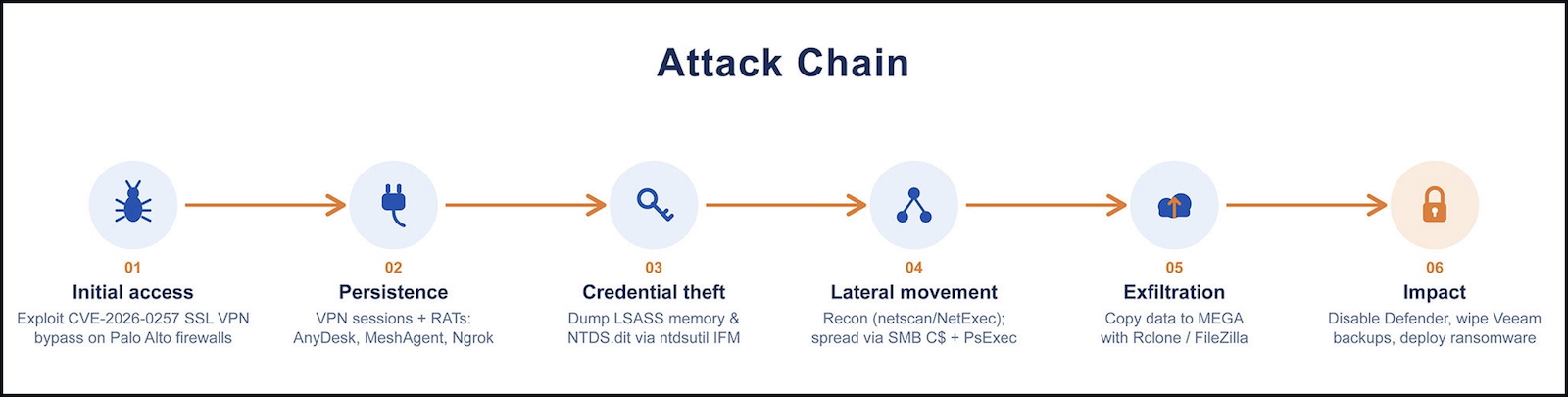
- Initial Access: Affiliates use automated tools to scan for the vulnerability on GlobalProtect gateways. Once an unpatched device is found, the exploit is triggered to bypass authentication.
- Establishment of Persistence: Upon gaining access, attackers often establish backdoors or secondary remote access tools to ensure they can return to the network even if the initial VPN flaw is later patched.
- Lateral Movement and Reconnaissance: The attackers move through the internal network, identifying critical servers, domain controllers, and backup systems. They often use legitimate administrative tools (Living-off-the-Land techniques) to avoid detection by security software.
- Data Exfiltration: Sensitive corporate data is compressed and uploaded to attacker-controlled cloud storage.
- Domain-Wide Encryption: In the final stage, the Qilin ransomware is deployed across the entire domain, locking out users and leaving behind ransom notes demanding payment in cryptocurrency.
Broader Cybersecurity Implications
The exploitation of CVE-2026-0257 by Qilin represents a broader shift in the threat landscape. For years, ransomware groups relied heavily on phishing and compromised credentials. While those methods remain effective, the pivot toward "Vulnerability Research and Exploitation" (VRE) marks an escalation in sophistication. Ransomware groups are now acting more like state-sponsored advanced persistent threats (APTs), proactively seeking out zero-day or recently patched vulnerabilities in infrastructure.
Furthermore, this incident highlights the inherent risks of the "VPN-centric" security model. As organizations have moved to remote and hybrid work, the VPN gateway has become a single point of failure. If the gateway is compromised, the entire internal network is potentially exposed. This has led many security experts to advocate for a "Zero Trust" architecture, where access is granted based on continuous verification of identity and device health, rather than just the successful login at a perimeter device.
Mitigation and Defensive Recommendations
In light of the ongoing Qilin campaign, cybersecurity experts and federal agencies recommend several immediate actions for organizations utilizing Palo Alto Networks PAN-OS:
- Immediate Patching: Organizations must verify that all GlobalProtect instances are running the latest patched versions of PAN-OS. This is the only definitive way to close the CVE-2026-0257 vulnerability.
- Log Analysis: Security teams should review logs for any unauthorized VPN connections or unusual administrative activity originating from GlobalProtect gateways dating back to early May 2026.
- Enhanced Monitoring: Deploying Endpoint Detection and Response (EDR) and Managed Detection and Response (MDR) services can help identify the lateral movement and data exfiltration stages of a Qilin attack before encryption occurs.
- Network Segmentation: Restricting the movement of users within the network can prevent a compromised VPN account from accessing sensitive domain controllers or backup repositories.
- Review of External-Facing Assets: Organizations should conduct regular audits of all internet-facing hardware to ensure that no legacy or unpatched systems are inadvertently exposed to the public web.
The collaboration between Qilin affiliates and the rapid exploitation of CVE-2026-0257 serves as a stark reminder of the agility of modern cybercrime. As long as critical vulnerabilities in widely used infrastructure remain unpatched, RaaS groups will continue to find high-value entry points into the world’s most sensitive networks.
Related posts: