Russian Enterprises Face Intensified Cyber Offensive from Three Distinct Threat Actor Clusters

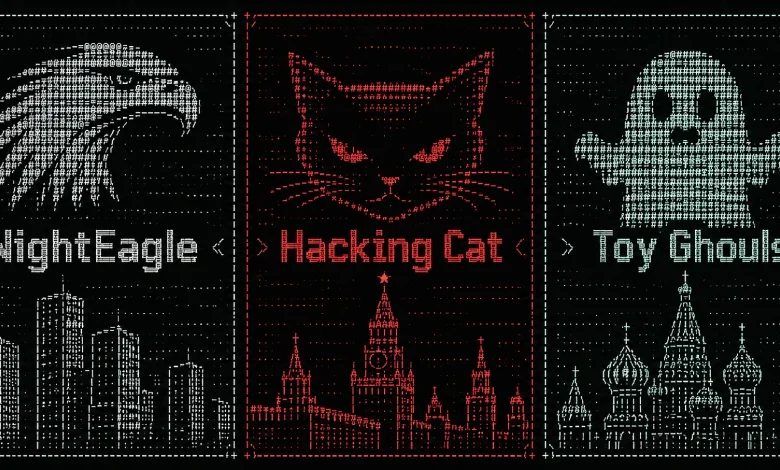
Russian commercial and state-affiliated enterprises are currently navigating a sophisticated and multi-pronged cybersecurity crisis as three distinct threat activity clusters—identified as NightEagle, Hacking Cat, and Toy Ghouls—have intensified their offensive operations against the nation’s digital infrastructure. According to comprehensive technical analyses released by Kaspersky, these groups are utilizing a mix of modular backdoors, destructive wiper malware, and advanced evasion techniques to compromise corporate environments, move laterally through internal networks, and exfiltrate sensitive data or disrupt operations entirely.
The emergence of these campaigns signals a significant evolution in the threat landscape targeting Russia. While some actors operate with clear political motivations, others are demonstrating a transition toward professionalized, financially driven, or destructive methodologies. The diversity in these tactics—ranging from the exploitation of legacy server vulnerabilities to the use of unconventional command-and-control (C2) communication channels—underscores the complexity of the security challenges facing Russian IT departments.
The NightEagle Offensive: Persistent Exploitation of Microsoft Exchange
NightEagle, also tracked as APT-Q-95, has maintained a consistent presence in the threat landscape since at least 2023. Recent findings indicate that the group has refined its operational security, focusing heavily on initial access through compromised virtual private network (VPN) credentials. The attackers frequently leverage IP addresses originating from the Russian segment of the internet, often routing traffic through Cloudflare WARP tunnels or European virtual infrastructure providers to mask their true geographical origin.
The core of the NightEagle methodology involves the deployment of GhostContainer, a sophisticated, modular backdoor. GhostContainer is designed to blend seamlessly into a target’s environment by masquerading as legitimate Microsoft Exchange Server components. Once installed, it provides operators with a full suite of administrative capabilities, including the execution of arbitrary code, file manipulation, and the ability to load additional malicious modules.
The delivery mechanism for GhostContainer remains a subject of intense investigation. Security researchers suggest that the actors likely extract cryptographic keys from ASP.NET configuration files to manipulate the VIEWSTATE framework parameter. By injecting a payload into this parameter, the attackers can force the backdoor to launch directly in memory, leaving minimal traces on the disk.
Once inside the network, NightEagle demonstrates high levels of technical proficiency in lateral movement. The group utilizes specialized tools such as rdp2tcp and Microsoft dev tunnels to redirect RDP traffic, effectively bypassing standard network perimeter defenses. Furthermore, the attackers have been observed exploiting critical vulnerabilities, including the notorious BlueKeep (CVE-2019-0708) flaw, to create rogue local accounts with administrative privileges. Their ultimate strategic objective appears to be the total compromise of Active Directory (AD) infrastructure, which would grant them long-term, persistent access to domain controllers and the ability to harvest credentials via DCSync attacks.

Hacking Cat: A Pivot to Destructive Hacktivism
The Hacking Cat collective represents a departure from traditional cyber espionage, characterized by its alignment with pro-Ukrainian hacktivist movements. Since its emergence in February 2024, the group has transitioned from low-impact activities like website defacement to high-stakes destructive operations. Kaspersky’s research suggests that Hacking Cat operates within a larger ecosystem of threat actors, frequently collaborating with entities such as the Cyber Anarchy Squad and the Ukrainian Cyber Alliance.
This collaborative environment has complicated attribution efforts, as multiple groups appear to share access to a common toolkit or developer source. A primary tool in Hacking Cat’s arsenal is the Go-based remote access trojan known as Gorilla RAT. This malware is typically deployed via the exploitation of known Microsoft Exchange vulnerabilities, such as CVE-2021-26855. Gorilla RAT facilitates internal network reconnaissance and provides a robust framework for command execution and traffic tunneling.
Perhaps most concerning is the group’s deployment of the Monkey ransomware family. Written in a variety of languages—including Rust, .NET, C++, and Golang—Monkey is designed to target a wide range of platforms, including Windows, Linux, and VMware ESXi environments. The ransomware is often employed not as a means of financial extortion, but as a weaponized wiper. In several observed instances, the malware generates encryption keys that are never stored or provided to the victim, rendering data recovery impossible regardless of whether a ransom is paid.
The group’s operational maturity has also faced scrutiny. Researchers noted that some variants of the Monkey ransomware contained redundant code—such as commands to delete shadow volume copies on Linux systems—which suggests a lack of rigorous quality assurance or, as some analysts hypothesize, a reliance on artificial intelligence tools to accelerate the development of their malware toolkit.
In response to the Kaspersky report, Hacking Cat issued a statement via their Telegram channel, claiming that while they utilize some of the tools identified, the more destructive lockers and wipers are not part of their official arsenal. The group challenged the security firm’s attribution models, highlighting the growing difficulty in distinguishing between independent hacktivist cells and coordinated state-backed operations.
Toy Ghouls: The Rise of Bespoke Backdoors
The third cluster, Toy Ghouls, has demonstrated a rapid evolution in its operational capacity. Initially identified by its reliance on publicly available ransomware builders—such as leaked Babuk and LockBit source code—the group has pivoted toward the development of custom-built malware. This shift indicates a move toward greater operational independence and a heightened focus on stealth.
The centerpiece of their new toolkit is the Bird Agent backdoor, which was first observed in mid-2026. This malware utilizes highly unconventional communication protocols, specifically the HiveMQ MQTT broker and the Matrix-based Element messenger platform, to relay commands from C2 servers. By utilizing legitimate, encrypted messaging services for command transmission, Toy Ghouls effectively obscures its traffic from traditional network monitoring tools.

Bird Agent is delivered via Windows Remote Management (WinRM) using open-source utilities like Evil-WinRM. Once deployed, the backdoor creates a system-specific configuration file, cryptographically bound to the victim’s machine using the Windows Registry’s MachineGuid. This technique prevents the malware from being analyzed in sandboxed environments that do not replicate the target’s unique hardware or software identifiers.
The sophistication of the Bird Agent variants—one communicating via HiveMQ and the other via Element—suggests that Toy Ghouls is investing significant resources into maintaining long-term access. By avoiding the use of traditional C2 infrastructure, the group aims to evade detection by security operations centers (SOCs) that are primarily tuned to flag known malicious IP ranges and domain signatures.
Broader Implications for Cybersecurity
The simultaneous activity of these three groups highlights a critical inflection point for Russian enterprise security. The tactics employed—ranging from the use of legitimate developer tools for lateral movement to the weaponization of AI-assisted malware development—reflect a broader trend toward the democratization of advanced cyber-offensive capabilities.
For organizations operating in this region, the implications are profound. First, the reliance on legacy vulnerabilities in Microsoft Exchange servers continues to be a major weakness, necessitating a more aggressive patch management strategy. Second, the shift toward "living-off-the-land" techniques—where attackers use built-in administrative tools like WinRM or RDP tunnels—demands a transition toward behavioral-based detection rather than simple signature-based prevention.
Furthermore, the blurring lines between hacktivist collectives and organized criminal syndicates make the threat landscape increasingly unpredictable. As these groups continue to share modular tools, codebases, and infrastructure, the traditional indicators of compromise (IoCs) used by defenders become increasingly ephemeral.
Experts emphasize that securing enterprise infrastructure against such persistent and evolving threats requires a defense-in-depth approach. This includes the implementation of rigorous identity and access management (IAM) protocols, the adoption of zero-trust architecture, and the continuous monitoring of encrypted traffic for anomalies. As these threat actors continue to refine their methods, the ability to rapidly detect and contain intrusions before they reach the domain controller level will remain the defining metric of a successful cybersecurity posture.
The situation remains fluid, with ongoing investigations by international cybersecurity firms expected to reveal further connections between these clusters and the wider ecosystem of global cyber-warfare. For now, Russian enterprises remain in a state of high alert, as the battle for digital supremacy continues to unfold across their critical information networks.