Kia Debuts the Spacious All-Electric PV7 Van at IAA Transportation 2026 to Target the Light Commercial Vehicle Market

Kia Corporation has officially pulled the wraps off its largest fully electric commercial vehicle to date, the PV7, debuting the versatile multi-purpose van at the prestigious IAA Transportation 2026 exhibition held in Hanover, Germany. Representing the second major pillar in the brand’s ambitious Platform Beyond Vehicle (PBV) business strategy, the PV7 follows closely on the heels of its smaller sibling, the PV5. Designed to capture a commanding share of the rapidly expanding light commercial vehicle (LCV) sector, the PV7 combines massive interior packaging, modular body styles, high-capacity battery options, and advanced artificial intelligence integrations to cater to both commercial fleets and private passenger needs.
The unveiling in Hanover marks a significant milestone for Kia’s corporate evolution from a traditional automaker into an innovative provider of customized mobility solutions. With stricter emissions regulations taking effect across global markets and commercial enterprises actively seeking sustainable fleet alternatives, the arrival of the PV7 positions Kia to directly challenge entrenched legacy automakers in the European and Asian commercial utility segments.
Architectural Foundations and Performance Specifications
Underpinning the new PV7 is the sophisticated E-GMP.S dedicated electric vehicle architecture, a platform shared with the smaller PV5 that has been specifically engineered to maximize interior volume through a completely flat floor design. This skateboard-style platform utilizes a modular engineering approach, allowing Kia to construct various "top hats" or body variations tailored precisely to specific business operations or passenger transport duties.
![Kia’s new EV van is over 17.5 ft long and can haul 9 people or lots of cargo [Images]](https://electrek.co/wp-content/uploads/sites/3/2026/09/Kia-PV7-EV-van-images.jpeg?quality=82&strip=all&w=1400)
Performance-wise, the vehicle comes standard with a front-wheel-drive (FWD) layout, though company representatives have confirmed that an all-wheel-drive (AWD) variant is currently in development to address operations in inclement weather or rugged terrain. Depending on the chosen configuration, the front-mounted electric powertrain generates up to 268 horsepower (200 kW) and 309 lb-ft (420 Nm) of torque, providing ample acceleration and pulling power even when the cabin or cargo bay is heavily loaded.
Energy storage is handled by advanced nickel-cobalt-manganese (NCM) battery packs available in two distinct capacities: 71.5 kWh and 96.2 kWh. When equipped with the larger 96.2 kWh battery in the Long Range Cargo configuration, the PV7 achieves an estimated all-electric driving range exceeding 460 kilometers (285 miles) under the Worldwide Harmonized Light Vehicles Test Procedure (WLTP) cycle.
Charging efficiency is another critical advantage of the PV7, thanks to its high-voltage 800V electrical architecture. When connected to a high-power 350 kW DC fast charger, the vehicle’s battery can replenish its energy state from 10% to 80% in approximately 25 minutes, significantly minimizing vehicle downtime for fleet operators and delivery drivers. Furthermore, the van incorporates Kia’s signature Vehicle-to-Load (V2L) technology, transforming the vehicle into a mobile power source capable of running heavy-duty tools, worksite equipment, or camping gear directly from the onboard battery system.
Dimensions, Capacity, and Interior Ergonomics
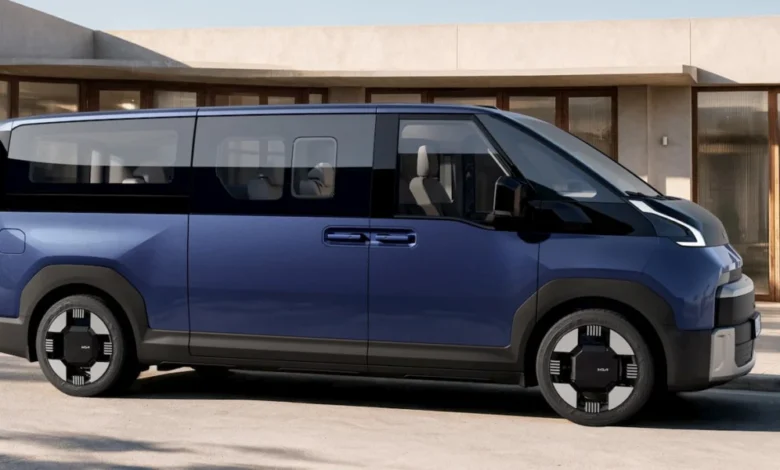
In terms of physical footprint, the PV7 establishes itself as a substantial contender in the large van category. The standard Passenger and Cargo models measure 5,350 mm (17.55 feet) in length, 1,995 mm in width, and 1,990 mm in height, built upon a generous 3,500 mm wheelbase. To put this into perspective, the PV7 significantly surpasses the dimensions of the PV5 Passenger model—which measures 4,695 mm long with a 2,995 mm wheelbase—and even outstrips the long-wheelbase Volkswagen ID. Buzz, which spans 4,962 mm in length with a 3,239 mm wheelbase.
![Kia’s new EV van is over 17.5 ft long and can haul 9 people or lots of cargo [Images]](https://electrek.co/wp-content/uploads/sites/3/2026/09/Kia-PV7-EV-debut.jpeg?quality=82&strip=all)
Inside the cabin, the layout prioritizes utilitarian flexibility and cutting-edge digital connectivity. The dashboard features Hyundai Motor Group’s advanced Pleos Connect infotainment system, displayed across expansive 12.9-inch and 14.6-inch screens. Operating on Android Automotive OS, the user interface mimics the intuitive nature of a modern smartphone, offering downloadable applications and deeply customizable display arrangements.
Of particular note is the inclusion of Gleo AI, an intelligent in-car digital companion powered by artificial intelligence. Gleo AI is capable of handling complex voice commands, answering driver queries, adjusting climate and vehicle functions, and optimizing navigation routes based on real-time traffic and delivery schedules.
Versatile Configurations: Cargo and Passenger Solutions
The PV7 family has been meticulously designed to accommodate a diverse array of commercial and private transport applications through a planned rollout of 23 distinct variants over the coming years.
The PV7 Cargo variant is offered in flexible two- and three-seat configurations, providing a standard cargo volume of up to 6.1 cubic meters. For operations requiring maximum vertical space, a High Roof variant expands the internal capacity to an impressive 8 cubic meters. Payload capabilities are equally competitive, with the Long version supporting up to 1,165 kg (2,568 lbs) and the compact model handling up to 1,200 kg (2,645 lbs).
![Kia’s new EV van is over 17.5 ft long and can haul 9 people or lots of cargo [Images]](https://electrek.co/wp-content/themes/ninetofive/dist/images/google-preferred-source-badge-dark.png)
To optimize loading efficiency, the PV7 Long features a low loading height of just 550 mm and offers a floor space large enough to accommodate up to three standard Euro pallets (800 x 1,200 mm). Additionally, Kia has integrated a dedicated heavy-loading driving mode, which automatically adjusts suspension and powertrain parameters to maintain stable handling and vehicle dynamics when transporting maximum payloads. Buyers can also specify their rear entry preferences, choosing between full-open twin-swing tailgate doors or a conventional lift-up tailgate.
On the passenger side, the PV7 Passenger variant targets shuttle services, vehicle rental companies, and large families. International markets will receive a standard configuration capable of seating up to nine occupants, while the domestic market in South Korea will offer an extended seating capacity of up to 11 passengers. The seven-seat model features Long-Rail Easy Remove Seats, allowing fleet operators or owners to rapidly alter interior seating arrangements. Meanwhile, the nine-seat model provides flexible layouts with or without a fourth row of seating.
Market Launch Timeline and Industry Implications
Kia has outlined a structured rollout strategy for the PV7 product family. Following the initial launch of the Passenger and Cargo models, the company intends to introduce specialized derivatives, including a Chassis Cab platform and a wide variety of third-party conversion models designed for specialized commercial sectors such as mobile clinics, refrigerated transport, and utility service vehicles.
The market release for the Kia PV7 Passenger and Cargo variants is officially scheduled to begin in the second half of 2027, starting in South Korea and European markets before expanding to other global regions. Pricing details will be announced closer to the official commercial launch. For context, the smaller PV5 starts at approximately 41 million won ($30,300) for the Cargo Compact and 45.9 million won ($34,000) for the Passenger Compact in South Korea, while the PV5 Passenger 5-seater starts at €38,390 ($44,200) in Germany.
![Kia’s new EV van is over 17.5 ft long and can haul 9 people or lots of cargo [Images]](https://electrek.co/wp-content/themes/ninetofive/dist/images/google-preferred-source-badge-light.png)
Industry analysts suggest that the introduction of the PV7 could fundamentally reshape expectations within the commercial fleet sector. Given that the smaller PV5 has already achieved strong commercial traction—establishing itself as a top-selling small electric van in Europe—the arrival of the larger, highly configurable PV7 addresses a critical market demand for high-capacity, long-range, zero-emission transport. As urban centers increasingly restrict access to internal combustion engine commercial vehicles through low-emission and zero-emission zones, Kia’s comprehensive PBV ecosystem offers a timely, scalable solution for businesses looking to future-proof their logistics operations.