Abbott Laboratories Investigates Dual Cybersecurity Incidents Involving Cancer Diagnostics and LabCentral Portal Data Breach Claims


Abbott Laboratories, a global leader in medical diagnostics and healthcare technology, is currently managing the fallout from two separate cybersecurity incidents involving unauthorized access to internal systems and the alleged exfiltration of massive quantities of sensitive data. The Illinois-based multinational confirmed that it is investigating a breach affecting legacy systems within its Cancer Diagnostics business, while simultaneously addressing claims from a separate threat actor regarding an intrusion into its LabCentral customer portal. These developments come amid a surge in targeted attacks against the medical technology (MedTech) sector, highlighting the persistent vulnerabilities of global healthcare infrastructure to sophisticated extortion groups.
The Cancer Diagnostics Breach and the Role of ShinyHunters
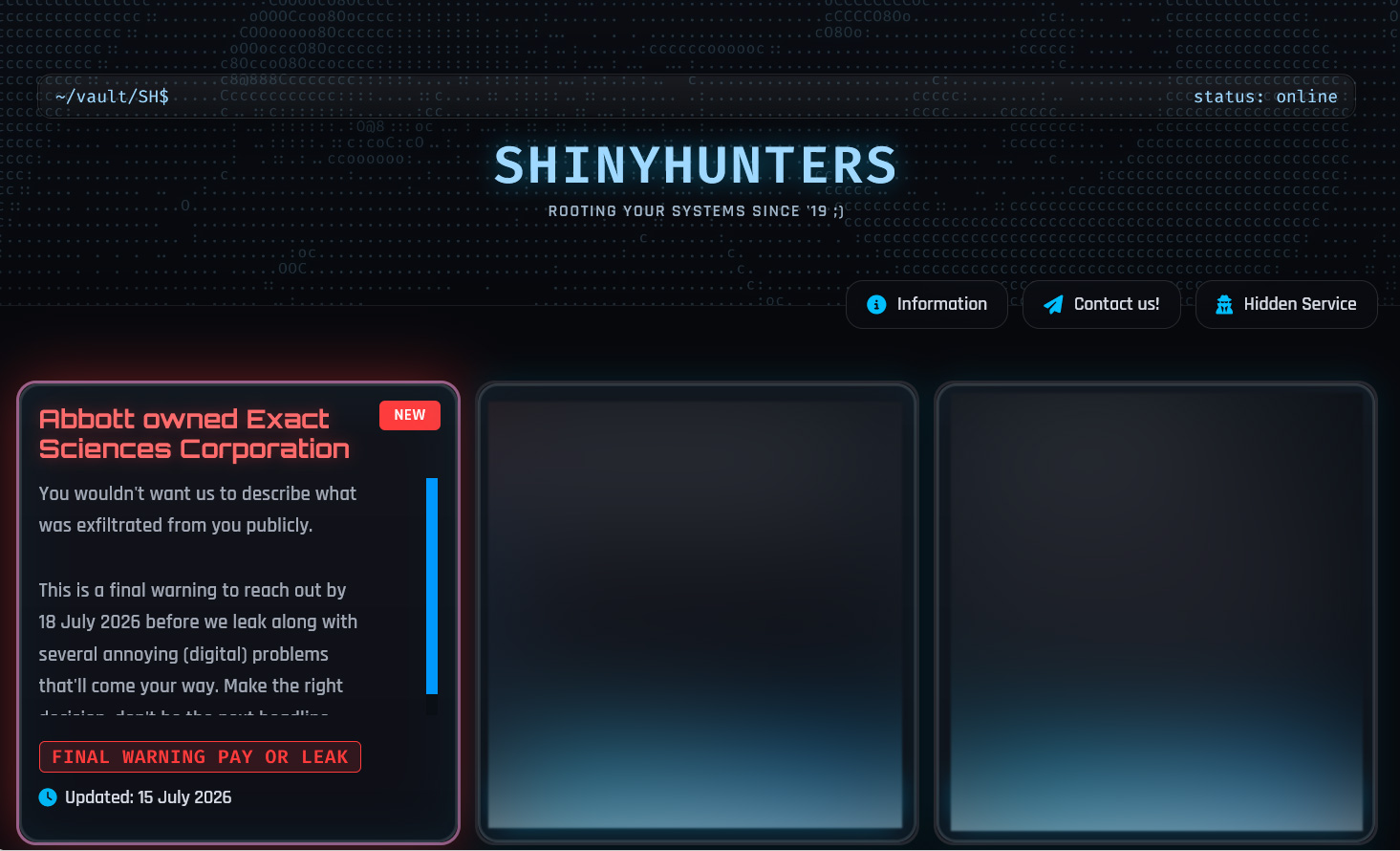
The first and arguably more significant incident involves Abbott’s Cancer Diagnostics business. The company confirmed the breach after the notorious extortion gang known as ShinyHunters listed Abbott on its dark web data leak site. According to the threat actors, the breach was facilitated through a sophisticated "vishing" (voice phishing) campaign initiated in mid-June 2026. This social engineering attack targeted several Abbott employees, eventually allowing the attackers to compromise a Microsoft Entra single sign-on (SSO) account.
Once the attackers gained a foothold through the compromised SSO credentials, they reportedly navigated through Abbott’s internal environment to access various connected Software-as-a-Service (SaaS) applications. ShinyHunters claims to have successfully exfiltrated data from high-value platforms including Microsoft Entra, ServiceNow, SharePoint, Databricks, and Coupa. The scope of the alleged theft is vast, with the group claiming to possess over 30 million rows of customer personally identifiable information (PII). This dataset reportedly includes names, physical addresses, phone numbers, email addresses, dates of birth, and more than one million Social Security numbers.
Furthermore, the extortion group asserts that it has stolen over 22 million client notes, which allegedly contain sensitive doctor-patient conversations, as well as 20 million medical orders and various corporate documents such as non-disclosure agreements (NDAs) and customer contracts. While Abbott has confirmed unauthorized access to a "limited number of internal systems" in its Cancer Diagnostics business, it has not yet verified the specific volume or nature of the data claimed by ShinyHunters.

Legacy Systems and the Exact Sciences Connection
A critical detail in the Cancer Diagnostics incident is the involvement of legacy Exact Sciences systems. Abbott clarified that the unauthorized access was confined to these specific legacy environments, which are maintained separately from Abbott’s primary corporate network. The systems in question originated from the Cancer Diagnostics business Abbott acquired, and the company has emphasized that the incident has not impacted its broader business operations, product availability, or laboratory functions.
The focus on legacy systems underscores a common vulnerability in large-scale corporate environments: the "security debt" associated with integrated acquisitions. Legacy systems often lack the robust, modern security controls found in newer infrastructure, making them attractive targets for threat actors seeking a path of least resistance into a larger corporate entity.
The LabCentral Portal Incident: ShadowByt3$ Claims
Parallel to the ShinyHunters investigation, Abbott is also looking into claims made by a threat actor using the handle ShadowByt3$. This individual or group claims to have breached Abbott’s Core Laboratory diagnostics business via the LabCentral customer portal on July 4, 2026. Unlike the vishing attack used by ShinyHunters, ShadowByt3$ claims to have leveraged compromised customer credentials and exploited a "weak point" in the portal’s environment to exfiltrate files through API endpoints.
The data allegedly stolen in this second incident includes technical specifications, calibrator value assignments, assay files, CE manufacturing certificates, and regulatory documentation. While ShadowByt3$ maintains that this data constitutes sensitive intellectual property and proprietary business information, Abbott has offered a firm rebuttal. A company spokesperson stated that LabCentral is an externally facing, third-party hosted portal used primarily for distributing publicly available technical product reference documents, such as operating manuals and troubleshooting checklists. According to Abbott, the environment does not contain proprietary or sensitive customer data.
Chronology of the Cybersecurity Crisis
The timeline of these incidents suggests a period of intense activity for Abbott’s security teams:
- Mid-June 2026: ShinyHunters initiates a vishing campaign against Abbott employees, successfully compromising Microsoft Entra SSO accounts.
- July 4, 2026: ShadowByt3$ allegedly gains access to the LabCentral portal and begins exfiltrating technical documentation via API endpoints.
- July 17, 2026: Reports emerge linking Abbott to the ShinyHunters leak site. The group sets an initial deadline of July 18 for negotiations.
- July 18, 2026: Abbott issues a public statement confirming the investigation into the Cancer Diagnostics incident and activating incident response procedures.
- July 19, 2026: ShinyHunters extends the extortion deadline to July 21, 2026, as the company continues its internal assessment.
- Current Status: Abbott continues to monitor both situations, maintaining that business operations remain unaffected while coordinating with law enforcement and external cybersecurity experts.
Analysis of Attack Vectors: Vishing and SSO Exploitation
The methodology employed by ShinyHunters—vishing to compromise SSO accounts—is part of a broader trend in the cyber threat landscape. As organizations have moved toward centralized identity management and multi-factor authentication (MFA), attackers have pivoted toward social engineering to bypass these controls. By posing as IT support or corporate security personnel, attackers can trick employees into revealing credentials or approving MFA prompts.
Once an SSO account is compromised, the "blast radius" can be immense. In modern enterprise environments, a single set of credentials often provides access to dozens of SaaS applications. For a company like Abbott, this includes sensitive platforms like SharePoint and Databricks, which house vast repositories of research, patient data, and financial records. The ability of ShinyHunters to pivot from a single account to 30 million rows of data demonstrates the high stakes of identity-centric security.
The MedTech Sector as a High-Value Target
Abbott is not the only MedTech giant to face such threats. The healthcare and medical device industry has become a primary target for extortion groups because of the high value of its data and the critical nature of its services. ShinyHunters has previously targeted companies such as Medtronic, OneMedical, and AdaptHealth. They were also identified as the group behind the iRhythm data breach and have reportedly targeted Stryker in the past.
The motivation for targeting MedTech is twofold: financial and strategic. On the financial side, medical records and Social Security numbers command high prices on underground forums. Strategically, the threat of disrupting life-saving medical services provides attackers with significant leverage during extortion negotiations. While Abbott has stated that its manufacturing and patient services are unaffected, the mere threat of releasing 22 million rows of doctor-patient notes creates significant reputational and legal pressure.
Official Response and Regulatory Implications
In its official communication, Abbott has focused on transparency regarding the operational status of the company while remaining cautious about the specific claims of the threat actors. The company has engaged third-party cybersecurity firms to conduct a forensic analysis of the breached systems and has notified federal law enforcement agencies.

From a regulatory perspective, Abbott must navigate the complex requirements of the Health Insurance Portability and Accountability Act (HIPAA) in the United States, as well as various international data protection laws like the GDPR. If the theft of one million Social Security numbers and millions of patient notes is confirmed, the company could face significant fines and years of oversight. Furthermore, as a publicly traded company, Abbott is subject to SEC rules regarding the disclosure of "material" cybersecurity incidents. At this stage, Abbott has stated it does not expect a material impact on its financial results, but this assessment could change as the full scope of the exfiltrated data is realized.
Broader Impact on Healthcare Trust
The dual incidents at Abbott highlight a growing crisis of trust in the healthcare sector’s ability to protect sensitive data. As medical diagnostics become increasingly digitized and interconnected, the surface area for attacks grows. The use of third-party portals like LabCentral and the retention of legacy systems from acquisitions create "blind spots" that even the most well-funded security programs struggle to eliminate.
For patients and healthcare providers, the primary concern remains the confidentiality of medical records. The claim by ShinyHunters regarding 22 million rows of "client notes" is particularly concerning, as these records often contain the most intimate details of a patient’s health history. Even if the data is not used for identity theft, its public release could have devastating personal consequences for the individuals involved.
Conclusion and Future Outlook
As of late July 2026, Abbott Laboratories remains in the "investigative and containment" phase of its incident response. The company’s ability to prevent the public release of the allegedly stolen data may depend on the outcome of its internal forensics and its strategy regarding the extortionists’ demands. While Abbott’s assertion that its core operations are intact provides some relief to the medical community, the potential exposure of millions of patient records remains a looming shadow.
This situation serves as a stark reminder for the MedTech industry: security is not a static state but a continuous process of managing identity, securing legacy infrastructure, and defending against the human element of social engineering. As extortion groups like ShinyHunters continue to refine their tactics, the global healthcare sector must prioritize the hardening of SSO environments and the rapid decommissioning of vulnerable legacy systems to protect the sanctity of patient data.
Related posts: