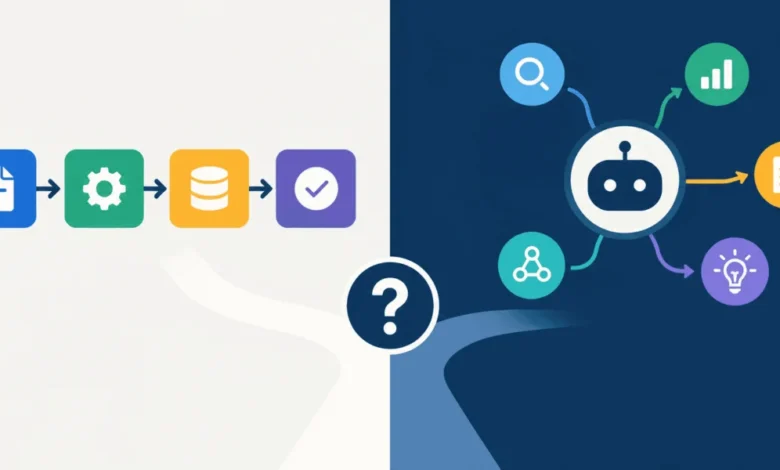
The rapid proliferation of Large Language Model (LLM) applications has introduced a significant nomenclature crisis within the software engineering industry. As organizations rush to integrate generative AI into their operations, the terms "AI workflow" and "AI agent" are frequently conflated, leading to misaligned project scopes, bloated development costs, and unreliable system architectures. At the core of this confusion lies a fundamental misunderstanding of control flow: while workflows represent deterministic, pre-programmed logic, agents embody autonomous, iterative decision-making. Distinguishing between these two paradigms is not merely a semantic exercise; it is a critical technical requirement for building scalable, cost-effective, and auditable enterprise systems.
The Evolution of AI Architecture
To understand the current industry landscape, one must look at the timeline of LLM deployment. Between 2022 and early 2024, the primary focus was on "prompt engineering"—crafting inputs to elicit specific outputs. As developers moved toward production, they began building pipelines (workflows) to chain these prompts together. The introduction of "function calling" capabilities in late 2023 marked the transition toward agents, which theoretically allow models to loop, plan, and execute actions based on environmental feedback.
Industry analysts estimate that nearly 70% of current enterprise AI projects currently labeled as "agents" could be executed more efficiently using deterministic workflows. This trend toward "agent-first" development often stems from the marketing hype surrounding autonomous systems, leading engineering teams to abandon structured logic in favor of probabilistic, non-deterministic loops that are notoriously difficult to test, debug, and monitor in production.
Defining the Workflow Paradigm
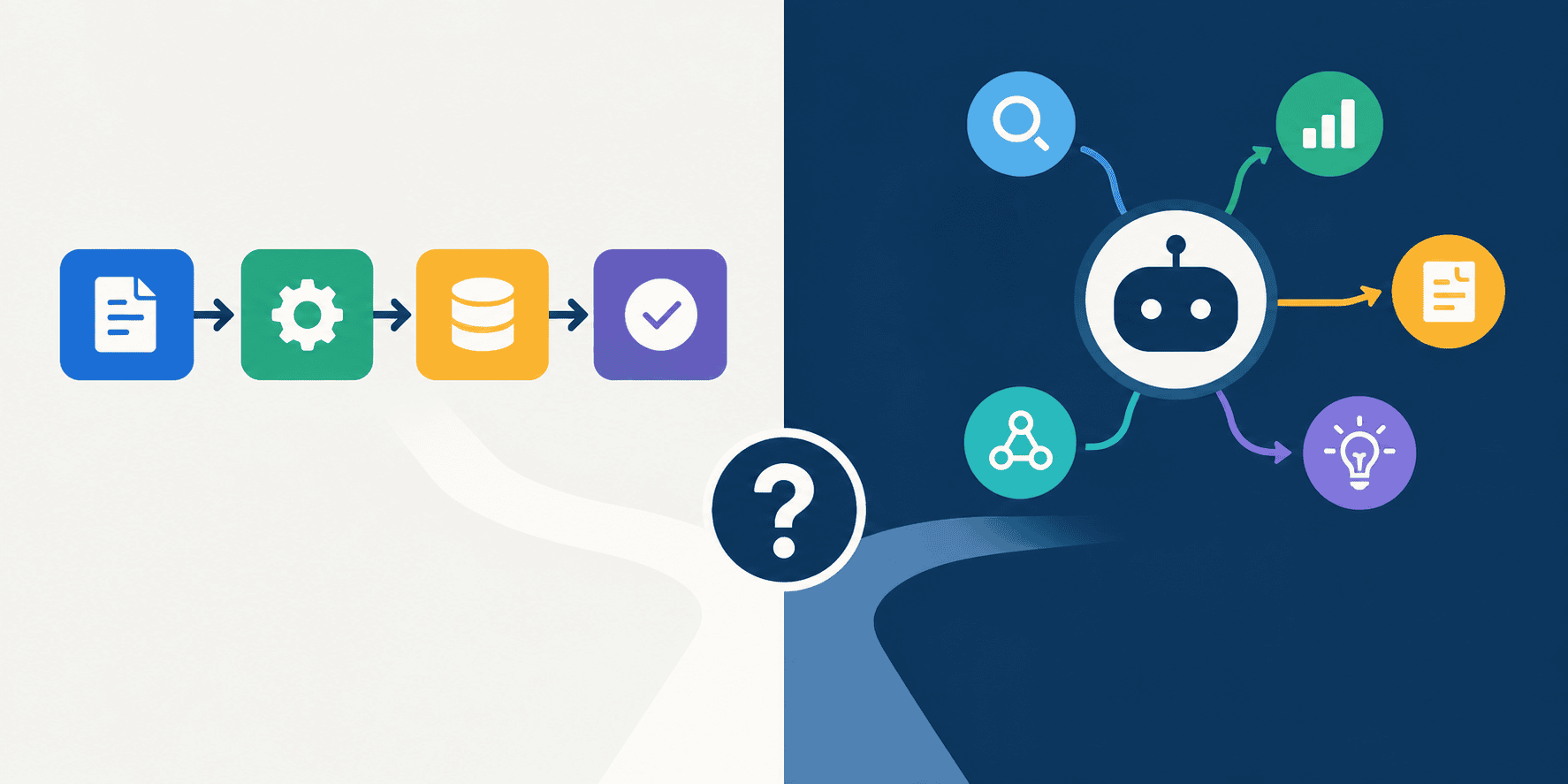
A workflow—often categorized as a pipeline or a chain—is a software construct where the path of execution is explicitly defined by the developer. Even if the system integrates advanced LLMs for decision-making at specific nodes, the high-level logic remains rigid. The developer dictates the sequence: Step A leads to Step B, followed by a conditional check (the "if-then" logic) that directs the process to Step C or Step D.
For example, in a standard automated refund processing system, the workflow is static. The system extracts invoice data, checks the purchase date against the return policy, verifies the transaction status in the database, and concludes with an approval or denial. While an LLM might be used to interpret the customer’s request, the "business rules" are hard-coded. This deterministic nature ensures that the system behaves predictably, making it an ideal choice for industries requiring high levels of compliance, such as finance, healthcare, and legal services.
The Autonomous Agent: A Paradigm Shift in Control
Conversely, an agent represents a radical departure from traditional software development. In an agentic architecture, the control flow is delegated to the LLM. The agent is provided with a high-level goal and a set of tools, and it is tasked with determining the sequence of operations required to achieve that goal. Unlike a workflow, which follows a pre-mapped route, an agent observes the environment, processes the result of an action, and decides its next move based on that information.
Consider a complex IT production outage: an agent tasked with identifying a root cause may begin by querying error logs. Upon discovering a database latency spike, it may autonomously decide to inspect recent deployment configurations or review regional DNS settings. Because the path is not predetermined, the agent can backtrack, retry failed tool calls, or explore multiple diagnostic paths until the goal is satisfied. The primary advantage here is flexibility; however, the cost of this autonomy is the loss of predictability and the risk of infinite loops or excessive API token consumption.
The Diagnostic Test: A Decision-Making Framework
Before committing to an architectural approach, engineers should employ the "Flowchart Test." If a senior engineer can accurately map the entire process on a whiteboard—including every decision node, branch, and error-handling state—before a single line of code is written, a workflow is almost certainly the superior choice.
This test serves as a safeguard against "architectural over-engineering." Building a system as an agent when a workflow suffices introduces several systemic risks:
- Unpredictability: Because agents make runtime decisions, two identical inputs might result in vastly different execution paths, making post-mortem debugging extremely difficult.
- Economic Inefficiency: Agents typically perform more reasoning cycles and tool calls than workflows, directly impacting API costs and latency.
- Auditability Gaps: Regulatory bodies and compliance teams often require documented proof of how a decision was reached. With a workflow, the audit trail is built into the state machine; with an agent, the trail is a opaque, probabilistic sequence that is difficult to reconstruct.
Comparative Metrics for Enterprise Deployment
In evaluating these two models, technical leads should prioritize volume, latency, and compliance. For high-frequency tasks—such as automated customer support FAQs, invoice extraction, or data classification—workflows provide the high throughput and low cost necessary for profitability. Agents, while computationally expensive, excel in "long-horizon" tasks where the sequence of actions is impossible to predict, such as complex market research, long-form content synthesis, or open-ended system debugging.
Data from early enterprise adopters suggests that hybrid systems are often the most effective. In these architectures, a primary workflow manages the overall business logic, but incorporates "agentic islands"—specific steps where an agent is triggered to handle an unpredictable sub-task. This "constrained autonomy" allows organizations to leverage the reasoning capabilities of LLMs without sacrificing the control and stability of traditional software engineering.
Strategic Implications and Industry Outlook
The industry is currently moving toward a more mature understanding of where agentic behavior provides value. We are witnessing a shift away from the "all-agent" philosophy toward a "workflow-first" approach. This is driven by the realization that in production environments, stability is the most critical metric.
When deciding which path to pursue, organizations must consider the following checklist:
- Constraint mapping: Can the process be linearized? If yes, use a workflow.
- Variable complexity: Are the inputs so varied that a decision tree would be too massive to maintain? If yes, consider an agentic component.
- Cost-to-benefit ratio: Does the complexity of an agent provide a measurable increase in the quality of the outcome compared to a refined, multi-step workflow?
As LLM technologies continue to advance, the distinction between these two concepts may blur further as agents become more reliable and workflows become more intelligent. However, for the foreseeable future, the "workflow-first" methodology remains the gold standard for enterprise-grade AI. By prioritizing deterministic design, organizations can build systems that are not only powerful and intelligent but also maintainable, scalable, and—most importantly—reliable. The future of AI is not just about building smarter models, but about building smarter systems that know exactly when to act autonomously and when to follow a proven, predictable path.