Combining LLM Embeddings with Tabular Features in a Unified Scikit-learn Pipeline

The Evolution of Modern Data Pipelines
Historically, data science workflows often treated text and structured data as siloed entities. Data engineers would frequently process text via traditional Natural Language Processing (NLP) techniques like TF-IDF or Bag-of-Words, while simultaneously preparing tabular features through separate scaling or encoding processes. This fragmentation often led to "feature drift" and cumbersome, error-prone manual reconciliation before the data could be ingested by a machine learning model.
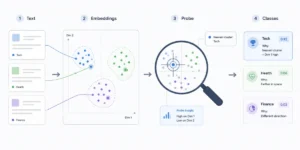
The current shift toward Large Language Model (LLM) integration represents a paradigm change. By utilizing lightweight, open-source models from the Hugging Face ecosystem, developers can now convert raw text into high-dimensional vector embeddings that capture semantic nuance. When these embeddings are merged with traditional tabular features—such as account metadata, timestamps, or usage metrics—the resulting model benefits from both the contextual intelligence of neural networks and the precise, feature-engineered logic of classical machine learning.
The Technical Framework: Bridging Modalities
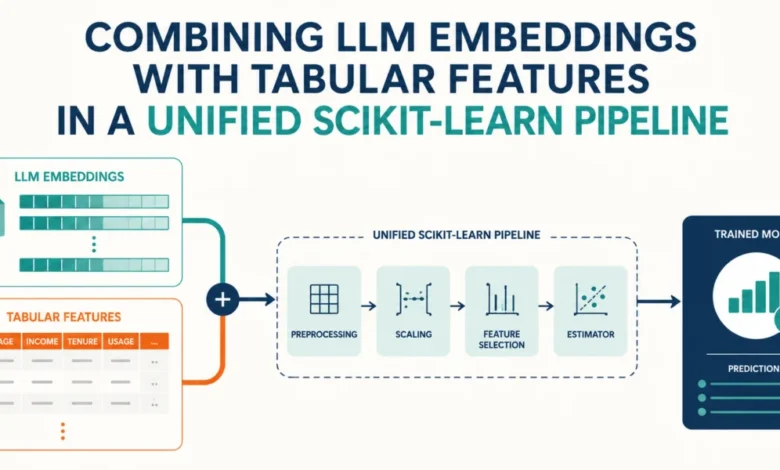
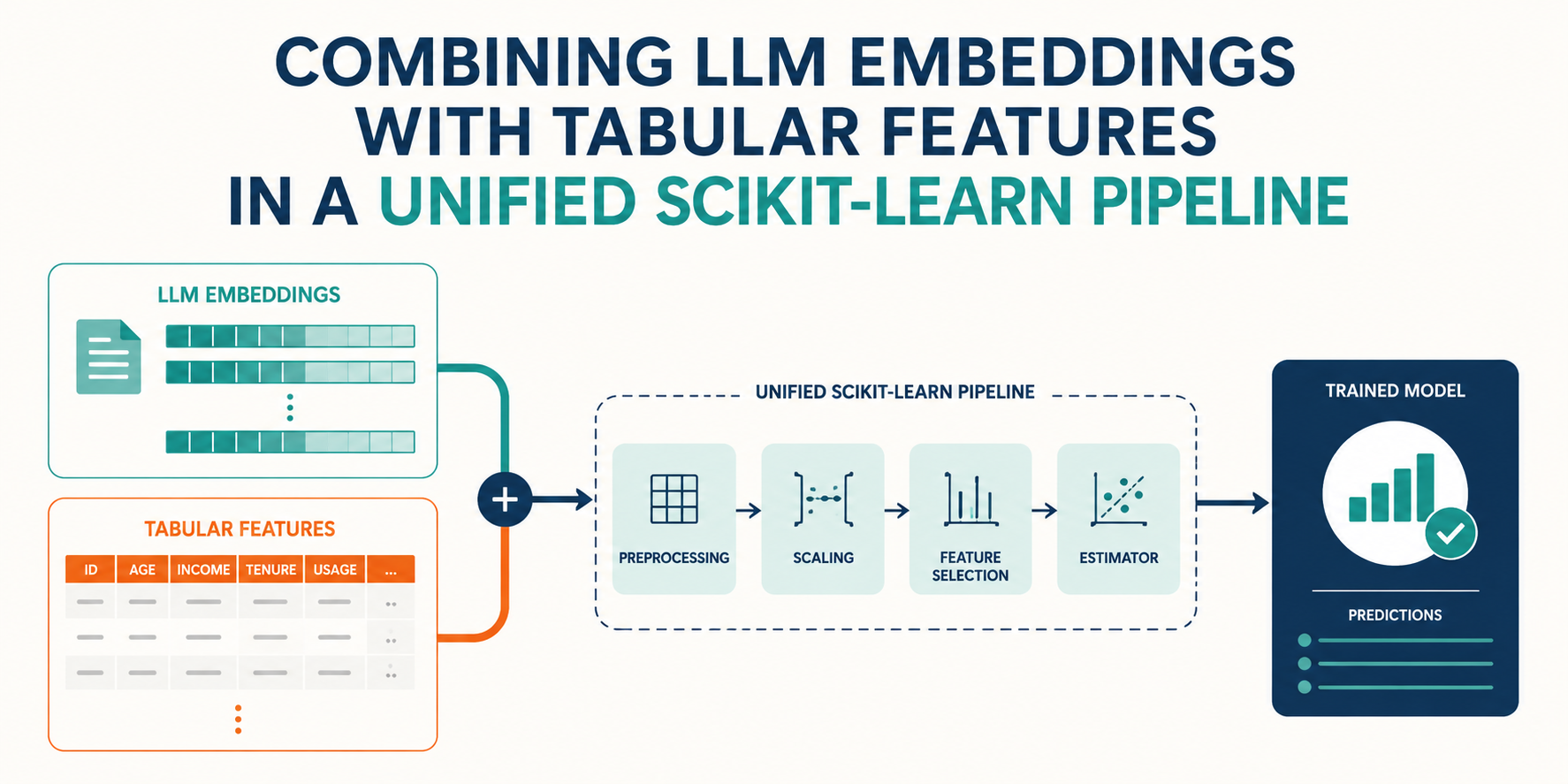
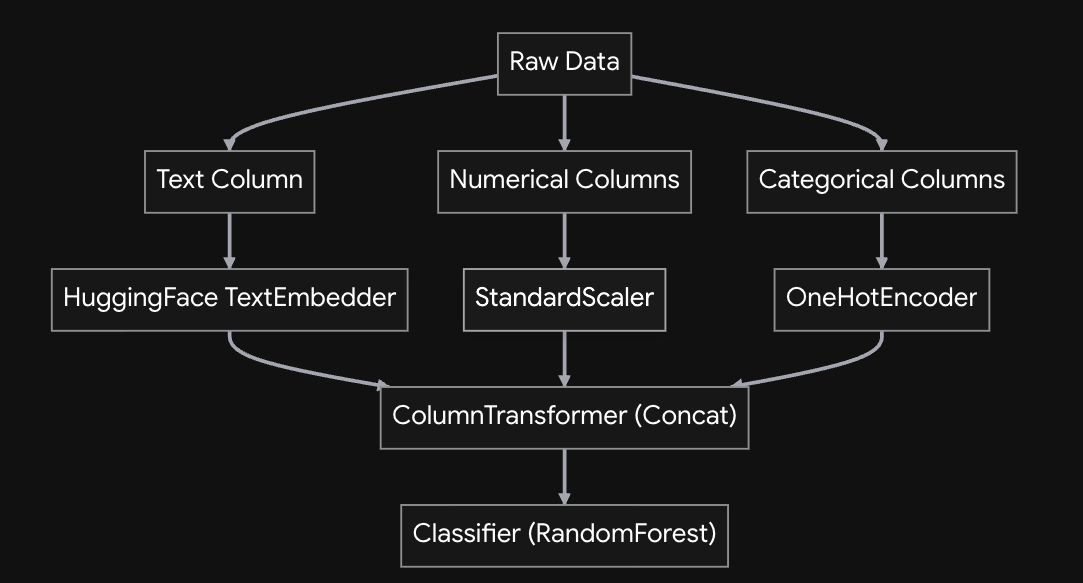
The core challenge in this integration is ensuring that the pipeline remains "production-ready"—a term denoting a solution that is robust, versionable, and scalable. Using the scikit-learn library’s ColumnTransformer and Pipeline objects, engineers can create a unified architecture. In this framework, the ColumnTransformer acts as a traffic controller, directing different columns of a dataset to their respective processing branches.
For instance, while a StandardScaler handles numerical features and a OneHotEncoder manages categorical variables, a custom transformer—the TextEmbedder—can be implemented to process raw text. This custom transformer inherits from BaseEstimator and TransformerMixin, ensuring it adheres to standard library conventions like fit() and transform(). By encapsulating the sentence-transformers library within this class, the pipeline becomes a singular object that can be saved, exported, and deployed via standard serialization protocols like pickle or joblib.
Experimental Implementation and Methodology
To demonstrate the viability of this approach, a hybrid dataset was constructed by merging the industry-standard SMS Spam Collection with synthetic tabular attributes. The SMS Spam dataset, originally curated for academic research on text classification, provides a foundation of binary labels ("ham" vs. "spam"). To simulate a real-world production environment, researchers introduced synthetic features such as account_age_days, is_premium, and priority_score.
These features were engineered with intentional statistical noise and overlapping distributions. This "noise injection" is a vital aspect of robust model validation; if a model performs perfectly on synthetic data without noise, it likely indicates overfitting or a data leakage issue. By creating an overlap in the priority_score between spam and legitimate users, the model is forced to rely on the interplay between the semantic content of the messages (via embeddings) and the behavioral metadata (via tabular features) to achieve a high degree of classification accuracy.
Chronology of Pipeline Development
The development of such a pipeline generally follows a four-stage lifecycle:
- Dependency Orchestration: Establishing the runtime environment, typically involving
sentence-transformers,scikit-learn,pandas, andnumpy. - Feature Engineering: Creating a structured, labeled dataset that maintains logical consistency. In this case,
account_age_dayswere assigned ranges that differentiate spam accounts (typically younger) from established user accounts. - Transformer Construction: Developing the custom
TextEmbedderclass. This stage is crucial, as the transformer must handle bothpandasDataFrames and standard Python iterables, ensuring thefitmethod remains lightweight by deferring model initialization until necessary. - Integration and Training: Final assembly within the
Pipelineobject and execution of thefit()method on a training subset, followed by verification on a hold-out test set.
Performance Analysis and Results
Empirical evidence from this approach yields high precision and recall metrics. In testing, the combined model achieved an accuracy of approximately 99%, with a macro-average F1-score of 0.97. The significance of these results lies not in the high accuracy itself—which is expected given the nature of the SMS dataset—but in the architecture’s efficiency.
By using the all-MiniLM-L6-v2 model, the pipeline remains CPU-friendly, avoiding the prohibitive latency and costs associated with querying large-scale LLM APIs like GPT-4. This makes the architecture particularly suitable for on-premises deployments or high-throughput, low-latency environments where round-trip times to external servers are unacceptable.
Broader Industry Implications
The implications of a unified pipeline are profound for several sectors:
- Customer Experience (CX): Automated ticket triage systems can now process both the subject line and body of a support request (text) alongside the customer’s service tier and recent purchase history (tabular) to prioritize urgent issues.
- Fraud Prevention: Fintech platforms can analyze transaction descriptions (text) in conjunction with geo-location data, time-of-day, and account velocity (tabular) to detect anomalies that neither method could identify in isolation.
- Regulatory Compliance: As organizations face increasing pressure to provide "explainable AI," having a single, unified pipeline makes it easier to track how features—both text-based and numerical—contribute to model decisions, simplifying the auditing process.
Future Outlook and Challenges
Despite the efficacy of this approach, challenges remain. The primary constraint is the computational cost of generating embeddings in real-time. As data volume increases, developers must consider batch processing or caching strategies for frequently occurring text patterns. Furthermore, the selection of the underlying embedding model—whether all-MiniLM-L6-v2 or a more modern, domain-specific transformer—will dictate the model’s performance on highly specialized jargon or industry-specific language.
As the machine learning field matures, the standard for "clean" code is shifting toward modularity. The use of ColumnTransformer is a definitive step toward this goal, allowing data scientists to swap out components—such as replacing a RandomForest with an XGBoost classifier or upgrading the TextEmbedder to a newer model version—without needing to rewrite the entire data flow.
In conclusion, the integration of LLM embeddings into structured scikit-learn pipelines represents a milestone in the democratization of advanced AI. By providing a clean, modular, and performant framework, this architecture empowers developers to move beyond the limitations of single-modality models, paving the way for more nuanced, intelligent, and highly capable predictive systems across the digital landscape. As the accessibility of lightweight models continues to improve, the adoption of such unified pipelines is expected to become the industry standard for production-grade machine learning.