Why The Jeep Recon Moab Proves That Off-Road Capability And EV Range Are Inherently At War

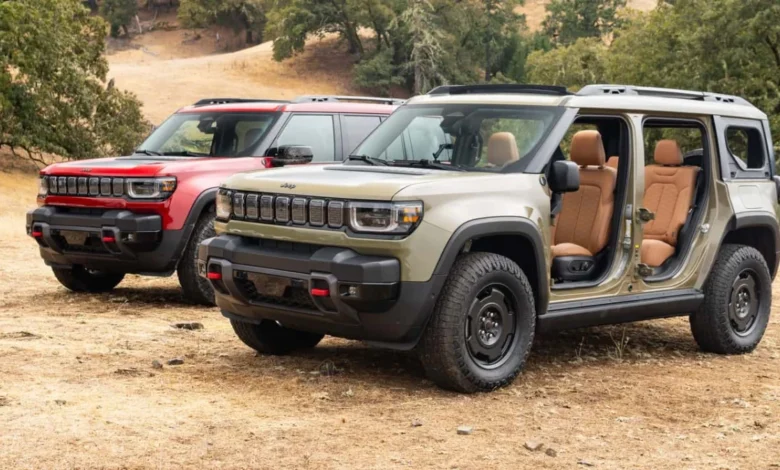
When Jeep first showcased the specifications for the all-electric Recon Moab, public reception was met with immediate skepticism. Journalists attending the Los Angeles Auto Show voiced concerns over its projected driving range of under 230 miles, a metric that many critics argued fell well short of modern industry standards for electric vehicles in the mid-2020s. Subsequent commentary across automotive forums echoed these sentiments, suggesting that a starting price of $66,995 coupled with a 222-mile range positioned the vehicle awkwardly in an increasingly competitive marketplace.
However, a closer examination of the engineering realities behind heavy-duty, trail-rated vehicles reveals that criticizing the Recon Moab solely for its range overlooks the fundamental physics of off-road design. Far from being a simple oversight by Jeep’s engineering department, the vehicle’s specifications are the result of deliberate compromises required to build an authentic electric off-roader. In the automotive industry, particularly within the specialized segment of rugged 4x4s, optimizing for maximum battery range while maintaining uncompromising trail capability remains an engineering paradox.
The Physics of Inefficiency: Why Off-Roaders Drink Energy
To understand the constraints facing electric off-road vehicles, one must first look at the historical precedent set by internal combustion engine (ICE) 4x4s. Traditional body-on-frame trucks outfitted with lifted suspensions, heavy-duty gearboxes, and large-displacement engines routinely suffer from poor fuel economy. Drivers of lifted trucks with aggressive all-terrain tires rarely expect to see fuel efficiency figures eclipse 10 to 15 miles per gallon.
This loss in efficiency is governed by unyielding physical laws. Elevated ground clearance, a necessity for clearing boulders and deep ruts during rock crawling, significantly degrades aerodynamic efficiency by allowing a larger volume of turbulent air to pass underneath the chassis. Similarly, large, knobby all-terrain tires feature deep tread blocks that create rolling resistance and high-frequency road noise, draining energy rapidly at highway cruising speeds.
Furthermore, mechanical attributes essential for traversing difficult terrain—such as low-range transfer cases and aggressive gear ratios designed to multiply torque at the wheels—inevitably compromise high-speed cruising efficiency. An engine or electric motor spinning at higher RPMs relative to vehicle speed to maximize low-end grunt will inherently consume more energy per mile than a highway-optimized aerodynamic sedan.
Comparing the electric vehicle landscape highlights this exact dichotomy. When comparing the Jeep Recon Moab to its sibling in the corporate lineup, the aerodynamic Wagoneer S, the divergence becomes glaring. Both vehicles utilize the same 100.5-kilowatt-hour battery pack. Yet, while the sleek, low-slung Wagoneer S achieves an EPA-estimated range of up to 294 miles on standard street tires and low ground clearance, the rugged Recon Moab drops to 222 miles.
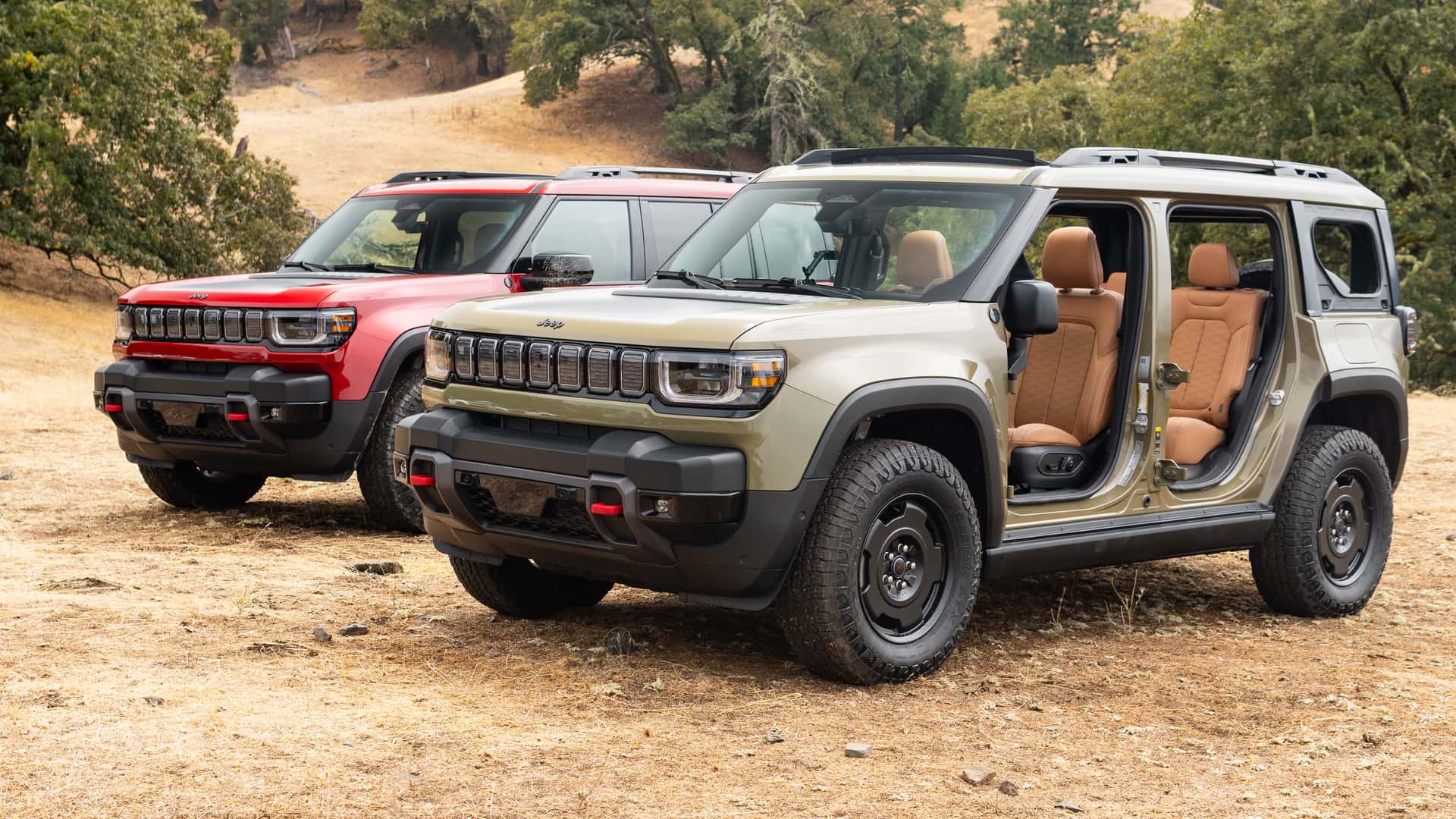
The Recon’s design choices—9.1 inches of ground clearance, heavy-duty underbody skid plates, boxy exterior proportions to optimize approach and departure angles, and 33-inch all-terrain tires—exact a heavy toll on energy consumption. During recent first-drive evaluations, real-world efficiency hovered around 2.5 miles per kilowatt-hour, illustrating the penalty exacted by trail-focused hardware.
The Gearing Dilemma and Torque Delivery
Beyond aerodynamics and rolling resistance, electric vehicles introduce a distinct mechanical variable: motor gearing. While EVs do not feature traditional multi-speed transmissions in the conventional sense, they do rely on fixed gear ratios to dictate how electric motors deliver torque to the wheels.
Taller gear ratios—such as a 9:1 ratio—favor high-speed efficiency and smooth highway cruising. Conversely, shorter gearing multiplies torque significantly from a dead stop, giving the vehicle the instantaneous muscle required to scale steep inclines and push through heavy mud or sand. To deliver true Jeep-level off-road capability, the Recon Moab utilizes a 15:1 gear ratio on its rear motor. This configuration not only provides exceptional rock-climbing prowess but also contributes to blistering straight-line performance, enabling the vehicle to accelerate from zero to 60 miles per hour in just 3.6 seconds.
Nevertheless, this performance trade-off directly impacts range. The shorter gearing forces the motors to spin faster at cruising velocities, compounding energy drain on the highway.
Industry-Wide Precedents and Competitive Landscape
Jeep is not alone in navigating these difficult engineering boundaries. Competitors across the luxury and adventure EV segments face identical mathematical roadblocks, attempting to balance massive battery weight, price ceilings, and practical range.
Rivian’s R1S, widely praised for its utility, presents a similar narrative. The base R1S equipped with a standard 108-kilowatt-hour battery pack does not even offer all-terrain tires from the factory. To secure off-road-ready rubber, buyers must upgrade to the larger 140-kilowatt-hour battery variant, which pushes vehicle pricing toward the $96,000 threshold. Even with the massive battery pack, range drops significantly when factoring in aggressive tires and heavy-duty hardware.

At the ultra-luxury end of the spectrum, the Mercedes-Benz G580 with EQ Technology represents the pinnacle of electric off-road engineering. Featuring four independent electric motors equipped with individual low-range gearboxes, the G580 can transition seamlessly from hyper-capable rock crawler to highway cruiser. Yet, despite utilizing a usable 116-kilowatt-hour battery and commanding a staggering starting price of $163,000, the vehicle delivers an EPA-rated range of just 239 miles. Real-world highway consumption for all these heavy luxury EVs frequently underperforms compared to combined cycle estimates due to the compounding aerodynamic drag at sustained speeds.
Broader Implications for the Electric Vehicle Market
The market arrival of vehicles like the Jeep Recon Moab, the Volkswagen ID. Buzz, and heavy electric SUVs signals a necessary maturation phase for the automotive industry. As electrification expands beyond commuter cars and aerodynamic crossovers into specialized utility segments, it has become apparent that the least aerodynamic and heaviest vehicles are the most complex and expensive to electrify efficiently.
Fitting massive battery packs exceeding 90 or 100 kilowatt-hours inflates vehicle manufacturing costs, raw material consumption, and curb weight. When those batteries are tasked with moving a heavy, boxy, high-clearance machine equipped with sticky off-road tires and short gearing, the stored energy depletes rapidly.
Automotive analysts suggest that consumer expectations must evolve alongside battery technology. While solid-state batteries, improved charging infrastructure, and denser chemical compositions will eventually alleviate range anxiety, the immediate future of electric off-roading will necessitate compromises. Buyers seeking genuine trail capability in an electric package must accept that range limitations and elevated price points are currently unavoidable byproducts of physics.
Ultimately, the Jeep Recon Moab does not attempt to be a universal mass-market commuter. Instead, it serves as a specialized tool engineered for a specific subset of enthusiasts—a rolling compromise where capability on the trail takes permanent precedence over efficiency on the asphalt.