Apple Enters the Foldable Era with the iPhone Duo and a Strategic Leadership Transition

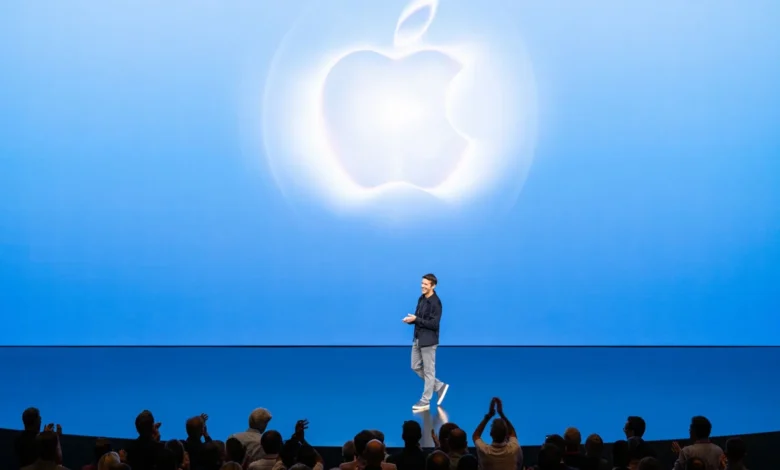
A transformative chapter has begun for Apple Inc. as the company navigates its most significant leadership change in over a decade. Last week, Tim Cook officially stepped down as Chief Executive Officer, concluding a 15-year tenure that defined the modern era of consumer technology. Succeeding him is John Ternus, the former Vice President of Hardware Engineering, who took the stage at Apple’s Cupertino headquarters to lead his first major product launch. The event marked a departure from tradition, signaling a shift in strategy that embraces new form factors while doubling down on the company’s burgeoning artificial intelligence ecosystem.
The centerpiece of the presentation was the long-rumored, highly anticipated debut of the iPhone Duo, Apple’s first foray into the foldable smartphone market. This announcement follows years of industry speculation and internal development, positioning Apple to compete directly in a category previously dominated by Android manufacturers like Samsung and Google.

The iPhone Duo: A Decade in the Making
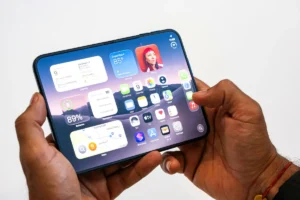
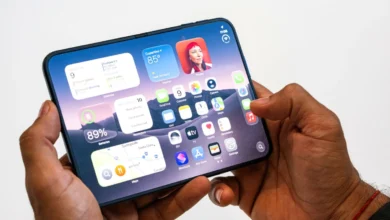
The iPhone Duo represents a "passport-sized" foldable device, meticulously engineered to blend the portability of a traditional handset with the expansive screen real estate of an iPad. Apple’s entry into this space is characterized by a "landscape-first" design philosophy. When closed, the device functions as a standard smartphone with a 5.3-inch exterior display. When opened like a book, it reveals a 7.7-inch internal screen, utilizing a vertical magnetic hinge system that the company claims is the most durable in the industry.
Priced at a premium starting point of $1,999 for the 256 GB model, the Duo is clearly positioned as a luxury device for power users and creative professionals. The construction features a lightweight titanium frame and a proprietary "custom polymer" screen material, designed to mitigate the creasing issues that have historically plagued foldable displays. Weighing 254 grams, the device is notably heavy, a compromise Apple engineers reportedly accepted to house the sophisticated battery array required to power dual displays.
Under the hood, the Duo is powered by the A20 Pro chip, paired with Apple’s custom C2 modem, ensuring 5G performance and seamless multitasking. Notably, the device marks the omission of Face ID in favor of a TouchID sensor integrated into the power button—a design choice aimed at maximizing internal space for battery cells and cooling components. Apple reports an impressive 31-hour battery life, which extends to 44 hours when utilizing only the exterior screen. For the highest-tier storage configuration of 2 terabytes, the price climbs to $3,199, reflecting both the current global memory shortage and Apple’s strategy of utilizing its "Apple Upgrade" subscription program to lower the barrier to entry for consumers.

iPhone 18 Pro: Refinement and Hardware Evolution
While the Duo garnered the most attention, the flagship iPhone 18 Pro and Pro Max remain the bedrock of the company’s revenue. Apple confirmed that there will be no base-model iPhone 18 released this year, with standard-tier updates deferred to early 2026.
The new Pro models maintain the aesthetic language of the iPhone 17 series but introduce significant internal advancements. The iPhone 18 Pro features a 6.3-inch display, while the Pro Max offers 6.9 inches. Beyond the display, the primary innovation lies in the thermal management system: a redesigned vapor chamber connected to a silicon-cased A20 Pro chip. This allows for sustained high performance without thermal throttling, a persistent challenge for mobile devices handling intensive AI workloads.
Charging speeds have also seen a boost, with the devices capable of reaching 50 percent capacity in just 15 minutes of charging. Perhaps most intriguing to professional photographers is the introduction of a mechanical variable aperture on the 48-megapixel main camera. This hardware-level control allows for authentic depth-of-field manipulation, moving beyond the software-based "Portrait Mode" that has characterized previous generations. Complementing this is the "Apple Reference Image" feature, a provenance-tracking technology that acts as a digital negative, ensuring that visual assets remain authentic in an age of generative media.

The Integration of Siri AI
Central to the entire hardware lineup is the advancement of Siri AI. Apple has moved beyond mere voice commands, integrating a dedicated Siri AI application that acts as a central hub for device intelligence. Currently in an English-language beta, the system is slated for expansion into French, Japanese, Korean, Portuguese, and Spanish by October.
This AI framework is designed to be cross-platform, appearing on the new AirPods 5, the iPhone 18 Pro, and the updated Apple Watch Series 12. The objective is to create a seamless ecosystem where the AI understands context across devices—whether it is transcribing a conversation via a smartwatch or facilitating live language translation through earbuds.
Apple Watch and Health Innovation
The wearable segment received a comprehensive update with the introduction of the Apple Watch Series 12 and the Apple Watch Ultra 4. Both models debut a "Health Sensing System," featuring high-frequency LEDs capable of measuring heart rate data every five seconds. This granular data collection powers a new "daily readiness" metric within the Health app, a feature designed to provide users with a more holistic view of their recovery and stress levels.

Perhaps the most controversial, yet innovative, feature is the watch’s new ambient listening capability. By utilizing microphones to record and process environmental sounds, the device can transcribe speech or alert the user to specific triggers, such as a baby crying, a doorbell ringing, or an emergency siren. Apple has emphasized privacy, stating that the audio is processed locally, never stored, and that the watch emits a physical chime when the transcription feature is active, alerting those in the immediate vicinity to the recording.
Market Implications and Future Outlook
The transition to the John Ternus era appears to be characterized by a "wait-and-see" approach to innovation, followed by a refinement that defines the standard for the industry. By avoiding early, buggy iterations of foldable technology, Apple has waited for the supply chain and manufacturing processes to mature. The launch of the iPhone Duo at a $1,999 price point indicates that Apple is not yet targeting the mass market with foldables, but is instead treating the device as a halo product for the brand.
Analysts suggest that the lack of Vision Pro or Mac announcements at this specific event was a deliberate choice to focus investor and consumer attention on the core mobile ecosystem. The company is clearly betting that the synergy between the A20 Pro chip, the new variable aperture cameras, and the expanded Siri AI will be enough to drive a new upgrade cycle.

From a macroeconomic perspective, Apple’s ability to maintain high margins despite the ongoing global memory and semiconductor supply constraints remains a point of interest. The expansion of the "Apple Upgrade" leasing program suggests the company is aware that the rising cost of its premium hardware may alienate traditional buyers. By shifting the conversation from a one-time purchase price to a monthly service fee, Apple is attempting to decouple its revenue from the volatility of hardware upgrade cycles.
Chronology of the September Event
- 10:00 AM: Opening remarks by CEO John Ternus, highlighting the legacy of Apple hardware.
- 10:15 AM: Unveiling of the iPhone Duo, with detailed demonstrations of the folding hinge and dual-display functionality.
- 10:45 AM: Introduction of the iPhone 18 Pro and Pro Max, focusing on thermal efficiency and the variable aperture camera system.
- 11:15 AM: Presentation of the Apple Watch Series 12 and Ultra 4, emphasizing the new Health Sensing System and ambient listening.
- 11:45 AM: Debut of the AirPods 5, featuring Siri AI integration and real-time translation capabilities.
- 12:00 PM: Closing statements, confirming pre-order dates for September 12 and retail availability for September 18.
As the industry assesses these new offerings, the focus will undoubtedly shift to how consumers react to the physical bulk of the Duo and the privacy implications of the Watch’s listening features. However, for Apple, the mission remains consistent: to curate an ecosystem that is as much about software intelligence as it is about premium industrial design. Under the leadership of Ternus, the company appears poised to continue its path of steady, calculated evolution, even as it enters the unpredictable and high-stakes arena of foldable technology.