Google Launches Gemini 4 Neon to Deliver Frontier-Level Intelligence for Complex Software Engineering and Knowledge Work

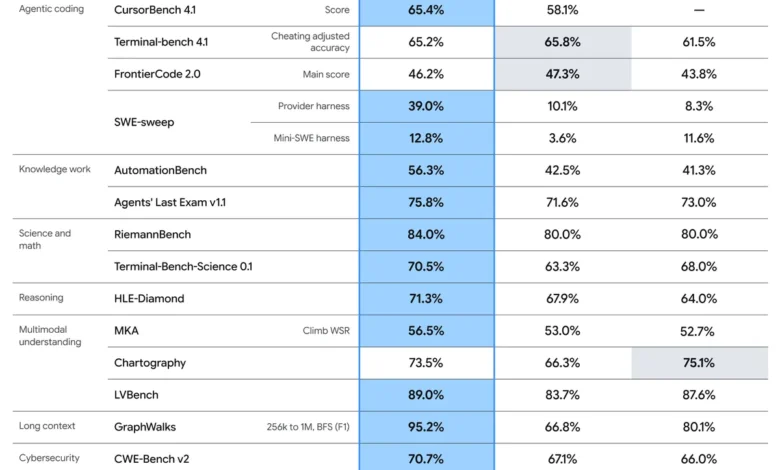
Google has officially announced the release of Gemini 4 Neon, a state-of-the-art artificial intelligence model engineered to provide frontier-level intelligence with fast, end-to-end task completion capabilities. Designed to tackle complex workflows across software engineering, advanced knowledge work, and scientific research, the model aims to bridge the gap between heavy, slow analytical models and rapid, lightweight execution tools. The launch represents a significant milestone in Google’s ongoing deployment of its Gemini 4 model family, following the introduction of its sibling architectures like Carbon and Hydrogen.

With the rapid acceleration of agentic computing across global enterprises, the demand for models that can sustain high performance through multi-step, tool-heavy tasks has surged. Gemini 4 Neon is designed specifically to meet these demands by offering deep analytical reasoning, precise code generation, and robust cybersecurity testing protocols, all while maintaining lower operational costs per task compared to traditional frontier alternatives.
Core Capabilities and Performance Benchmarks

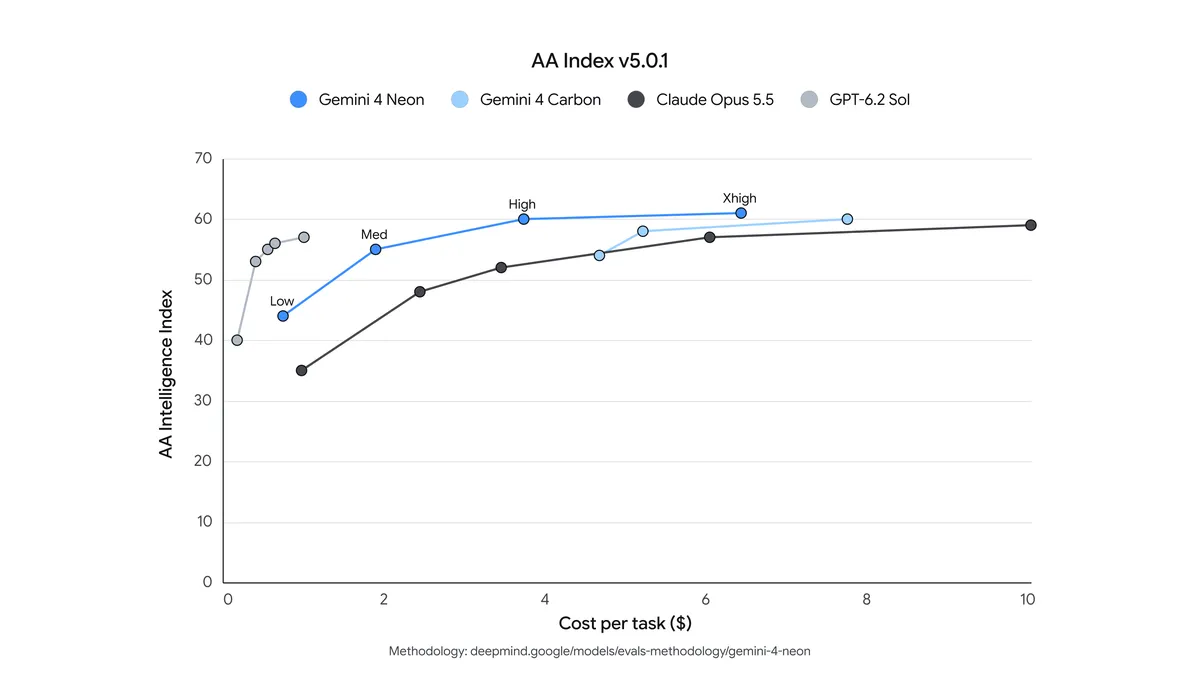
In independent evaluations, Gemini 4 Neon has demonstrated competitive performance against the industry’s leading systems. On the Artificial Analysis Intelligence Index, Neon ranks third overall with a score of 61 when operating at its highest thinking tier, placing it immediately behind larger and slower architecture models. Furthermore, it secures the second position on the Vals Index, successfully landing on the Pareto frontier for efficiency and capability.
Beyond raw computational metrics, Gemini 4 Neon excels in operational flexibility. It ranks second globally on the Agent Arena Index for steerability, a metric that measures a model’s ability to cleanly adapt to mid-task user corrections across complex, real-world agent sessions. Google’s internal testing via the Antigravity framework also indicates that Neon records the lowest fabrication rate of any model in its class, addressing a primary hurdle in enterprise adoption where accuracy and factual grounding are paramount.
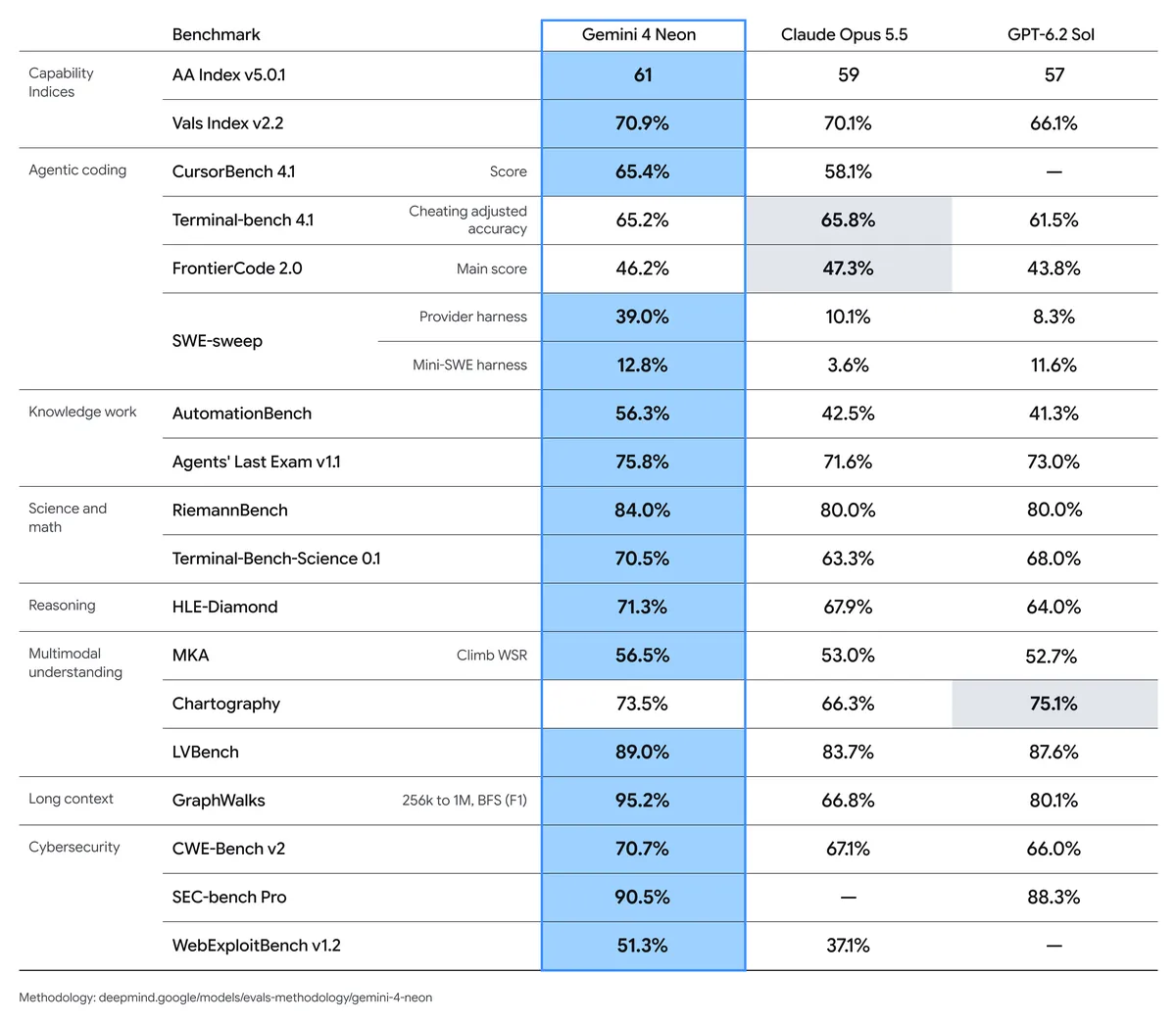
The model features a robust one-million-token context window, allowing it to ingest and synthesize vast arrays of enterprise data simultaneously, including spreadsheets, PDFs, complex charts, audio streams, and video files. According to benchmark data, Neon achieves top-tier rankings in specialized domains, capturing first place on Zapier’s AutomationBench and Andon Labs’ Vending-Bench 2, which simulates long-horizon business management. In scientific and mathematical reasoning, the model leads its class on Terminal-Bench Science, RiemannBench, and HLE-Diamond.
Engineering for Production-Grade Code and Cybersecurity
Gemini 4 Neon is heavily optimized for developers and technical researchers managing long-running agent workflows. Whether operating independently or functioning as an orchestrator directing parallel subagents within Google Antigravity, the model minimizes redundant file reads, provides real-time progress updates, and executes reliable context compaction during extended coding sessions.
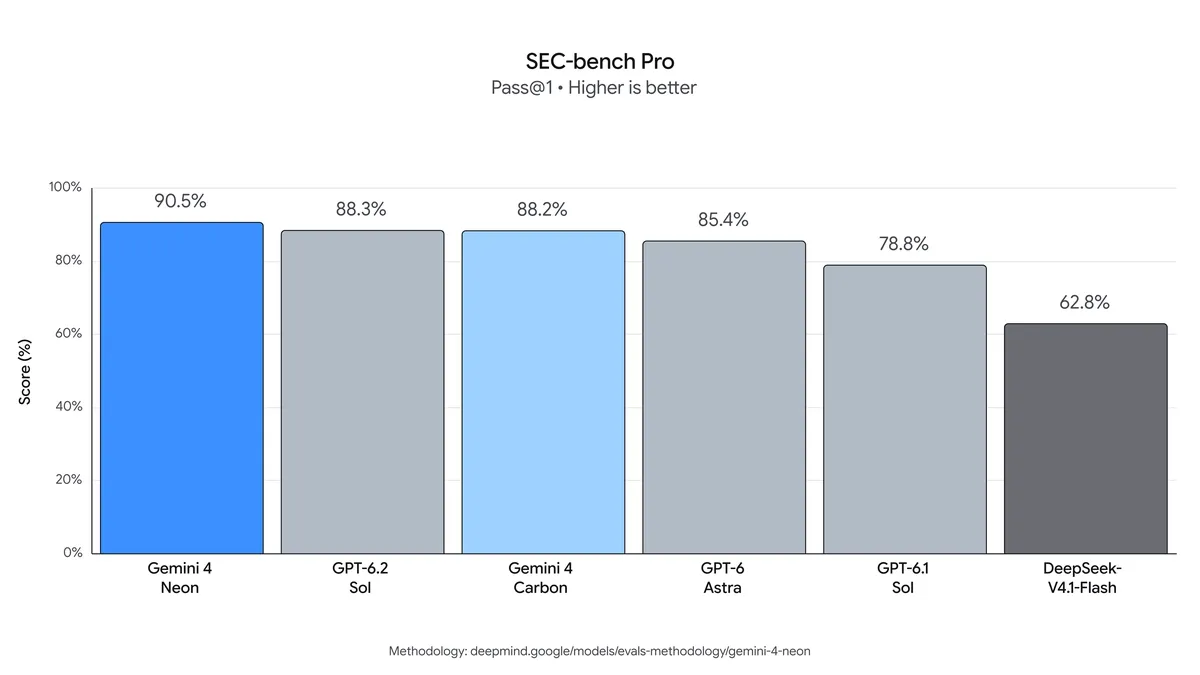
In coding evaluations, Neon achieves the top ranking on the Artificial Analysis Coding Agent Index and records strong scores on Terminal-Bench and FrontierCode. When applied to real-world software development, the model performs surgical multi-file debugging, repository refactoring, and complex architectural implementations. In Google Antigravity environments, its performance on specialized harnesses highlights its capability to handle end-to-end software deployment tasks with minimal human intervention.
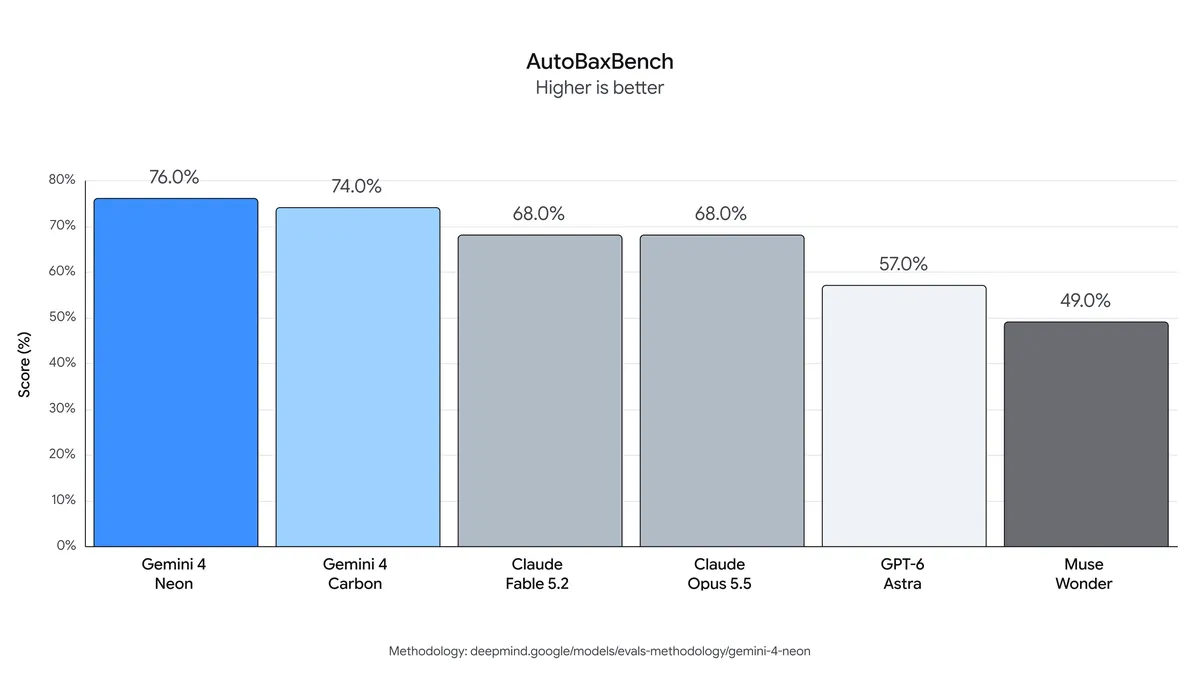
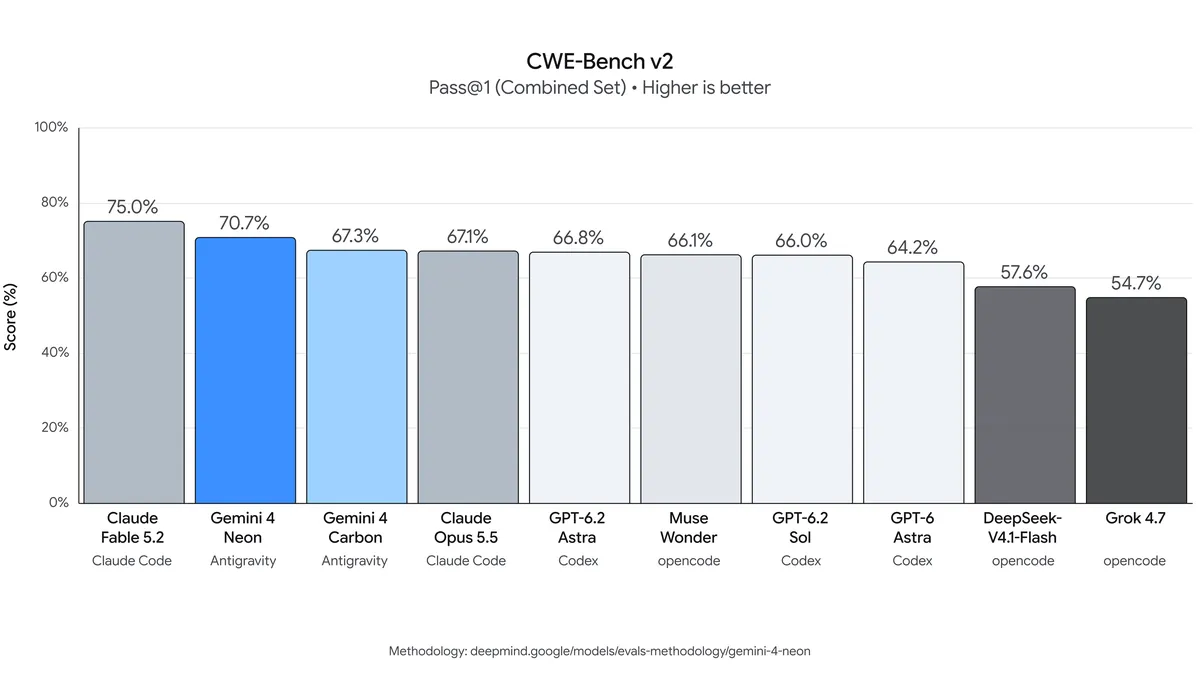
Concurrently, Google is addressing the critical intersection of automated coding and system vulnerability. As software generation scales, producing secure code from inception is paramount. Gemini 4 Neon has demonstrated superior secure-code generation compared to its predecessor, Carbon, across challenges on AutoBaxBench.
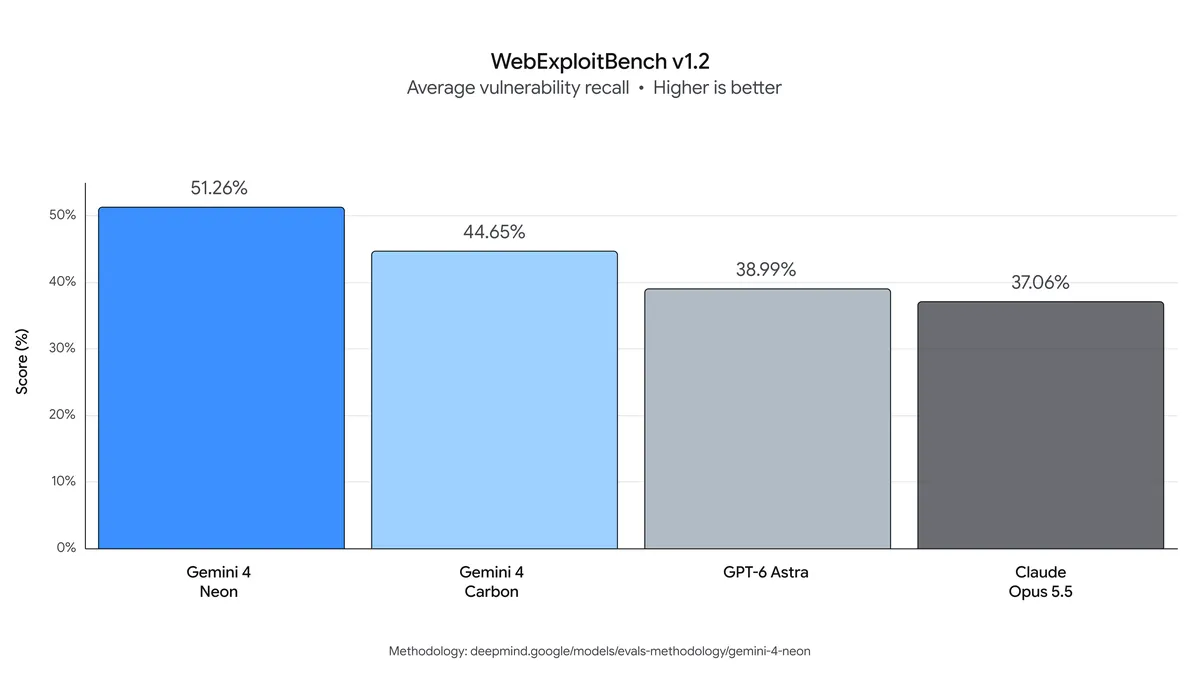
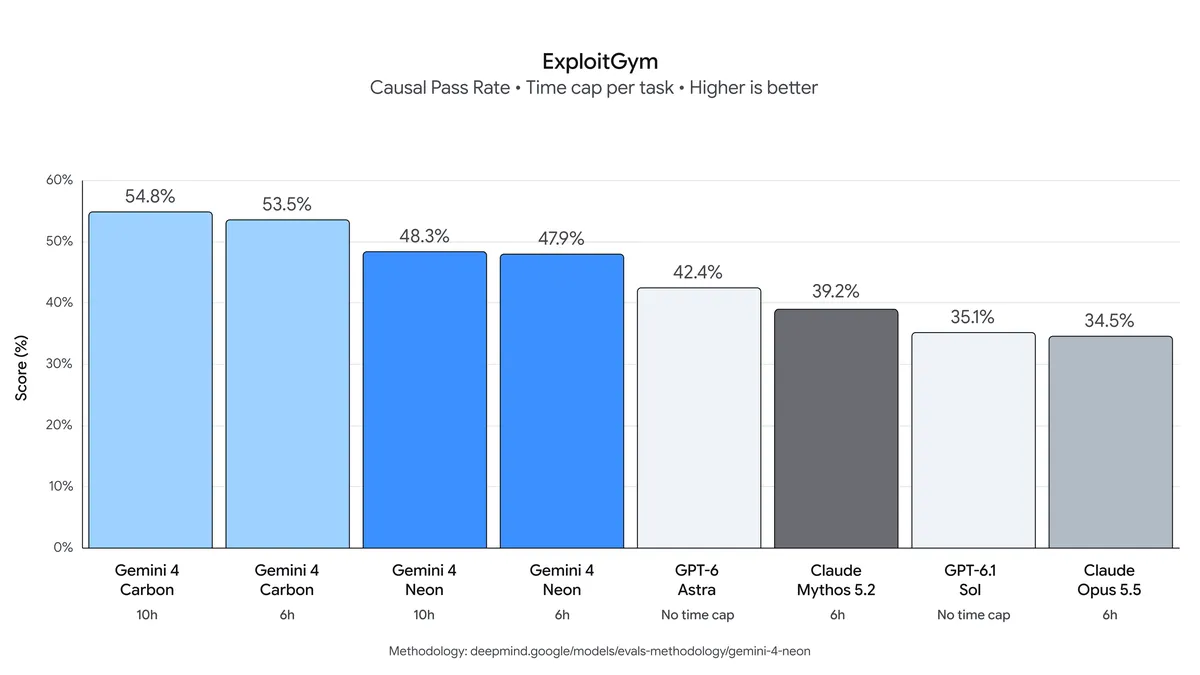
For defensive cybersecurity operations, the model establishes new benchmarks in vulnerability detection, validation, and patching. On WebExploitBench v1.2, Neon delivers state-of-the-art performance in penetration testing simulations at a fraction of the cost of competing large-scale models. To ensure responsible deployment in this sensitive domain, Google is rolling out Gemini 4 Neon for cyber defense to trusted security professionals through its Fairwind Program.
Pricing, Thinking Levels, and Market Placement
To accommodate diverse enterprise requirements, Google has structured Gemini 4 Neon around a scalable thinking-level framework. Users can adjust the model’s depth of reasoning across four distinct tiers, scaling computational intensity and token expenditure to match the specific complexity of the workload.
At its standard high-thinking setting, Neon achieves a high intelligence score while reducing per-task costs by approximately 32% compared to the Carbon architecture. When scaled to its maximum xhigh setting, the model handles the most rigorous mathematical, scientific, and structural engineering problems while maintaining a cost advantage of over 36% relative to competing frontier models operating at equivalent tiers.
The model is commercially accessible at a base rate of $3 per million input tokens, accompanied by a cached input token rate of $0.15 per million—representing a 95% discount for cached workloads. Output tokens are priced at $15 per million within the standard one-million-token context window.
Availability and Deployment Across Ecosystems
Google has initiated the immediate rollout of Gemini 4 Neon across its primary developer and consumer platforms. Enterprise users and developers can access the model via the Gemini API in Google AI Studio, as well as through Gemini for business via API integrations and model selection dropdowns.
For individual power users, the model is available to paid subscribers of Google AI Pro and Ultra tiers within the Google Antigravity environment, as well as general Pro and Ultra subscribers utilizing the consumer Gemini application. By striking a balance between deep analytical depth, production-grade coding efficiency, and cost-effective execution, Gemini 4 Neon positions itself as a versatile core engine for the next generation of enterprise artificial intelligence applications.