Tesla primes Cybercabs for 4K streaming and high bandwidth gaming with Starlink integration


Tesla has officially initiated the mass production of its dedicated robotaxi, the Cybercab, featuring integrated Starlink satellite connectivity as a standard hardware component. Recent aerial surveillance of the Gigafactory Texas facility confirms that the latest units rolling off the assembly line are equipped with the specialized satellite antenna module, visibly mounted on the rear hatch. This development signals a strategic shift in Tesla’s vehicle architecture, moving beyond traditional cellular reliance to ensure persistent high-bandwidth connectivity for its autonomous fleet.
The integration of Starlink into the Cybercab is not merely a technical upgrade; it represents a fundamental change in the operational philosophy of autonomous vehicles. According to recent reports, the satellite modules are no longer being installed as aftermarket retrofits but are now fully integrated during the primary manufacturing process. Drone footage captured on September 8, 2026, by Austin-based observer Joe Tegtmeyer, revealed a significant volume of Cybercabs in the outbound lot, with the distinctive satellite hardware visible on a majority of the fleet. This mass-production milestone follows a series of incremental announcements, beginning with a conceptual diagram released in July and a public showcase of a single prototype unit on August 10.
The Strategic Rationale for Satellite Connectivity
The decision to outfit robotaxis with Starlink hardware addresses a critical vulnerability in autonomous driving: the "Bermuda Triangles" of cellular connectivity. During Tesla’s Q2 2026 earnings call, Elon Musk emphasized that the reliability of a robotaxi fleet cannot be predicated on the inconsistent coverage of terrestrial cellular networks. While Ashok Elluswamy, Tesla’s VP of AI software, clarified that the Starlink connection is not a prerequisite for the core autonomous driving task—which relies on local compute and vision—the satellite link serves as a vital redundancy for navigation, fleet management, and real-time diagnostic reporting.
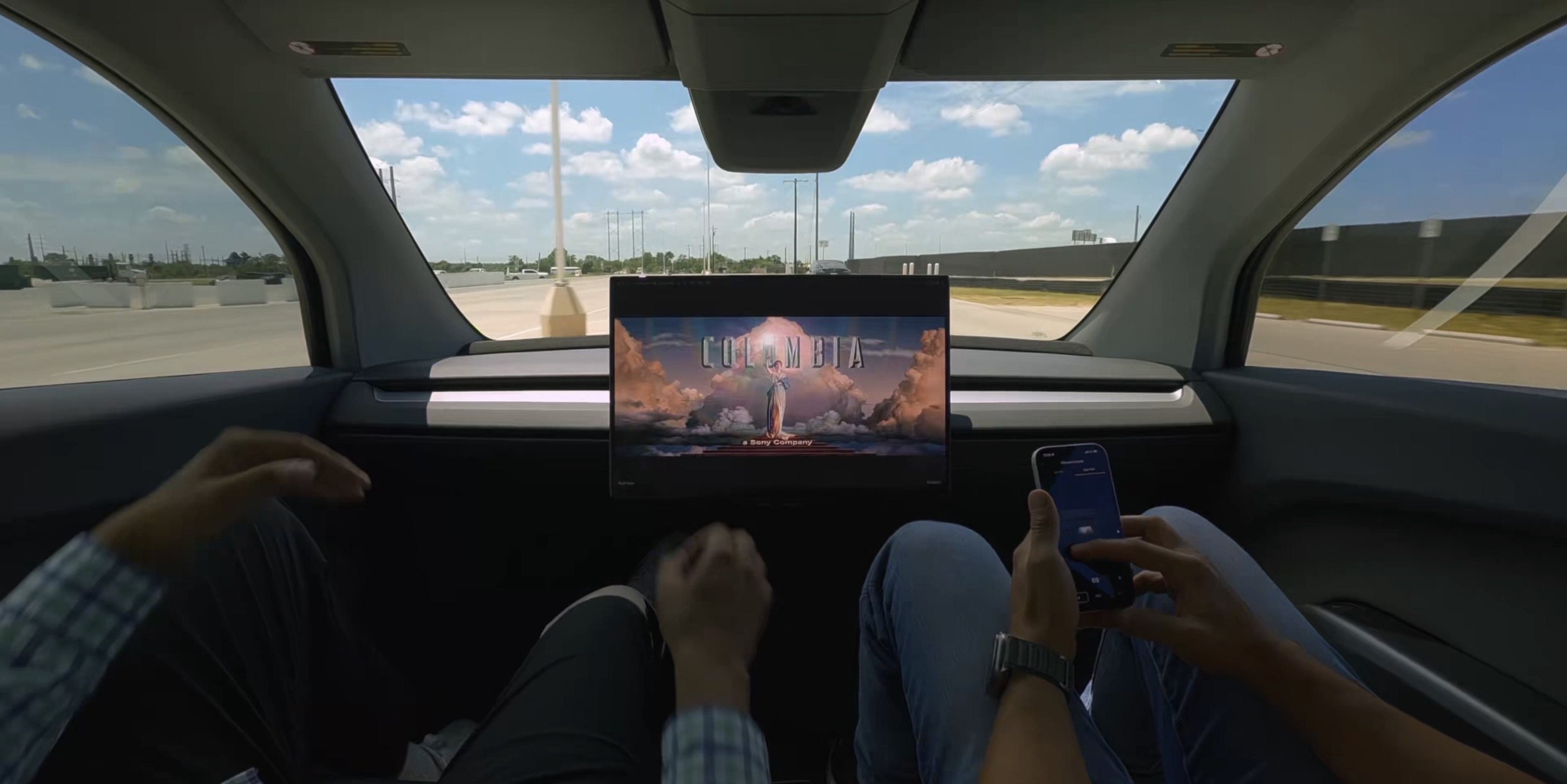
Beyond operational stability, the inclusion of Starlink is explicitly aimed at elevating the passenger experience. With the high-speed data throughput provided by the low-Earth orbit (LEO) constellation, Tesla aims to transform the Cybercab interior into a mobile entertainment hub. Passengers are expected to have access to 4K video streaming and high-bandwidth gaming, features that require a stable, high-speed connection that standard 5G networks often struggle to maintain in high-demand environments or rural transit corridors. By standardizing this hardware, Tesla is positioning the Cybercab as a premium service where the journey time is as productive or entertaining as the destination.
A Chronology of Integration and Public Testing
The transition from concept to production has been remarkably rapid. The following timeline outlines the key milestones in the deployment of Starlink-equipped Cybercabs:

- July 2026: Tesla and Starlink publish a collaborative technical diagram detailing the antenna placement on the Cybercab chassis.
- August 10, 2026: The first physical prototype featuring the integrated Starlink module is showcased by the official Robotaxi account.
- Late August 2026: Cybercabs are identified in public road tests in Houston and near Miami International Airport, providing data on real-world satellite link performance.
- September 3, 2026: Commercial robotaxi services officially launch to the public in Austin, Texas.
- September 8, 2026: Giga Texas begins volume production of Cybercabs with pre-installed Starlink modules.
Despite the rapid rollout, industry analysts remain cautious regarding the cost-benefit analysis of such an integration. While the system provides robust coverage, the current unsupervised robotaxi service is primarily concentrated in dense metropolitan areas where cellular infrastructure is already mature. The true value of the Starlink integration may not be realized until Tesla expands its fleet into more remote or geographically challenging service areas.
Proximity to Aviation Tragedy in Miami
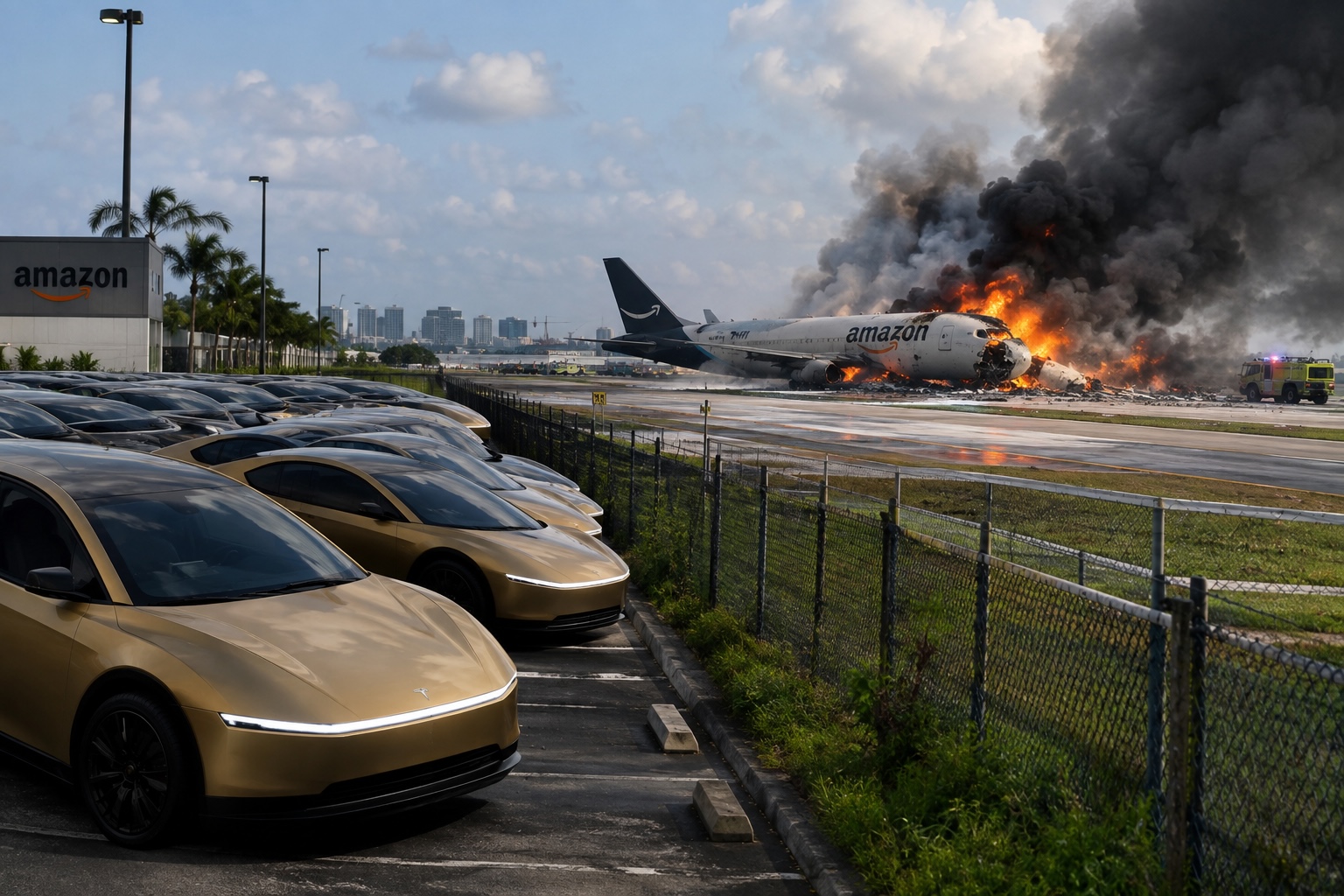
While the Cybercab program advances, the platform recently found itself at the center of a tragic event in Florida. On September 3, 2026, an Amazon Prime Air Boeing 767 cargo jet, operated by 21 Air as Flight 7598, suffered a runway overrun at Miami International Airport. The aircraft departed the perimeter, crossed NW 67th Avenue, and struck multiple vehicles before catching fire.
Preliminary imagery from the scene indicated that the wreckage came to a halt within meters of a fenced staging area containing a significant fleet of gold-painted Tesla Cybercabs. The proximity of the autonomous vehicles to the disaster site prompted immediate public concern and speculation regarding the safety of the stored units. While Miami-Dade Fire Rescue confirmed that the aircraft struck multiple vehicles, officials have not explicitly identified whether any of the Tesla units were involved in the collision. Elon Musk addressed the situation briefly on social media, describing the proximity of the vehicles to the wreckage as "Weird," but provided no further elaboration.
The incident has drawn additional scrutiny to Tesla’s expansion, which was already facing a federal audit. The National Highway Traffic Safety Administration (NHTSA) is currently conducting an inquiry into the certification processes for the Cybercab, specifically focusing on the vehicle’s design, which lacks manual controls such as a steering wheel and pedals. While the Miami crash is being investigated by the FAA and NTSB as an aviation matter, the event highlights the logistical challenges of managing large, high-value autonomous fleets in complex, high-traffic urban environments.
Historical Context: The Necessity of Success
The current pace of innovation at Tesla and SpaceX is frequently contextualized by the precarious early days of the latter. In a recent reflection on the origins of SpaceX, Elon Musk reiterated the "all-or-nothing" nature of the company’s early development. Following three consecutive failed launches of the Falcon 1 rocket, the firm was nearing insolvency. The fourth launch, which occurred on September 28, 2008, represented the company’s final attempt with its remaining capital.
The failure of the first three flights—attributed to issues ranging from corrosion in fuel line fittings to propellant slosh and stage collision—brought the company to the brink of dissolution. The success of the fourth mission, which placed the Ratsat mass simulator into orbit, served as a catalyst for the company’s survival and subsequent growth. This history of high-stakes engineering informs the current approach to the Cybercab: a willingness to iterate rapidly and integrate unconventional technology, such as satellite connectivity, to ensure the long-term viability of the product.
Implications for the Future of Autonomous Transit
The integration of Starlink into the Cybercab is a significant signal to the automotive industry. By decoupling the vehicle’s connectivity from terrestrial constraints, Tesla is setting a new standard for the "connected car." If successful, this model could be emulated by other autonomous vehicle operators looking to ensure fleet-wide uptime and provide competitive, high-bandwidth services to consumers.
However, the path forward is not without hurdles. Beyond the ongoing NHTSA audit, Tesla must address the operational costs of satellite-linked fleets. As the density of the Cybercab fleet increases, the demand for satellite bandwidth will scale accordingly. Furthermore, the public perception of autonomous vehicles, influenced by events like the Miami airport crash, will continue to play a pivotal role in the regulatory approval process.
As of mid-September 2026, Tesla continues to ramp up production at Giga Texas, with hundreds of Cybercabs entering the outbound logistics chain. The company’s ability to successfully scale this production, while simultaneously proving the utility of Starlink in an urban autonomous environment, will be a defining factor in the commercial success of the robotaxi platform. With regulatory inquiries ongoing and the public beginning to experience the service firsthand, the next few months will prove critical in determining whether the Cybercab can overcome its current scrutiny and establish itself as the dominant force in the autonomous ride-hailing market. The combination of satellite-grade connectivity and a revolutionary design architecture suggests that Tesla is preparing for a future where the vehicle is not merely a mode of transport, but a fully integrated node in a global, high-speed communication network.