Re-Architecting the Grid: How Medium-Voltage Power Systems Are Solving the AI Data Center Crisis


The rapid expansion of artificial intelligence infrastructure has placed unprecedented demands on global electrical grids, exposing critical vulnerabilities in traditional power distribution architecture. While public discourse often focuses heavily on power generation—debating the construction of new natural gas turbines, solar farms, and high-voltage transmission lines—recent catastrophic failures in major data center hubs reveal that the crisis is fundamentally architectural rather than a simple shortage of supply.
On July 22, 2026, a major transmission line fault in Ashburn, Virginia—widely recognized as "Data Center Alley" and the epicenter of the world’s largest cluster of data-processing facilities—triggered a sudden load drop of more than 3 gigawatts from the electrical grid within a matter of seconds. This severe disruption was not an isolated incident. Just two years prior, a single failed surge arrester caused approximately 60 facilities across Virginia to simultaneously drop 1,500 megawatts of load off the grid. Grid operators and electrical engineers alike were caught off guard by the sheer scale of uniform, synchronized responses from modern data centers encountering grid disturbances.
These recurring events underscore a profound mismatch between legacy electrical infrastructure and the unique operational behaviors of modern AI workloads. As the technology sector prepares to deploy an even larger wave of multi-gigawatt AI campuses, industry experts, utility providers, and policymakers are urgently re-evaluating how power is managed, protected, and delivered inside and outside the data center fence.
The Behavioral Shift: Traditional Loads vs. AI Workloads
To understand why traditional power architectures are failing, engineers must examine how electrical grids were historically designed. For over a century, power grids were built to accommodate predictable, stable industrial loads such as steel mills, chemical refineries, and municipal water systems, alongside residential demand that peaked predictably around dinnertime. These conventional loads drew electricity smoothly, occasionally malfunctioned in isolated ways, and recovered gracefully without coordinated system-wide shocks.
Artificial intelligence data centers operate under entirely different operational physics. A modern hyperscale AI campus running intensive training algorithms can swing up to 70 percent of its total electrical load within milliseconds. Conversely, at the first sign of an upstream voltage anomaly or grid instability, these same facilities can trip offline almost instantaneously to protect billions of dollars in sensitive graphics processing units (GPUs) and specialized compute hardware.
While each individual data center’s response is entirely rational from a risk-management perspective, their collective behavior at gigawatt scale introduces volatility that legacy grid management systems were never engineered to handle. With upcoming AI facilities planned at unprecedented multi-gigawatt capacities, maintaining grid stability requires a complete overhaul of how power reaches the server racks.
Where the Legacy Power Stack Breaks Down
The standard internal power architecture of a commercial data center has remained largely unchanged for decades. Medium-voltage power arrives from the utility, transformers step the voltage down, low-voltage uninterruptible power supply (UPS) units condition the electricity, and power distribution units finally deliver it to the server racks. When pushed to the immense scale required by modern AI operations, this traditional configuration breaks down at three critical junctures.
First, the placement and capacity of low-voltage UPS systems are inadequate for modern workloads. Traditionally located deep within the building close to the compute halls, a standard UPS relies on battery banks designed to bridge short-term outages for a few minutes. These batteries were never intended to continuously absorb rapid, massive, round-the-clock load swings characteristic of AI training clusters.
Second, legacy power converters waste significant amounts of energy under continuous load fluctuations, leading operators to run systems in "eco-mode." In this configuration, a static switch feeds the server racks directly from the utility grid, bypassing filtering mechanisms entirely. Consequently, the rapid load swings generated by the compute hardware exit the facility unfiltered, while sub-millisecond grid transients enter the building too quickly for mechanical switches to intercept, frequently damaging sensitive equipment.
Third, legacy protection logic was established during an era when a "large industrial load" was considered to be roughly 50 megawatts. Modern protection schemes often fail to comprehend the broader grid environment they now inhabit. When upstream disturbances occur, safety protocols frequently execute pre-programmed responses that exacerbate the problem. During the 2024 Virginia grid event, forensic reviews indicated that a substantial portion of the lost load resulted from protection logic programmed to count voltage dips and automatically disconnect upon detecting the third deviation—operating precisely as designed, but at the absolute worst possible moment for grid stability.
Transitioning to Medium-Voltage Inline Architecture
To address these systemic vulnerabilities, power systems engineers are proposing a fundamental restructuring of the data center power path, centered around three coordinated engineering shifts: moving voltage levels up, relocating equipment outside the primary building envelope, and integrating protection directly into the continuous power path.
The first strategic change involves shifting power protection from low voltage (typically 480 volts) up to medium voltage, generally operating at 13.8 kilovolts and higher—the exact voltage tier at which large facilities draw power directly from utility transmission lines.
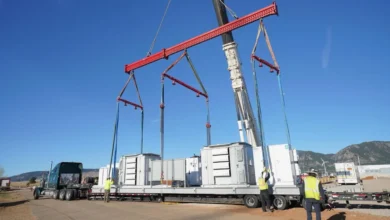
The second change repositions the heavy power conditioning and backup infrastructure out of the data hall and into modular enclosures situated adjacent to the facility’s main electrical substation. Under this model, the main building houses exclusively compute servers and the specialized thermal management systems required to keep them operational, dramatically improving physical space utilization.
The third change implements an inline architecture. Instead of deploying standby batteries that passively monitor conditions and react after a fault occurs, modern medium-voltage systems place energy storage directly in the primary power path. Every electron consumed by the facility runs through the system continuously. Because the power is never routed around the conditioning equipment, there is no latency associated with detection or switching; transients are neutralized instantly, and load swings are smoothed before they can impact the broader transmission grid.
Operational and Economic Implications
Adopting a medium-voltage inline architecture transforms the operational relationship between hyperscale data centers and local utility providers. When thousands of high-performance GPUs initiate training runs simultaneously, the medium-voltage system absorbs the electrical surge internally and presents the utility grid with a flat, highly predictable load profile. Conversely, when external grid disturbances occur, the facility’s internal operations remain completely insulated from the voltage drop.
This architectural shift also streamlines the complex interconnection and permitting process that currently delays critical infrastructure deployment. Rather than requiring utility engineers to individually evaluate and certify hundreds of disparate transformers, low-voltage UPS units, chillers, and switchgear assemblies within a facility, utilities can certify a single, standardized medium-voltage enclosure. This simplification allows data center operators to upgrade chip generations and expand compute capacity without triggering lengthy, repetitive interconnection studies, potentially shaving months off municipal permitting timelines.
Furthermore, the economic profile of backup power undergoes a fundamental reversal. Equipment that operates at medium voltage, is housed externally, and incorporates scalable energy storage can qualify for various federal and state clean energy tax credits. More importantly, these systems can actively participate in grid services markets, including peak shaving, frequency regulation, and demand response programs. Backup power transitions from a passive capital expense insurance policy into a revenue-generating grid asset.
Rigorous Validation and Industry Testing
To prove the efficacy of medium-voltage inline architectures under extreme operational stress, full-scale system prototypes underwent rigorous validation testing. In early 2026, engineers conducted comprehensive evaluations at the National Laboratory of the Rockies, a premier U.S. Department of Energy research facility recognized as the only institution in the Western Hemisphere capable of simultaneously replicating realistic, high-amplitude AI load swings and severe grid faults within a closed-loop testing environment.
During the evaluation, test engineers subjected the medium-voltage system to extreme dual-sided stress: aggressive, real-world AI load profiles were applied to the compute side at full medium-voltage capacity, while simultaneous grid-side disturbances—including complete zero-voltage fault events—were introduced from the utility side.
The results demonstrated that the advanced architecture successfully isolated both systems. The compute hardware experienced zero operational interruption, while the utility interface seamlessly absorbed the shock. Moreover, the system easily surpassed the stringent large-load voltage ride-through compliance mandates established by regional transmission organizations such as the Electric Reliability Council of Texas (ERCOT). As grid operators increasingly enforce strict technical standards for large industrial interconnections, inline medium-voltage systems provide out-of-the-box regulatory compliance.
Broader Industry Outlook and Future Infrastructure
As the artificial intelligence industry enters its next phase of rapid expansion, the structural challenges facing electrical grids cannot be resolved by generation capacity alone. A significant portion of what appears to be a generation shortfall is actually an architectural inefficiency residing inside the facility fence, driven by legacy equipment designed for an outdated industrial paradigm.
By elevating power protection to medium voltage, relocating infrastructure outside the main data halls, and integrating storage directly into the continuous power path, data center operators can convert potential grid liabilities into valuable grid assets. This engineering transition increases physical power density, accelerates permitting schedules, and transforms backup power systems into economic contributors.
Industry stakeholders note that as multi-gigawatt AI campuses continue to break ground globally, the choice of foundational electrical architecture will determine whether these massive facilities strain local electrical grids to their breaking point or reinforce them against future instability.