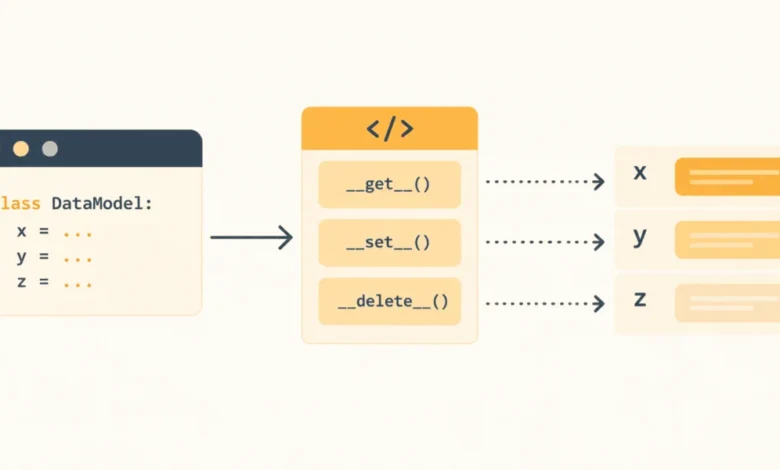
Python descriptors represent one of the most powerful yet often overlooked features of the language’s data model. At their core, descriptors are objects that define how attribute access, assignment, and deletion are handled within a class. By implementing specific methods such as __get__, __set__, and __delete__, developers can create sophisticated, reusable logic for class attributes, effectively moving beyond the limitations of standard getters and setters. This article explores the architecture of descriptors and demonstrates how they can be used to implement validated, computed, and lazily loaded attributes in a professional development environment.
The Mechanism of the Descriptor Protocol
The Python data model relies on a protocol that governs object interactions. When an attribute is accessed, the interpreter checks for the existence of descriptor methods. If a class defines __get__, __set__, or __delete__, it becomes a descriptor. Since Python 3.6, the __set_name__ method has become a critical addition to this protocol. It allows the descriptor to recognize the variable name it is assigned to within the owner class, facilitating clean storage in the object’s __dict__ and preventing naming collisions.
The transition from simple property decorators to descriptors is a significant milestone for developers working on large-scale systems. While decorators like @property are effective for single-instance attribute control, they often lead to "boilerplate bloat" when applied across multiple attributes in a complex model. Descriptors, by contrast, encapsulate logic into reusable classes that can be applied to any number of attributes, ensuring consistency across an entire codebase.
Chronology and Evolution of Attribute Management
In the early years of Python, attribute access was relatively transparent. As the language matured, the need for data integrity led to the introduction of properties. However, as applications grew, the complexity of managing state-dependent attributes increased. The industry shifted toward more modular approaches, where data validation and computation were separated from the primary business logic of the class.
This evolution mirrors the broader trend in software engineering: the move from monolithic classes to composition-based architectures. By offloading logic to descriptors, developers maintain a "clean" class interface, where the business logic remains focused on the domain model rather than the plumbing of attribute validation or caching mechanisms.
Implementing Validated Attributes for Data Integrity
Data integrity is the cornerstone of any reliable software system. In scenarios such as financial modeling or e-commerce, ensuring that an attribute—such as a rating or a price—falls within a specific range is non-negotiable. Using a custom descriptor, a developer can enforce these constraints globally.
Consider a system designed to handle user feedback. Rather than writing manual if-else validation checks within every setter method, one can define a ValidatedRating descriptor. This class handles the type checking (ensuring the input is an integer or float) and the range checking (ensuring the value remains between 1.0 and 5.0). If an invalid assignment is attempted, the descriptor raises a ValueError or TypeError immediately, preventing the application state from becoming corrupted. This centralized validation approach ensures that error handling is consistent, testable, and maintainable across the entire software ecosystem.
Computed Attributes and Real-Time Data Processing
Computed attributes provide a mechanism to derive information dynamically. In many enterprise applications, the base data is stored in one format, while the user interface or external APIs require another. The ComputedUSDPrice descriptor illustrates this: while the internal database stores prices in Japanese Yen (JPY), the application must display these values in US Dollars (USD).
By implementing a __get__ method that performs the conversion, the descriptor acts as a bridge between the stored data and the requested output. Because the conversion logic resides within the descriptor, it is automatically recalculated every time the attribute is accessed. This ensures that the displayed price is always accurate, even if the exchange rate or the base JPY price changes during the object’s lifecycle. This pattern is particularly useful in financial reporting tools and real-time dashboarding systems where data accuracy is paramount.
Optimization through Lazily Loaded Attributes
One of the most significant performance bottlenecks in modern Python applications is the unnecessary retrieval of heavy data. Often, an object may contain an "itinerary" or a "report" that requires an expensive database query or an API call to generate. If the user never requests that information, the resources spent generating it are wasted.
A "Lazy Loader" descriptor solves this by deferring the computation until the exact moment of access. Upon the first request for the attribute, the descriptor executes the expensive function, caches the result in the object’s __dict__, and returns the value. On subsequent accesses, the descriptor detects that the value is already present in the dictionary and returns it instantly, bypassing the expensive computation entirely. This "lazy" strategy is a fundamental optimization technique for high-performance applications, effectively reducing memory usage and CPU load by ensuring that heavy tasks are only performed when strictly necessary.
Broader Implications and Industry Impact
The adoption of descriptors represents a shift toward more "Pythonic" design patterns. Industry experts argue that while descriptors have a steeper learning curve than standard methods, their long-term impact on code maintainability is profound. By abstracting the logic of attribute access, developers create codebases that are easier to debug, refactor, and extend.
Furthermore, many popular Python frameworks—including Django and SQLAlchemy—rely heavily on descriptors to map database tables to Python objects. Understanding these underlying mechanisms provides developers with a deeper insight into how their tools function, allowing them to troubleshoot complex issues that might otherwise appear as "magic."
Analysis: When to Use Descriptors
While descriptors offer significant power, they should be used judiciously. Over-engineering a simple class with complex descriptors can lead to unnecessary abstraction, making the code harder for newcomers to follow. The ideal use case for a descriptor is when logic needs to be reused across multiple classes or attributes. If a specific validation rule or caching mechanism is needed only once, a standard property or a simple method is usually sufficient.
However, for developers building SDKs, large-scale data processing engines, or complex domain models, descriptors are an indispensable tool. They provide a structural guarantee that consistency will be maintained regardless of how many developers interact with the data model.
Conclusion
The Python descriptor protocol remains a testament to the language’s flexibility and depth. By mastering the ability to intercept and control attribute access, developers can move beyond simple data containers and build intelligent objects that handle their own validation, computation, and optimization. Whether it is enforcing strict data ranges, performing real-time currency conversions, or implementing memory-efficient lazy loading, descriptors provide the tools necessary to build the next generation of robust, professional-grade Python software. As the ecosystem continues to grow, the ability to leverage these advanced features will distinguish the most efficient and scalable architectures in the field.