Linux 7.1 Introduces Major In-Kernel NTFS Driver Rework, Promising Seamless Windows Filesystem Integration and Performance Boost

The forthcoming Linux kernel 7.1 is set to usher in what many anticipate will be the most significant, albeit subtly introduced, storage infrastructure change in years: the integration of a brand-new in-kernel NTFS driver. This development marks a pivotal shift, finally elevating Microsoft’s widely used New Technology File System (NTFS) from a somewhat tolerated foreign entity to a natively supported and high-performing component within the Linux ecosystem. For decades, Linux users navigating mixed environments have contended with suboptimal solutions, ranging from slow Filesystem in Userspace (FUSE) drivers to intermittently maintained kernel modules. The new driver promises to deliver robust, high-speed, and fully integrated NTFS support directly out of the box, fundamentally altering cross-platform data management for millions.
The core of this transformative update lies in a complete architectural overhaul of NTFS support, meticulously engineered to reside directly within the Linux kernel. This approach diverges significantly from its predecessors, particularly the widely adopted NTFS-3G driver. NTFS-3G, while highly functional and reliable for many years, operates in userspace, leveraging the FUSE module. This design inherently introduces overhead due to context switching between kernel and userspace, limiting its ultimate performance potential, especially under heavy I/O loads. Another kernel-based driver, NTFS3, developed by Paragon Software and introduced in Linux 5.15, offered improved performance but faced challenges with consistent maintenance and integration, leaving many users without a truly optimized and perpetually updated solution. The new driver, by contrast, is a ground-up implementation, explicitly designed to align with modern Linux filesystem infrastructure from its inception.
The Historical Struggle for Seamless NTFS Integration
To fully appreciate the gravity of this update, it is crucial to understand the long and often challenging history of NTFS support within Linux. NTFS was introduced by Microsoft in the early 1990s as a successor to FAT, offering significant advancements in terms of security, journaling, file size limits, and robust data integrity features. As Windows became the dominant desktop operating system, NTFS became the de facto standard for disk formatting, making interoperability a critical concern for any alternative operating system, including Linux.
Early Linux distributions offered only rudimentary, often read-only, support for NTFS partitions. The complexity of the proprietary filesystem, coupled with Microsoft’s initial reluctance to share specifications, made full read-write implementation a daunting task. This led to the emergence of community-driven projects.
The most prominent of these was NTFS-3G, developed by Szabolcs Szakacsits and others. Released in 2006, NTFS-3G quickly became the standard for NTFS read-write access on Linux. Its FUSE-based architecture allowed it to run safely in userspace, preventing kernel panics from potential bugs in a complex, reverse-engineered driver. This design decision was a pragmatic one, prioritizing stability and safety over raw performance. While NTFS-3G provided essential functionality, allowing users to read and write to Windows partitions, its performance was often a bottleneck. Operations involving large files or numerous small files, particularly during concurrent access, could lead to noticeable slowdowns and higher CPU utilization compared to native Linux filesystems like Ext4 or XFS. The constant context switching between the kernel and the userspace FUSE module was the primary culprit, limiting throughput and increasing latency.
In a significant development in 2021, Paragon Software, a company known for its cross-platform data management solutions, contributed an in-kernel NTFS driver (NTFS3) to the Linux kernel, starting with version 5.15. This driver promised a substantial performance leap over NTFS-3G by operating directly within the kernel, eliminating the FUSE overhead. Initial benchmarks confirmed its superior speed and efficiency. However, despite its technical merits, the NTFS3 driver faced an uncertain future. Concerns arose regarding its maintenance model, particularly after the initial merge, leading to a perception that it was not receiving the consistent attention required for a core kernel component. This lack of ongoing development and bug fixing prevented it from becoming the definitive, universally adopted solution that many had hoped for.
The Resurrection: A New Era with Linux 7.1
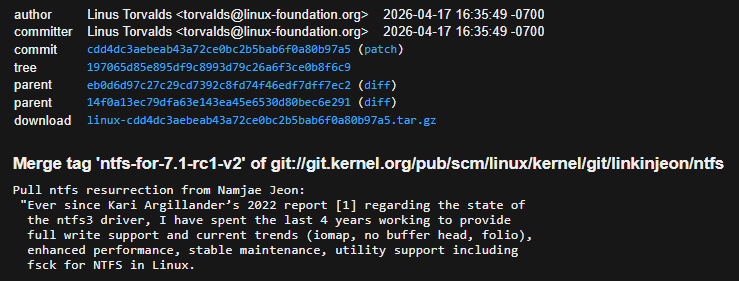
The new driver integrated into Linux 7.1 represents a definitive commitment by the kernel developers to provide first-class NTFS support. Spearheaded by developer Namjae Jeon, this implementation is not merely an incremental update but a complete "resurrection," as described by Linus Torvalds himself during the merge process. Torvalds’ comment underscores the significance of Jeon’s work, acknowledging the long-standing need for a robust and well-maintained in-kernel solution.
The design philosophy behind Jeon’s driver centers on modern Linux filesystem infrastructure. This includes leveraging mechanisms like iomap for highly efficient block mapping and integrating seamlessly with the Virtual File System (VFS) layer. iomap allows for direct I/O and optimized memory handling, reducing data copies and improving cache utilization, which are critical for high-performance storage operations. By building the driver from the ground up with these contemporary kernel facilities, the new NTFS implementation is poised to offer performance and stability that previous drivers could not match.
The integration process for the new driver has been meticulous. It underwent rigorous review and testing within the kernel development community, reflecting the high standards expected for any new core component. The merge into git.kernel.org and its subsequent inclusion in the 7.1 release cycle indicate a strong endorsement from the maintainers and a belief in its long-term viability and performance.
Unprecedented Performance and Reliability
The most anticipated benefit of the new in-kernel NTFS driver is a dramatic improvement in performance. The inherent advantage of operating in kernel space, rather than userspace via FUSE, immediately eliminates a substantial amount of overhead. Context switching, which occurs every time data needs to pass between the kernel and the userspace driver, is a significant performance drain. By residing directly within the kernel, the new driver can access hardware resources more efficiently and process I/O requests with far less latency.
Preliminary performance metrics shared by the developer are highly encouraging. Single-threaded write operations are reportedly 3-5% faster than with the NTFS3 driver, a respectable gain. However, the most impressive improvements are observed in multi-threaded write scenarios, where the new driver achieves between 35% and a staggering 110% faster performance. This exponential leap in multi-threaded capabilities is crucial for modern applications, particularly those involving large data transfers, virtualization, or concurrent access by multiple processes. Furthermore, mounting a substantial 4TB NTFS drive is said to be four times faster, a quality-of-life improvement that will be immediately noticeable for users dealing with large external or dual-boot drives.
These performance gains are not merely theoretical; they are a direct consequence of the architectural choices. The adoption of iomap and optimized memory handling directly contributes to more consistent throughput under load and lower CPU overhead during intensive file operations. This means not only faster data transfers but also a more responsive system overall, as the CPU can dedicate fewer cycles to managing filesystem interactions.
Beyond raw speed, the new driver also demonstrates superior reliability and compatibility. It successfully passes 326 xfstests, a comprehensive suite of filesystem tests designed to validate the correctness and robustness of filesystem implementations. This significantly outperforms the NTFS3 driver, which passed 273 xfstests. The higher number of passing tests indicates a more mature and resilient driver, capable of handling a broader range of filesystem operations and edge cases with greater stability. While the driver is new, this extensive testing provides a strong foundation for user confidence.
Implications and Future Outlook
The introduction of this robust in-kernel NTFS driver in Linux 7.1 carries profound implications across various user segments and use cases.
For dual-boot users, particularly those who frequently switch between Windows and Linux, this driver is a game-changer. Accessing Windows partitions (often formatted as NTFS) will become as seamless and performant as accessing native Linux filesystems. This eliminates a long-standing point of friction, making the dual-boot experience far more integrated and efficient. Users will no longer need to worry about slow file transfers or potential data corruption when moving files between their operating systems.
In professional and enterprise environments, where mixed operating systems are common, the benefits are equally substantial. Businesses utilizing Linux servers to interact with Windows-based network attached storage (NAS) or shared drives will experience improved performance and reliability. Data migration, backup operations, and cross-platform development workflows will all be streamlined. Media production houses, scientific research facilities, and engineering firms often rely on large datasets and high-speed I/O; for them, enhanced NTFS performance on Linux could significantly boost productivity.
Gaming on Linux, an increasingly popular pursuit, could also see indirect benefits. While most games are ideally installed on native Linux filesystems for optimal performance, some users might have games or large asset libraries on NTFS partitions. The new driver could improve load times and overall responsiveness in such scenarios, although it’s unlikely to fully bridge the performance gap with native filesystems.
Despite the significant advancements, it is important to acknowledge that the driver is new code, and like any nascent technology, it may encounter unforeseen edge cases. Less commonly used NTFS features, such as advanced Access Control List (ACL) permissions, compression, encryption, or specific journaling quirks, may take time to fully stabilize and achieve perfect compatibility. The kernel development community’s commitment to ongoing maintenance will be crucial in addressing these as they emerge.
Moreover, while compatibility is vastly improved, NTFS itself remains a filesystem designed around Windows semantics. It will not suddenly behave exactly like ext4 or XFS in every single case, especially concerning file permissions, symbolic links, or certain metadata handling. However, the goal is not to transform NTFS into a Linux-native filesystem but to enable Linux to interact with it in the most efficient and reliable way possible.
The long-term success of this new NTFS driver hinges on consistent maintenance and community involvement. The history of NTFS support on Linux is replete with "almost there" solutions that eventually faltered due to a lack of sustained development. With the new driver’s strong initial integration and positive reception from core kernel developers, there is optimism that it will receive the necessary attention to evolve and mature into a truly indispensable component of the Linux kernel.
In conclusion, Linux 7.1’s new in-kernel NTFS driver marks a monumental leap forward for cross-platform interoperability. By offering native, high-performance, and reliable access to NTFS partitions, it finally addresses a decades-old friction point between the Linux and Windows ecosystems. This development not only enhances the user experience for dual-booters but also provides critical infrastructure for professional environments and solidifies Linux’s position as a truly versatile and capable operating system for a wide array of computing tasks. The "tolerated guest" era for NTFS on Linux is drawing to a close, replaced by a vision of seamless integration and robust performance, promising a future where data fluidity between these two dominant operating systems is no longer a luxury, but a standard.