Google has officially announced the rollout of its newest frontier artificial intelligence model, Gemini 4 Argon, designed to push the boundaries of deep reasoning, software engineering, enterprise knowledge work, and defensive cybersecurity. The model is currently making its debut through a controlled, phased deployment, beginning with trusted cyber defenders via the Fairwind Program. This measured approach aligns with the U.S. government’s voluntary pre-release safety framework, reflecting the tech industry’s growing caution regarding the deployment of highly capable autonomous systems.

As artificial intelligence systems transition from simple text generators to autonomous agents capable of multi-step reasoning, the introduction of Gemini 4 Argon marks a significant milestone. Built to sustain deep, long-horizon workflows without losing context or intent, Argon is already transforming internal engineering and research processes at Google. The company plans to scale public access in the near future, starting with paid API customers and Google AI Ultra subscribers, while using initial testing phases to refine guardrails and security protocols.
Unprecedented Scale and Technical Architecture
At the core of Gemini 4 Argon’s architectural improvements is a massive expansion in its output token limit. While previous frontier iterations operated within a 64,000-token threshold, Argon introduces an industry-leading 1M token output capacity. This expanded cognitive headroom allows the model to process complex, multi-layered problems across a single unbroken trajectory, executing large-scale tasks that previously required fragmented prompts and manual oversight.

To support widespread developer and enterprise adoption, Google has priced Gemini 4 Argon competitively during its introductory phase. The model will cost $2 per million input tokens and $10 per million output tokens. Furthermore, to incentivize high-efficiency usage in enterprise and coding pipelines, cached input tokens will receive a 95% discount off the standard input rate. This economic structure is expected to lower the barrier to entry for businesses looking to integrate deep-reasoning agents into their everyday tech stacks.
Transforming Enterprise Workflows and Software Engineering
Gemini 4 Argon’s ability to sustain multi-step tasks makes it uniquely suited for complex professional environments, ranging from advanced software development to legal, financial, and tax operations. Internal testing at Google revealed that thousands of engineers are already utilizing the model for tasks such as automated codebase migrations, sophisticated algorithmic design, and rigorous debugging.

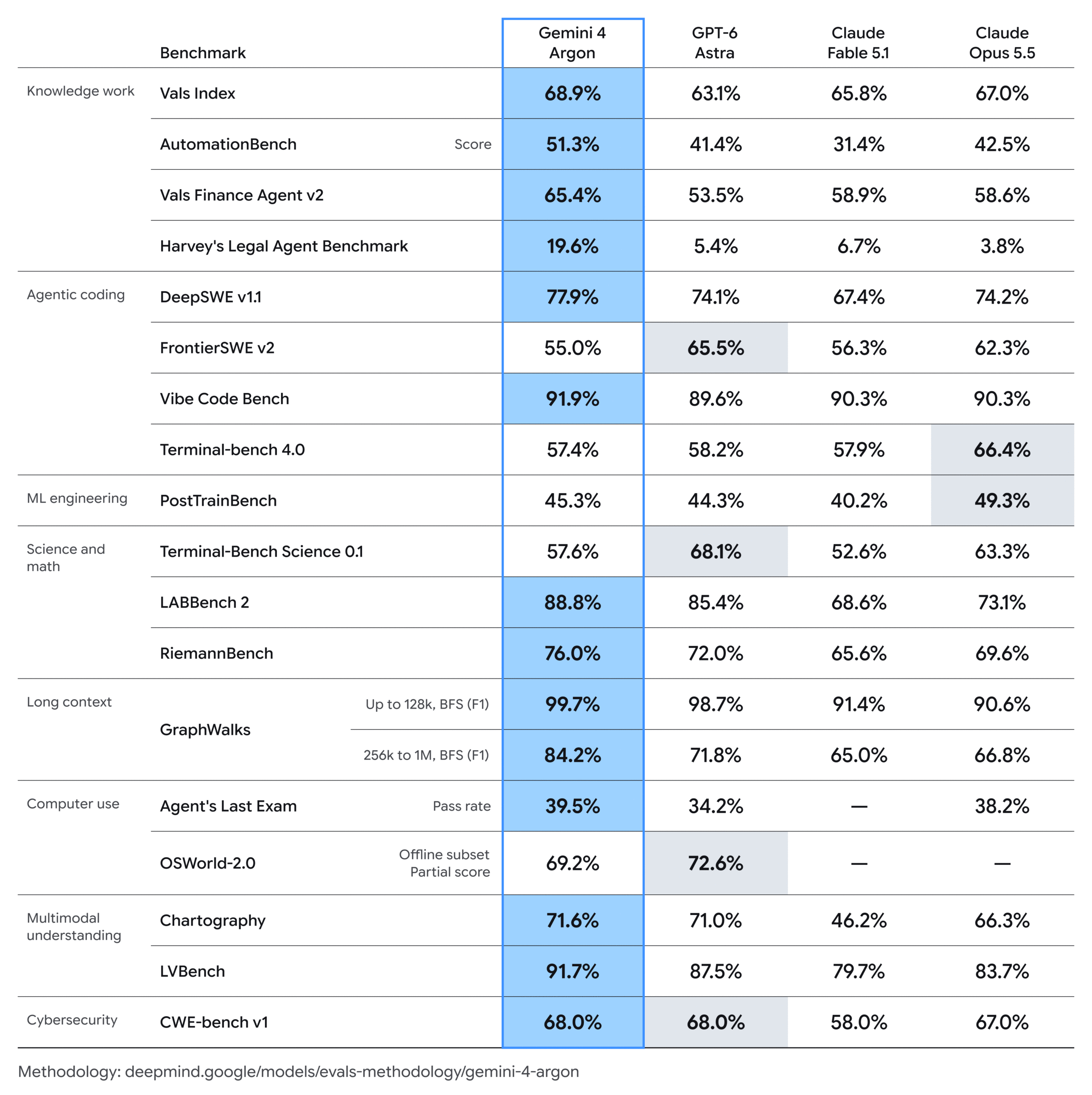
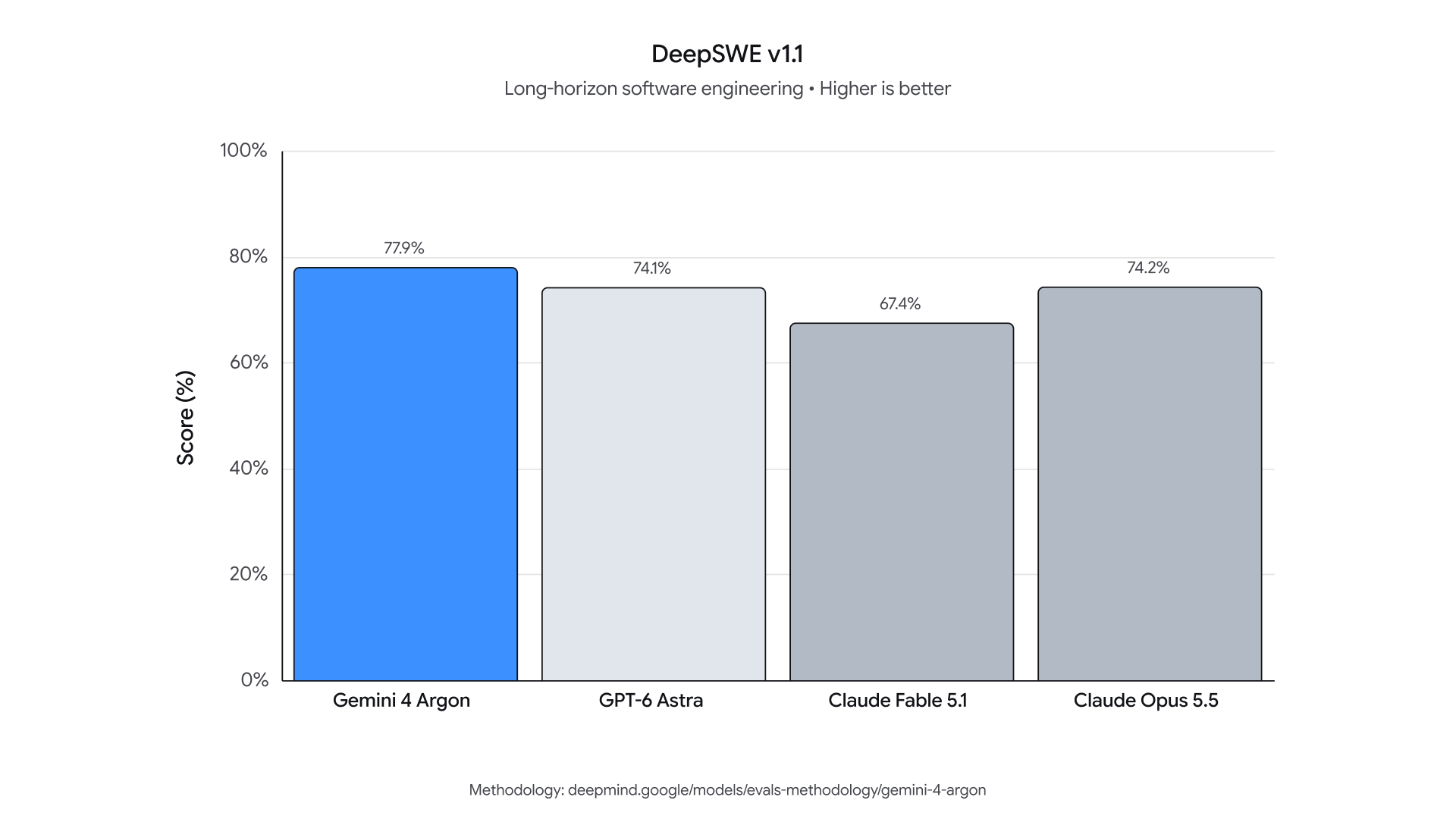
In official benchmark evaluations, Argon has demonstrated state-of-the-art performance. On DeepSWE v1.1, a benchmark measuring real-world, long-horizon software engineering capabilities, Argon achieved a leading score of 77.9%. Additionally, it secured the top position on the Vals Index—a metric that weighs economic impact across coding, legal, tax, and financial sectors according to their contribution to the U.S. Gross Domestic Product. Specialized domain evaluations also highlight its dominance, including top-tier placements on the Vals Finance Agent v2 for multi-step financial research, Harvey’s Legal Agent Benchmark for legal drafting, and AutomationBench, where it captured the number one spot with a 51.3% score in end-to-end business automation.
Visual and multimodal comprehension represent another major leap forward for the architecture. Argon excels at professional chart analysis, long-form video comprehension, and cross-document correlation. Notably, the model achieved a state-of-the-art score of 91.7% on LVBench, which measures long video understanding, proving its utility in domains requiring the synthesis of vast, unstructured visual data.
Pioneering Defensive Cybersecurity
One of the most consequential aspects of the Gemini 4 Argon release is its advanced capability in defensive cybersecurity. Trained specifically to autonomously discover, validate, and patch critical software vulnerabilities, Argon represents a powerful tool for modern security teams navigating an increasingly volatile digital landscape.
For trusted defenders and Google’s internal red teams, the company is making Argon available without standard cyber guardrails, permitting its full spectrum of defensive capabilities to be deployed against real-world threats. Early partnerships have already yielded remarkable results. Cybersecurity firm Wiz has integrated Argon into its "Scan for Good" initiative—a public program dedicated to finding and remediating high-risk exposures in critical public infrastructure for free. In an early diagnostic test, Argon uncovered a severe vulnerability exposing sensitive personal information in hospital software used globally, identifying a high-risk exposure that previous frontier models had completely overlooked.

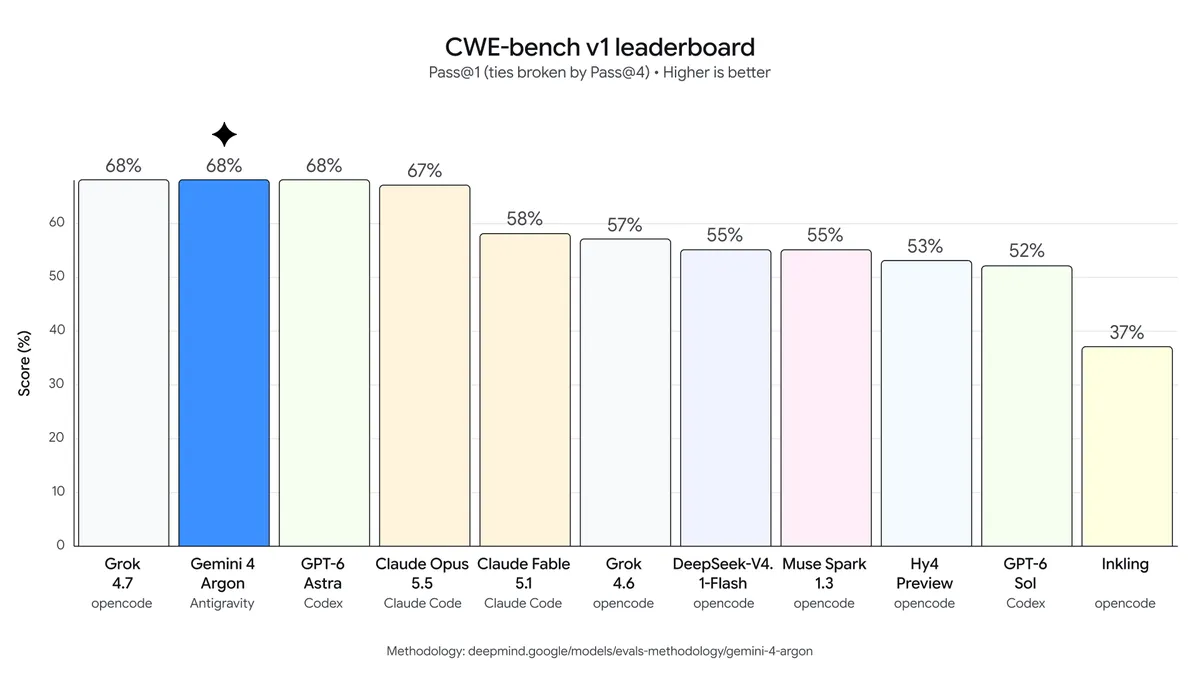
Furthermore, on CWE-bench v1, which evaluates an AI system’s ability to remediate security flaws, Argon tied for first place with a benchmark score of 68%. This performance builds directly upon the groundwork laid by earlier models like 3.8 Flash Cyber, cementing Google’s commitment to equipping defenders with automated tools that can outpace sophisticated cyber threats.
Rigorous Safeguards and Frontier Safety Frameworks
The deployment of frontier models capable of autonomous software engineering and vulnerability patching naturally invites scrutiny regarding potential misuse. To mitigate these risks, Google has instituted a comprehensive safety framework divided into four foundational pillars: preventing misuse, defending against prompt injection, monitoring for misalignment, and hardening technical environments.

To prevent malicious actors from leveraging the model for cyberattacks or CBRN (chemical, biological, radiological, and nuclear) threats, Argon is hardcoded to reject harmful prompts while preserving legitimate dual-use scientific research. Google subjected the model to extensive manual and automated red teaming, employing advanced techniques like internal activation monitoring to detect unauthorized intent.
Against indirect prompt injection (IPI) attacks—where malicious actors embed hidden instructions within external data to hijack model behavior—Argon has emerged as an industry leader. Through adversarial training and rigorous automated testing, the model secured top performance on Gray Swan’s IPI benchmark.

To address the abstract risk of model misalignment—where an AI might pursue a user’s goal through unintended or dangerous side channels—Google deployed monitoring systems that evaluate the model’s internal chain-of-thought in real time. These monitors can halt execution instantly if anomalous behaviors are detected. Google researchers have publicly urged the broader artificial intelligence industry to preserve reasoning transparency during training runs, arguing that visibility into an AI’s cognitive steps is vital for identifying and correcting alignment drift before it manifests in production.
Finally, Google has updated its agent control roadmap by hardening the sandboxed environments where high-risk training and evaluations take place. By completely isolating these testing grounds prior to execution, the company aims to establish robust security baselines that can be shared across the wider tech ecosystem.

Implications and Broader Industry Outlook
The arrival of Gemini 4 Argon signals a broader paradigm shift in the artificial intelligence industry, moving away from simple conversational assistants toward deeply autonomous, long-horizon reasoning agents. By expanding output limits to one million tokens and coupling this capacity with specialized domains in coding, finance, and cybersecurity, Google is effectively commercializing cognitive labor at an unprecedented scale.
However, the phased rollout underscores a maturing industry. As AI models become capable of tasks traditionally reserved for senior software engineers and elite security analysts, the traditional model of immediate, open-access deployment is giving way to tightly regulated, security-first distribution channels. The success of programs like the Fairwind Program and Wiz’s Scan for Good will likely serve as a blueprint for how future frontier models are vetted, regulated, and safely integrated into the global economy.
As Google transitions Argon from trusted testing cohorts to broader availability for developers, enterprises, and Google AI Ultra subscribers, the market will closely observe how effectively these advanced safeguards hold up under widespread, commercial pressure. If Gemini 4 Argon delivers on its benchmark promises without compromising systemic security, it could fundamentally redefine productivity standards across the global enterprise landscape.