Iran-Linked Hacktivist Group Handala Claims Massive Data-Wiping Attack on Global Medical Tech Giant Stryker Following US Missile Strike

Stryker Corporation, a premier global medical technology firm based in Kalamazoo, Michigan, is currently grappling with a catastrophic cybersecurity breach that has reportedly paralyzed its international operations. The attack, characterized by a massive data-wiping campaign, has been claimed by Handala, a hacktivist group with documented ties to the Iranian government’s intelligence apparatus. According to statements released by the group and corroborated by reports from Stryker’s international hubs, the incident has forced the company to shutter offices in dozens of countries, sent thousands of employees home, and disrupted critical healthcare supply chains and emergency medical services across the United States and Europe.
The scale of the disruption is unprecedented for a medical device manufacturer of Stryker’s size. As of Wednesday, callers to the company’s main headquarters in Michigan were met with a recorded voicemail stating that the facility was experiencing a "building emergency." Meanwhile, in Ireland—Stryker’s largest operational base outside of the United States—the company reportedly sent home more than 5,000 workers after internal systems became unresponsive. The attack appears to have targeted not only traditional servers and workstations but also mobile devices and cloud-integrated infrastructure, effectively severing the company’s ability to conduct business or coordinate medical logistics.
The Perpetrator: Handala and the Void Manticore Connection
The group claiming responsibility, Handala (also known as the Handala Hack Team), has emerged as a significant threat actor in the geopolitical cyber landscape. Cybersecurity researchers at Palo Alto Networks’ Unit 42 have recently profiled the group, identifying it as a persona maintained by "Void Manticore," an actor affiliated with Iran’s Ministry of Intelligence and Security (MOIS). While Handala historically focused its "hack-and-leak" operations on Israeli targets, its recent pivot toward a major U.S.-based medical technology firm marks a significant escalation in its operational scope.
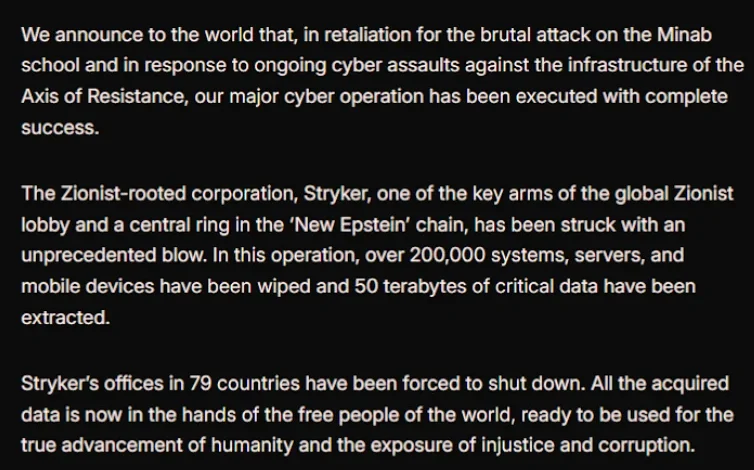
In a lengthy manifesto posted to the encrypted messaging platform Telegram, Handala claimed to have infiltrated Stryker’s global network, erases data from more than 200,000 systems, and seized control of servers across 79 countries. The group’s statement was laden with ideological rhetoric, describing the data-wiping as an act of "justice" and labeling Stryker a "Zionist-rooted corporation." This label likely stems from Stryker’s 2019 acquisition of OrthoSpace, an Israeli medical technology firm, which has seemingly placed the company in the crosshairs of Iranian state-sponsored actors seeking to strike at interests perceived as being aligned with Israel or the United States.
Geopolitical Motivations: Retaliation for the February 28 Strike
The timing and motivation of the attack are explicitly linked to recent kinetic military actions. Handala stated that the wiper attack was a direct retaliation for a February 28 missile strike that hit a school in Iran, resulting in the deaths of at least 175 people, many of whom were children. While the origins of that strike were initially shrouded in mystery, a report published by The New York Times on March 11 revealed that a military investigation determined the United States was responsible for the Tomahawk missile strike.
This cyberattack represents a textbook example of "asymmetric warfare," where a nation-state or its proxies respond to physical military strikes with digital sabotage. By targeting a critical node in the global healthcare supply chain, the attackers have moved beyond mere data theft, seeking instead to cause tangible operational paralysis that affects civilian infrastructure far beyond the borders of the Middle East.
Technical Execution: The Abuse of Microsoft Intune
Unlike typical ransomware attacks, where data is encrypted in hopes of a payout, a "wiper" attack is purely destructive. The goal is to render systems unbootable and data unrecoverable. Preliminary reports and insights from cybersecurity experts suggest that the attackers utilized a sophisticated method to achieve this at scale.
A source familiar with the incident, speaking on the condition of anonymity, indicated that the perpetrators likely gained administrative access to Stryker’s Microsoft Intune environment. Intune is a cloud-based endpoint management solution used by IT departments to manage mobile devices and laptops, enforce security policies, and—critically—remotely wipe lost or stolen devices. By hijacking this "master key," the attackers were able to issue a remote wipe command to every device connected to the corporate network.
This methodology explains why employees in Ireland reported that personal phones containing the Microsoft Outlook app were suddenly wiped clean. On Reddit and other community forums, individuals identifying as Stryker employees described a chaotic scene where laptops and mobile devices began resetting to factory settings simultaneously, displaying the Handala logo on the login screens before becoming unusable. This "quick and dirty" approach allowed the attackers to bypass individual system defenses and strike the entire global fleet of devices from a single centralized console.
Impact on Global Operations and the Irish Hub
Stryker is a titan in the medical technology sector, reporting approximately $25 billion in global sales last year and employing 56,000 people across 61 countries. The disruption of its Irish operations is particularly significant. Ireland serves as a critical manufacturing and R&D hub for the company, with multiple facilities located in Cork.
Reports from the Irish Examiner indicate that the Cork facilities have been effectively "shut down." With internal networks dark, employees have been forced to use third-party messaging apps like WhatsApp to receive updates from management. The loss of access to Microsoft Outlook and internal databases has halted production lines and administrative functions, raising concerns about the long-term impact on the regional economy and the company’s ability to fulfill global orders for surgical instruments and orthopedic implants.
Healthcare Supply Chain and Patient Care Disruptions
The most alarming aspect of the Stryker breach is its immediate impact on the healthcare delivery system. Stryker is a primary supplier of surgical equipment, including robotic-arm assisted surgery systems, joint replacement implants, and emergency medical response tools.
A healthcare professional at a major U.S. university medical system told investigators that the outage has already hindered their ability to order essential surgical supplies. Because Stryker’s ordering portals are offline, hospitals that rely on "just-in-time" inventory management are facing potential shortages. "This is a real-world supply chain attack," the professional noted. "Pretty much every hospital in the U.S. that performs surgeries uses their supplies."
Furthermore, the attack has compromised critical life-saving technology. A memo from the Maryland Institute for Emergency Medical Services Systems (MIEMSS) alerted paramedics that Stryker’s LIFENET system is currently experiencing a "global network disruption." LIFENET is a cloud-based platform that allows emergency medical technicians (EMTs) and paramedics to transmit EKG data from the field directly to hospital emergency rooms. This allows doctors to prepare for heart attack patients before they even arrive, significantly improving survival rates for "STEMI" (ST-Elevation Myocardial Infarction) patients.
In response to the breach, several hospitals have proactively disconnected from Stryker’s services to prevent the potential spread of malware into their own networks. While medical protocols have reverted to radio consultations to describe EKG findings, the loss of high-fidelity data transmission represents a regression in emergency care capabilities.
Official Responses and Industry Analysis
John Riggi, the national advisor for cybersecurity and risk for the American Hospital Association (AHA), confirmed that the organization is monitoring the situation closely. While the AHA has not yet seen widespread reports of "direct impacts" on hospital operations, Riggi cautioned that the situation remains fluid. "That may change as hospitals evaluate services, technology, and supply chain related to Stryker and if the duration of the attack extends," he stated.
Stryker itself has remained largely silent, providing no formal statement to the press beyond the "building emergency" voicemail at its headquarters. This lack of transparency is common in the early stages of a massive cyber event, as legal and forensic teams work to determine the full extent of the damage. However, the pressure on the company to provide a timeline for recovery is mounting, especially from healthcare providers who depend on their products for daily surgical schedules.
Cybersecurity analysts view this attack as a harbinger of a new era of state-sponsored cyber activity. For years, the primary threat to corporations was ransomware from criminal syndicates. However, the rise of "hacktivist" personas like Handala—which serve as fronts for national intelligence agencies—introduces a more volatile element. These actors are not motivated by profit but by political messaging and strategic damage.
The use of supply-chain footholds and administrative tools like Microsoft Intune highlights a critical vulnerability in modern corporate infrastructure. As companies centralize control of their digital assets to improve efficiency, they inadvertently create a single point of failure that can be exploited to catastrophic effect.
Conclusion and Future Outlook
The attack on Stryker Corporation serves as a stark reminder of the interconnectedness of global geopolitics, cybersecurity, and public health. What began as a military strike in the Middle East has manifested as a digital crisis in the American Midwest and the industrial centers of Ireland, ultimately threatening the stability of surgical wards and emergency rooms.
As Stryker begins the arduous process of rebuilding its digital infrastructure and restoring its 200,000 compromised systems, the broader medical community must now confront the reality of its dependence on a handful of global suppliers. The incident will likely prompt a rigorous review of how medical device manufacturers protect their "crown jewel" administrative systems and how hospitals can build more resilient supply chains that can withstand the fallout of the world’s ongoing cyber conflicts. For now, the "building emergency" at Stryker remains a global emergency for the healthcare industry.
Related posts: