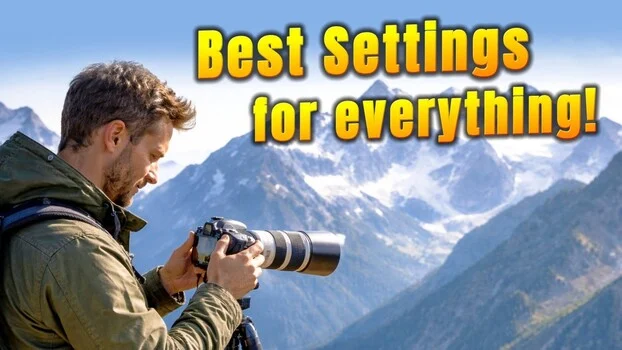
Andrew Banner’s latest video dissects a pervasive misconception within the photography community, asserting that true photographic skill transcends the mere mastery of camera settings, pivoting instead to the cultivation of observational prowess and compositional acumen. The critique, delivered with characteristic directness from Banner’s YouTube channel, targets the prevalent tendency among aspiring photographers to seek definitive "best settings" for specific scenarios, arguing that such inquiries fundamentally misunderstand the art and practice of image-making. Banner’s central thesis posits that the ability to anticipate and frame a compelling visual narrative is an innate skill, independent of technical camera configurations.
The Illusion of "Best Settings"
The genesis of Banner’s argument lies in a common frustration echoed across online photography forums and social media groups: the incessant search for universal "best settings." Whether for landscape, portraiture, or action photography, users frequently pose questions like, "What are the best settings for mountain photography?" Banner unequivocally dismisses such queries as misguided, emphasizing that the efficacy of any photographic setting is entirely contextual. He illustrates this point by posing a series of critical follow-up questions: "How close are you to the mountain? What specific part of it are you focusing on? What are the prevailing light conditions?" The very act of posing these questions, Banner contends, reveals a fundamental misunderstanding of photography as a responsive art form, rather than a formulaic process.
His video, filmed on location at a coastal promenade, deliberately employs an older Nikon D60, a device chosen for its accessibility and to underscore his core message: the camera itself is secondary to the subject and the photographer’s interpretive eye. This choice serves as a practical demonstration, illustrating that compelling imagery can be achieved with even rudimentary equipment, provided the photographer possesses the requisite observational skills. Banner’s intent is not to diminish the importance of technical knowledge but to reframe its role within the broader spectrum of photographic expertise. He suggests that while understanding the exposure triangle and experimenting with fundamental controls like shutter speed and aperture can unlock approximately 90% of technical proficiency, the remaining crucial gap that separates an average photograph from a truly impactful one is not bridged by settings but by practiced observation and artistic vision.
Cultivating the Observational Eye
Banner’s core message champions the development of "seeing" as the paramount skill for photographers. He demonstrates this throughout his video by actively seeking out and capturing images that might otherwise be overlooked by the casual observer. His subjects are often subtle details, imbued with character and narrative by their context and condition: the intricate texture of a decommissioned lifeboat door, the stark geometry of a rusted light switch nestled within a decaying alcove, or the compelling contrast between weathered flint pebbles and a utilitarian steel gantry. These are not subjects that inherently demand specific, exotic camera settings.
In many of these instances, Banner opts for a pragmatic approach, allowing the camera to manage exposure primarily through aperture priority mode. This strategy frees him to concentrate on composition and the inherent visual interest of the subject. He acknowledges that camera settings do possess a critical role, but this role is always in service of a pre-conceived artistic vision. For example, he notes that the distinction between a slow and fast shutter speed is crucial for rendering moving water effectively, and that shooting with a wide aperture versus a stopped-down aperture significantly alters the background’s appearance. However, Banner stresses that these are deliberate creative choices made to realize a specific aesthetic outcome, not a series of technical checkboxes to be completed before the photographic intent is even formed. This contrasts sharply with the approach of photographers who consult online forums for "best settings" before they have even considered what they wish to convey with their image.
A Technical Reframing of Camera Settings
Beyond his philosophical stance, Banner also provides a concise and technically accurate overview of what camera settings fundamentally represent. He clarifies that ISO, for instance, does not inherently increase the sensor’s sensitivity to light. Instead, it applies a digital gain to the signal after the light has been captured, a process that can introduce noise. He identifies shutter speed, aperture, and focus as the sole camera controls that physically alter the image-making process, and notes that these fundamental principles have remained consistent for over a century.
Banner further points out that modern digital cameras have largely automated the complex technical aspects of photography. The existence of scene modes on cameras like the Nikon D60, he explains, is a testament to their ability to provide satisfactory results for a broad range of common photographic situations. His perspective is that dedicating a moderate amount of time to understanding the exposure triangle and engaging in practical experimentation will equip a photographer with the necessary technical foundation for approximately 90% of their work. The remaining disparity between an average photograph and one that resonates deeply with viewers is not a function of technical settings mastery but of consistent practice and the development of a discerning eye. This involves actively seeking out visual opportunities, honing the ability to perceive potential images in everyday environments, and allowing those images to emerge organically rather than searching for them through a predefined technical lens.
Real-World Application and Broader Implications
To solidify his argument, Banner shares a personal anecdote, detailing a recent shoot with a supporter of his channel. This real-world example vividly illustrates the practical application of "learning to see." The narrative serves as a powerful testament to how this cultivated observational skill can elevate a photographic encounter, making the point more effectively than any purely technical explanation could. This emphasis on practical application and demonstrable results resonates with a significant segment of the photography community who are seeking tangible guidance beyond theoretical concepts.
The implications of Banner’s message extend beyond individual photographers. For camera manufacturers and educators, it suggests a potential shift in focus. While advanced technical features continue to be a selling point, there may be an increasing demand for resources and tools that emphasize compositional training and observational development. The proliferation of image-editing software and the increasing sophistication of in-camera processing have, in some ways, democratized the technical aspects of photography. This, in turn, may be placing greater emphasis on the photographer’s unique perspective and their ability to identify compelling subjects and frame them effectively.
Industry analysts have noted a trend towards experiential learning in many creative fields. Photography is no exception. The desire to move beyond simply capturing an image to creating a meaningful visual statement is a driving force for many enthusiasts and professionals alike. Banner’s video taps into this desire by providing a clear, actionable framework for photographers to re-evaluate their approach. By de-emphasizing the often-intimidating technical jargon and focusing on the fundamental act of seeing, he democratizes the path to better photography, making it accessible to a wider audience.
The sustained popularity of photography as a hobby and profession underscores its enduring appeal. As technology continues to evolve, the core elements of compelling photography – light, form, narrative, and emotion – remain constant. Banner’s argument serves as a timely reminder that while technical proficiency is a necessary foundation, it is the development of a personal vision and the cultivated ability to observe the world with a discerning eye that truly distinguish a photographer. His work encourages a paradigm shift, urging individuals to look beyond the numerical readouts on their camera screens and instead, to truly see the world around them, waiting to be captured. The coastal promenade, with its weathered details and subtle interplay of light and shadow, becomes not just a backdrop for a video demonstration, but a metaphor for the countless visual opportunities that exist everywhere, awaiting the photographer who has learned to see.
Related posts: