Elegoo M1 Ultra 3D Scanner Review: A Professional-Grade Leap Forward for the Maker Brand


Elegoo, a brand historically synonymous with budget-friendly, entry-level 3D printers favored by hobbyists and educational institutions, is undergoing a profound strategic pivot. In recent hardware releases, the manufacturer has heavily invested in refined industrial design, enhanced manufacturing tolerances, and professional-tier feature sets. The culmination of this evolution is the Elegoo M1 Ultra, a sophisticated handheld 3D scanner designed to challenge established market leaders such as Creality and rival mid-tier professional solutions. Priced competitively at $1,699 in the US, £1,399 in the UK, and €1,699 across Europe, the M1 Ultra attempts to bridge the historical gap between accessible hobbyist equipment and expensive metrology-grade scanning hardware.
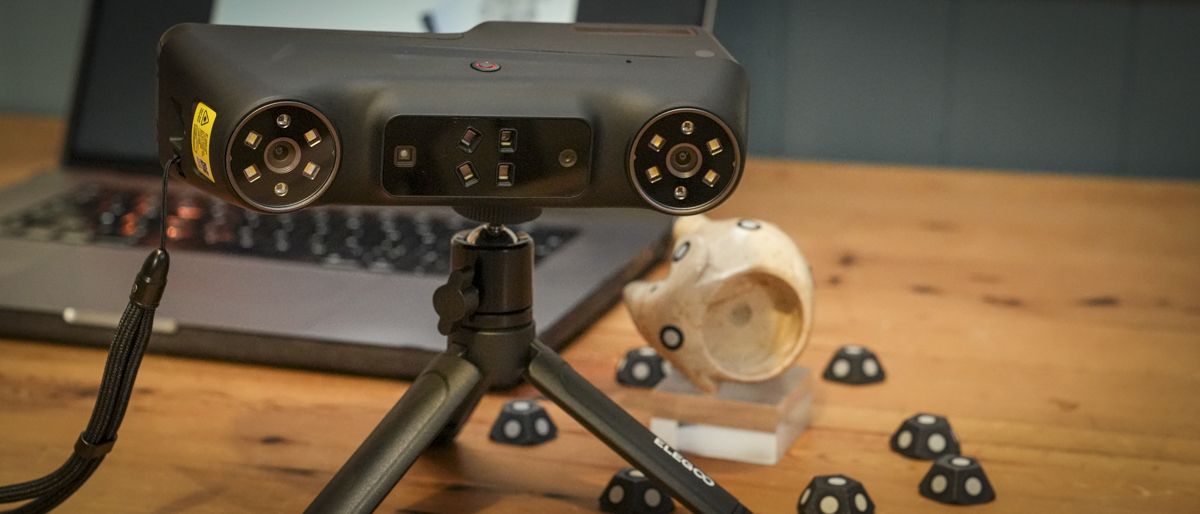
Design, Ergonomics, and Build Quality
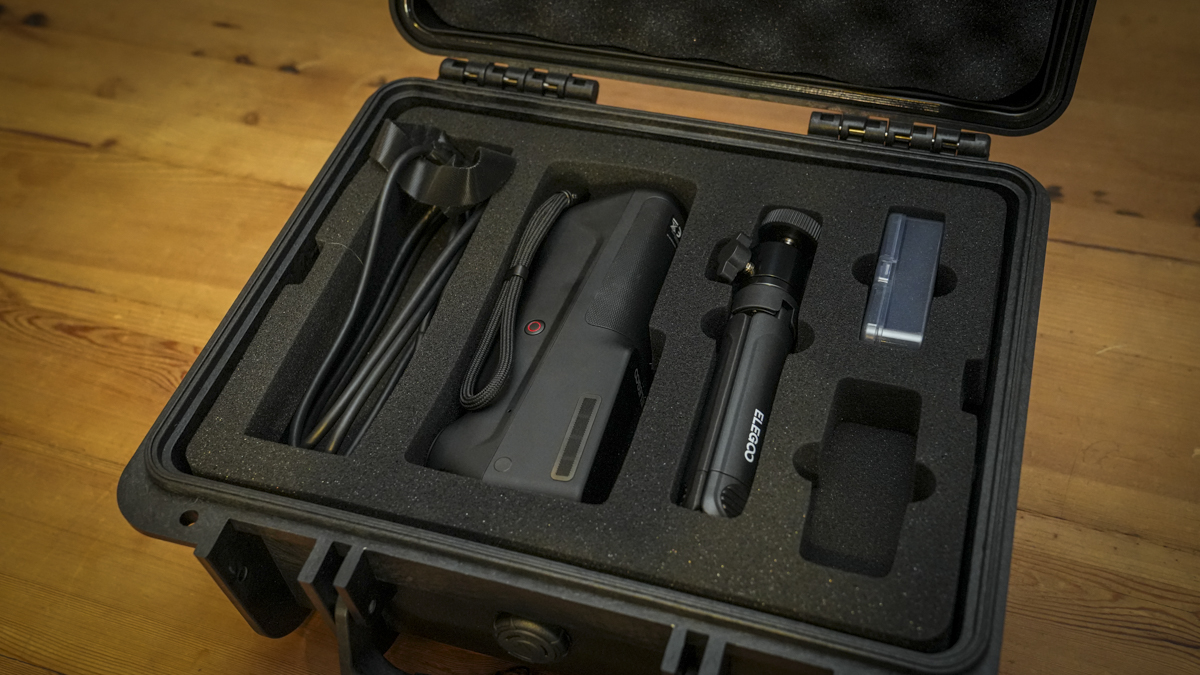
Upon unboxing the Elegoo M1 Ultra from its robust, foam-lined protective hard case—a storage solution strikingly similar to those utilized by industry competitors—the shift in manufacturing philosophy is immediately apparent. Weighing approximately 511 grams including its removable battery, the device exhibits a balanced weight distribution that reduces wrist fatigue during extended scanning sessions.
The chassis features a partial rubberized grip that ensures a secure hold, which is vital when executing precise, controlled movements around complex mechanical geometry. While reviewers have noted that a slightly longer handle could enhance ergonomics for larger hands, the overall physical construction feels remarkably solid. This level of finish represents a distinct departure from older Elegoo products, drawing favorable comparisons to the refined aesthetic standards popularized by manufacturers like Bambu Lab.
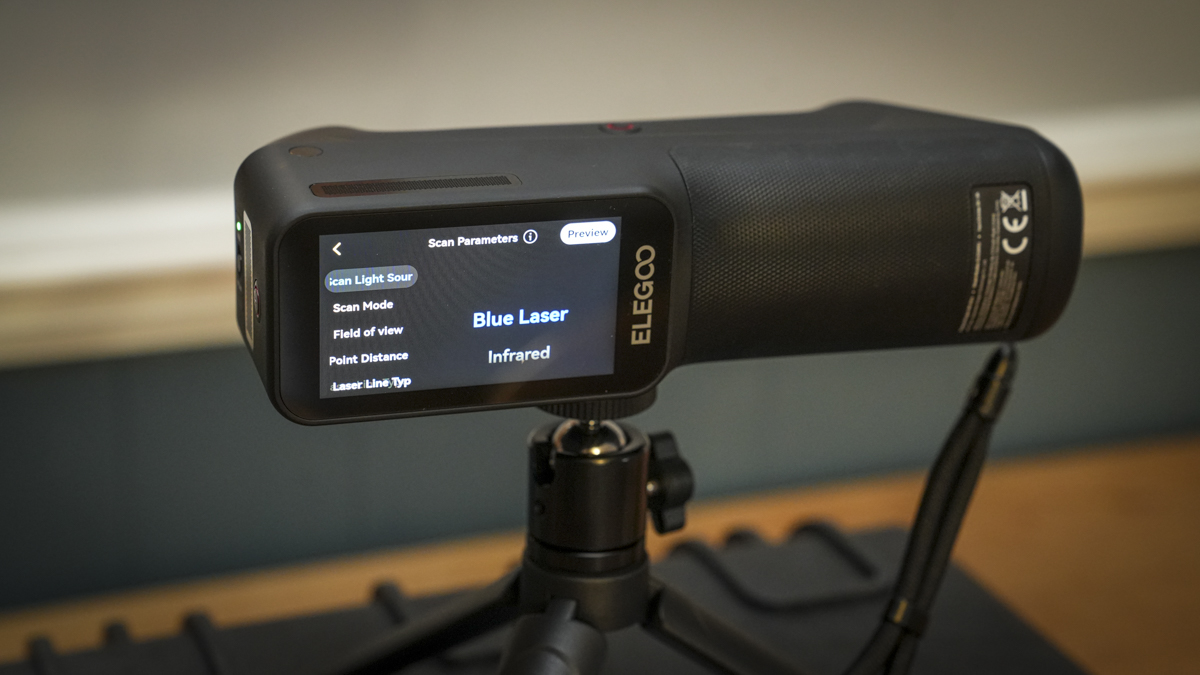
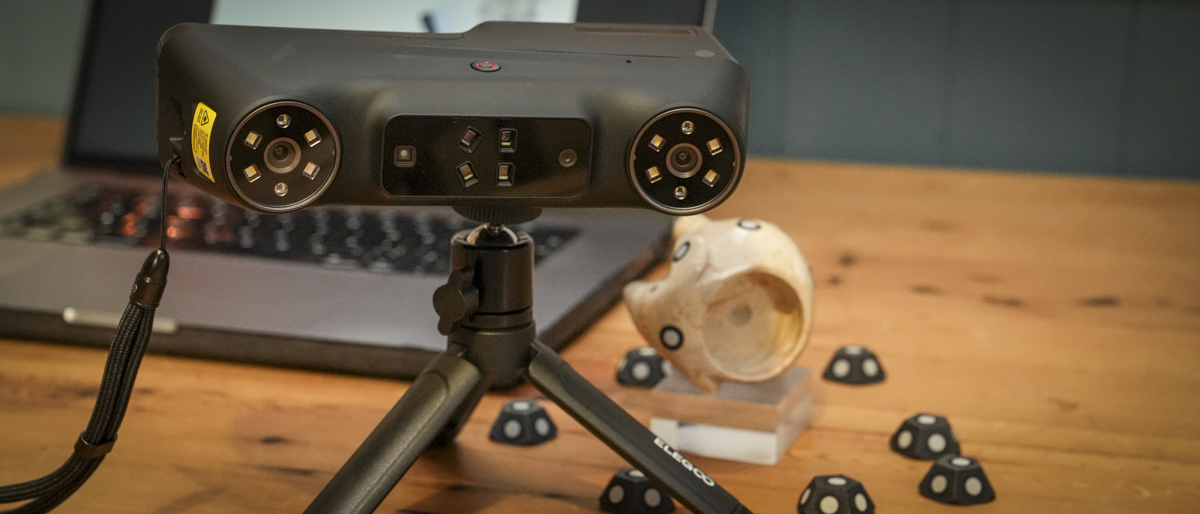
At the front of the unit, the optical assembly cleanly integrates laser emitters, high-resolution cameras, and structured light projectors behind protective lenses. A standout physical feature is the 3-inch high-definition touchscreen display. This interface reduces reliance on a tethered workstation, providing real-time visual feedback, exposure controls, zoom capabilities, and immediate access to system settings such as Wi-Fi configurations, UI language, and an onboard digital user manual.
Core Specifications and Scanning Configurations
The M1 Ultra distinguishes itself within its price bracket by combining two distinct scanning methodologies: blue laser technology and infrared structured light. This dual-technology approach feeds into five distinct operational configurations, allowing users to tailor the hardware to specific object dimensions, material properties, and required detail levels.
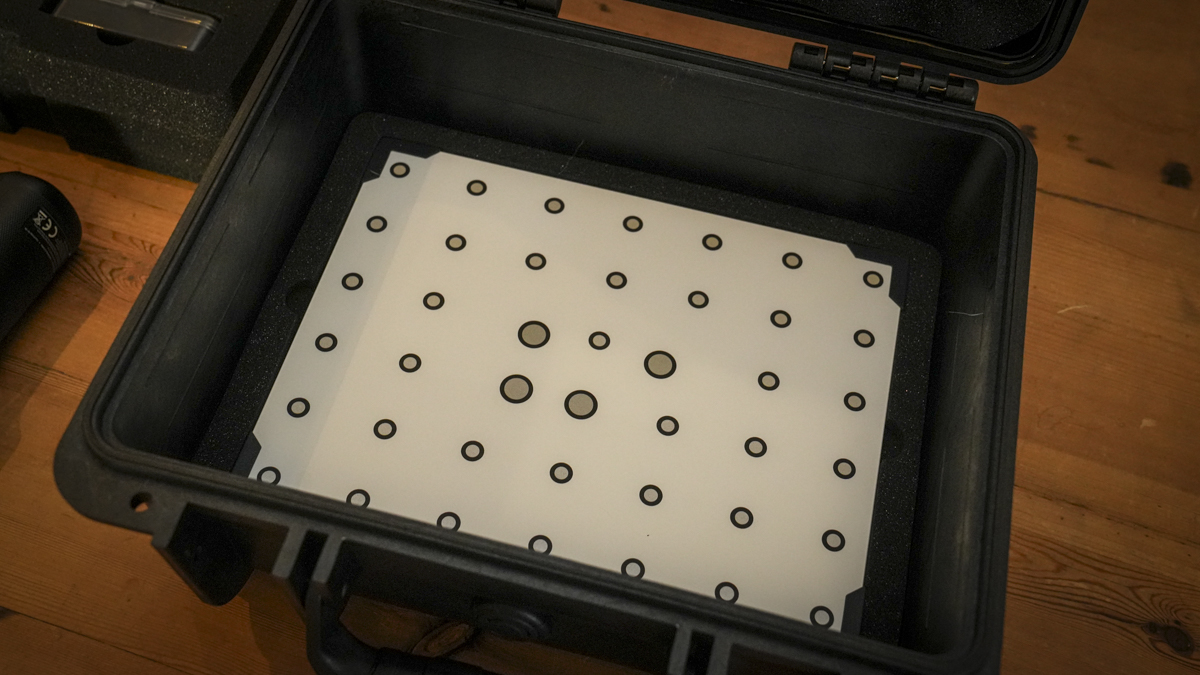
- 34-Line Crossed Blue Laser: Engineered for rapid data acquisition across medium-to-large objects, offering a balanced trade-off between speed and surface coverage.
- 7-Line Parallel Blue Laser: Optimized for small mechanical components, sharp edges, and intricate features requiring high-density point clouds.
- Single-Line Blue Laser: Designed specifically to penetrate deep holes, narrow gaps, and recessed cavities that multi-line configurations cannot resolve.
- Infrared Structured Light: Tailored for larger structures, architectural elements, human faces, and full bodies, utilizing geometry- and texture-based tracking algorithms.
- Marker-Free Blue Laser: A specialized mode for delicate or valuable items—such as museum artifacts—where adhesive reflective markers cannot be applied directly to the surface.
In its finest blue laser mode, the scanner achieves a top dimensional accuracy of up to 0.02mm, with scanning resolutions ranging from 0.05mm to 2mm. The operational volume scales dramatically, accommodating subjects from a tiny 5 x 5 x 5mm up to expansive 4,000 x 4,000 x 4,000mm structures. Connectivity is handled via USB-C 3.1 for wired tethering or Wi-Fi 6 for wireless operation, supported by a 4,800mAh swappable battery rated for up to 90 minutes of continuous field use (though practical field testing typically yields closer to 60 minutes).
Software Ecosystem and Operational Workflow
Hardware capability is heavily reliant on software processing, and the M1 Ultra utilizes the proprietary Elegoo Scan application. While the physical hardware exudes a polished, professional aesthetic, the software user interface retains subtle traces of older hobbyist styling—notably in legacy-looking gradient effects on start and pause controls. However, functionality supersedes cosmetic quirks; the software proved remarkably stable throughout testing, exhibiting zero crashes, freezes, or memory leaks.
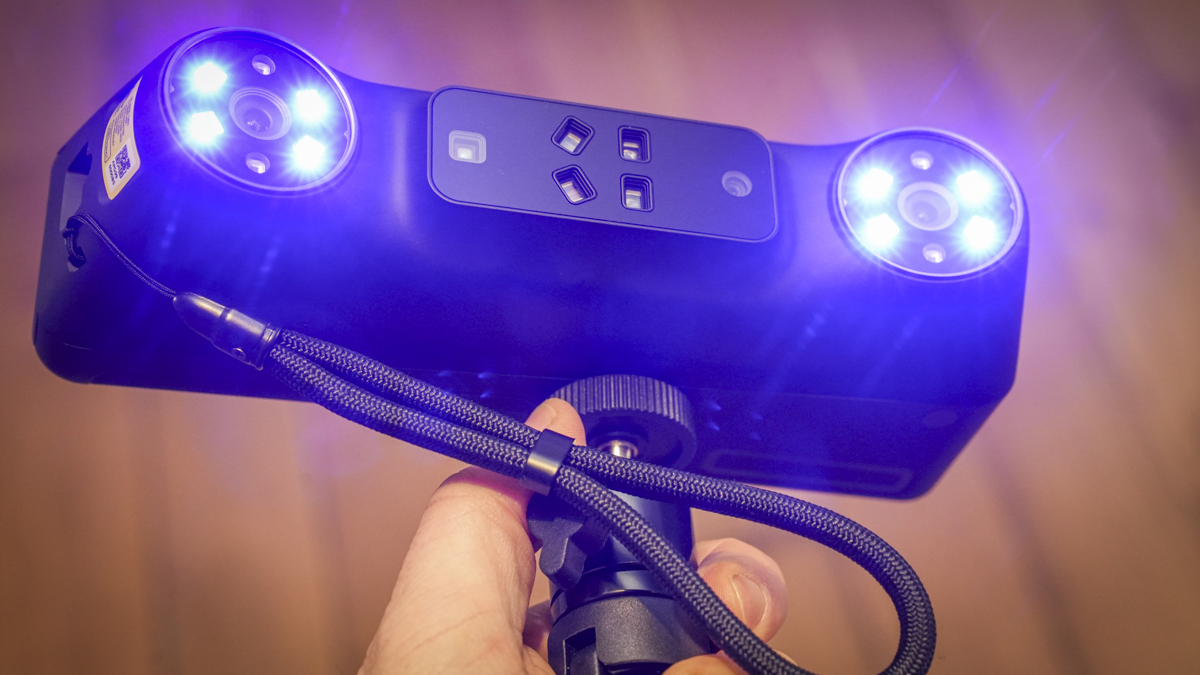
The operational workflow follows a structured sequence: initial hardware calibration using an included flat chart, target preparation, data capture, point-cloud cleanup, mesh alignment, and final export. Calibration, historically a tedious chore in early-generation scanning systems, has been streamlined through guided on-screen prompts that dramatically shorten setup times.
Data processing typically requires only a couple of minutes per scan, depending on geometric complexity. A notable characteristic observed during testing is the stark contrast between the initial live point-cloud preview—which can appear coarse and lacking in fidelity—and the final processed mesh. Once the initial refinement algorithm runs, fine surface details instantly resolve with high dimensional accuracy. Finished models can be exported in industry-standard formats including OBJ, STL, and 3MF, facilitating seamless integration into computer-aided design (CAD) packages or polygon editors like Blender.
Performance Analysis and Field Evaluation
Field testing across a variety of materials—including weathered metals, matte ceramics, organic wood, and standard plastics—revealed consistent performance. When tasked with reverse-engineering a residential electric vehicle (EV) charger to design a custom wall-mounted bracket, the M1 Ultra successfully captured complex outer contours. The resulting digital asset, imported directly into CAD software, yielded a 3D-printed physical mount that fit the hardware precisely on the first iteration.
Despite the inclusion of advanced tracking modes, professional results remain fundamentally dependent on physical preparation. Highly reflective, transparent, or glossy black surfaces present inherent challenges to optical sensors, frequently necessitating the application of specialized matte scanning sprays. Furthermore, optimal tracking reliability relies on strategic placement of adhesive reflective markers and elevated acrylic platforms to cleanly separate the subject from its background environment. A disciplined setup routine—ensuring a minimum of five markers remain visible to the scanner lenses at all times—virtually eliminates tracking loss.
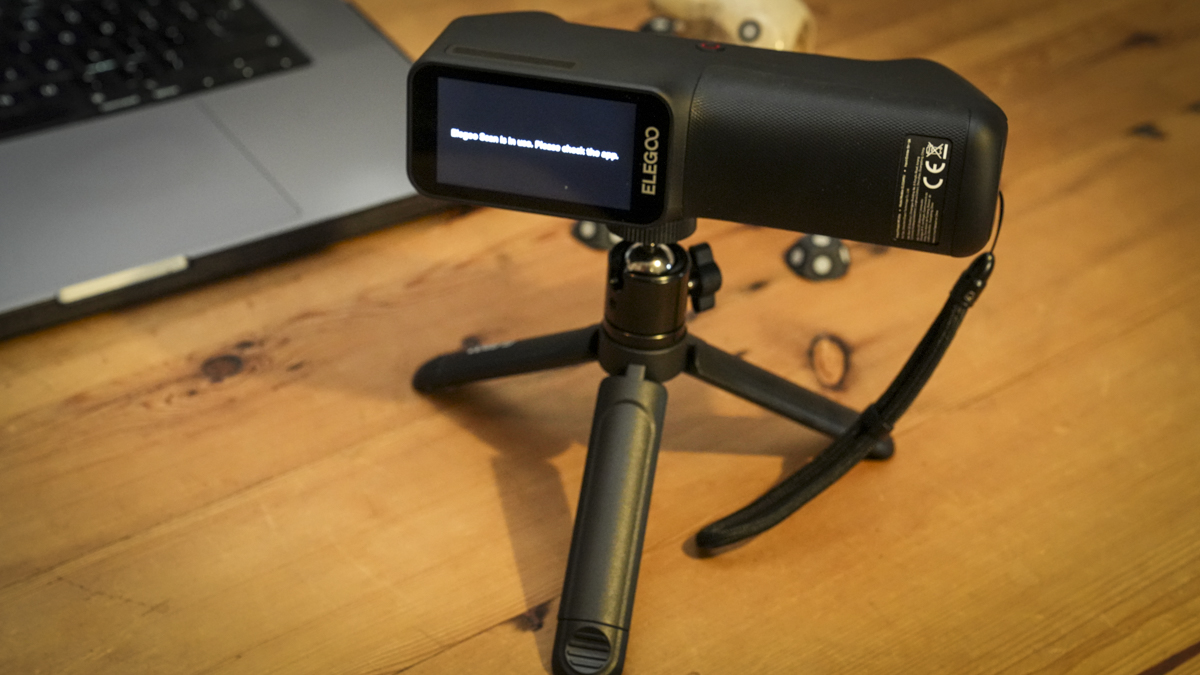
The transition from wired USB to wireless Wi-Fi operation introduces notable ergonomic freedom, liberating the user from trailing cables. Monitoring live scan previews directly on the scanner’s integrated touchscreen significantly improves maneuverability when circling large or awkwardly positioned objects. However, wireless operation requires the host computer to connect directly to the scanner’s dedicated Wi-Fi hotspot, temporarily severing access to local workshop networks. While manageable, this limitation requires occasional reconnection when web-based reference materials or cloud resources are needed mid-session.
Market Implications and Competitive Positioning
The introduction of the Elegoo M1 Ultra at a sub-$1,700 price point signals an aggressive expansion strategy by Elegoo into professional prototyping and metrology ecosystems. By delivering professional-grade blue laser accuracy, wireless tethering, and a robust physical build in a first-generation product, the company has lowered the financial barrier to entry for small businesses, independent makers, and design professionals.
While minor interface refinements and expanded network flexibility would benefit subsequent software iterations, the M1 Ultra successfully redefines expectations for what an emerging manufacturer can achieve in the handheld 3D scanning market. For users seeking a balance of high-resolution detail capture, structural versatility, and budget-conscious acquisition costs, the M1 Ultra establishes a compelling new benchmark.
Related posts: