PrivacyHawk Review: Balancing Data Removal with Comprehensive Digital Privacy Tools

In the digital age, personal information has become one of the world’s most traded commodities. Anytime an individual navigates a website, fills out an online form, or creates a profile, traces of their identity are captured, aggregated, and sold. Data brokers—commercial entities that collect personal information from public records, social media, and browsing habits—compile these fragments into detailed consumer profiles. This information is subsequently packaged and sold to advertisers, insurance companies, financial institutions, and, alarmingly, bad actors seeking to commit fraud or identity theft.
To combat this pervasive digital surveillance economy, a specialized sector of cybersecurity solutions has emerged: data removal and digital privacy services. Among the platforms vying for consumer attention is PrivacyHawk, an application designed to locate and expunge personal information from public databases while bundling additional protective utilities into a single subscription. A thorough examination of PrivacyHawk reveals a service that trades raw data broker coverage volume for an expansive suite of holistic security features, though it remains hindered by certain operational limitations.
The Growing Need for Automated Data Eradication
Historically, reclaiming one’s privacy online required a painstaking manual process. Consumers had to identify every data broker operating in legal gray areas, locate their respective opt-out pages, and submit individual removal requests—often following up multiple times as brokers frequently re-add profiles once new public records surface.
Automated data removal services streamline this endeavor by continuously scanning networks of people-search engines and data harvesting websites, issuing removal demands on behalf of the user, and tracking the status of these requests. While PrivacyHawk operates within this established framework, it distinguishes itself by focusing heavily on mobile accessibility and proactive security layering, setting it apart from traditional desktop-oriented competitors.
Plans, Pricing, and Value Proposition
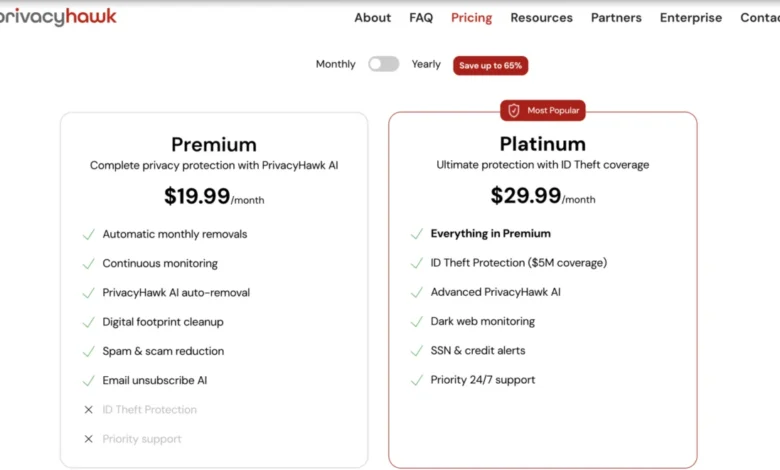
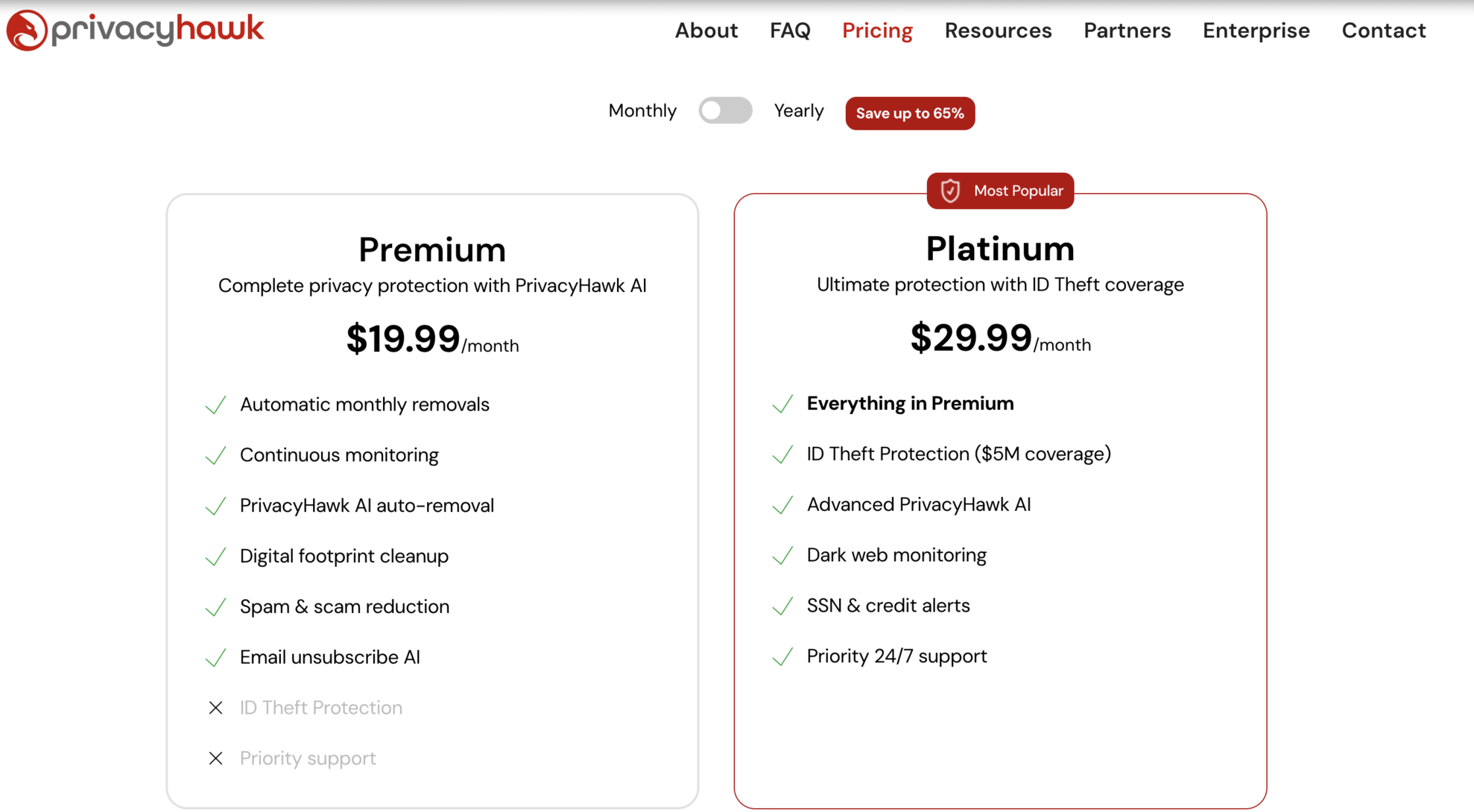
PrivacyHawk employs a straightforward pricing structure divided into two primary tiers: the Premium plan and the higher-tier Platinum plan. Designed primarily for individual users, the Premium tier focuses heavily on core data removal capabilities. In contrast, the Platinum plan expands the service envelope to include advanced utilities such as continuous dark web monitoring, identity theft protection tools, and priority customer assistance.
For individual subscribers, the standard monthly rate for the Premium plan stands at $20, while the Platinum plan commands $30 per month. However, a closer financial analysis reveals a significant cost divergence for users willing to commit to long-term subscriptions. PrivacyHawk incentivizes annual renewals by offering steep discounts: an annual Premium subscription drops to $74—representing a massive reduction compared to the $240 total if paid on a month-to-month basis. Similarly, the annual Platinum subscription is priced at $125, significantly undercutting the $360 annual expenditure of a monthly billing cycle.
For households, PrivacyHawk offers family packages designed to cover up to four individuals. The Premium Family package is priced at $200 annually, whereas the Platinum Family package costs $300 per year. Opting for month-to-month billing on family plans escalates costs substantially, running $40 monthly ($480 annually) for Premium and $50 monthly ($600 annually) for Platinum. Consequently, industry analysts strongly advise consumers to opt for annual billing to extract genuine value from the service.
Notably, PrivacyHawk does not provide a standard, commitment-free trial period, a factor that may deter cautious buyers. Instead, the company relies on a 30-day money-back guarantee, allowing dissatisfied customers to request a full refund within the first month. While the application does permit users to run limited, complimentary preliminary scans as an unofficial free tier, this does not fully replicate the evaluation experience of a traditional trial period.
Setup, Onboarding, and User Experience
Unlike many legacy privacy utilities that require complex desktop software installations, PrivacyHawk is engineered specifically for mobile ecosystems, offering dedicated, highly polished applications for both iOS and Android devices. This mobile-first architecture significantly lowers the barrier to entry for non-technical users.
The onboarding process is streamlined. After downloading the application from the Apple App Store or Google Play Store, users can authenticate their accounts using existing Google or Apple credentials. Once permissions are established, the application immediately prompts the user to input basic identifying details—specifically their first name, last name, and age.
With this seed data, PrivacyHawk initiates its initial reconnaissance scan, querying a network of over 100 U.S.-centric people-finder sites and data brokers to identify exposed records. It is important to note the geographic limitation: while international users can utilize the platform’s digital footprint and email scanning utilities, the automated data broker removal features are strictly optimized for the United States regulatory environment.
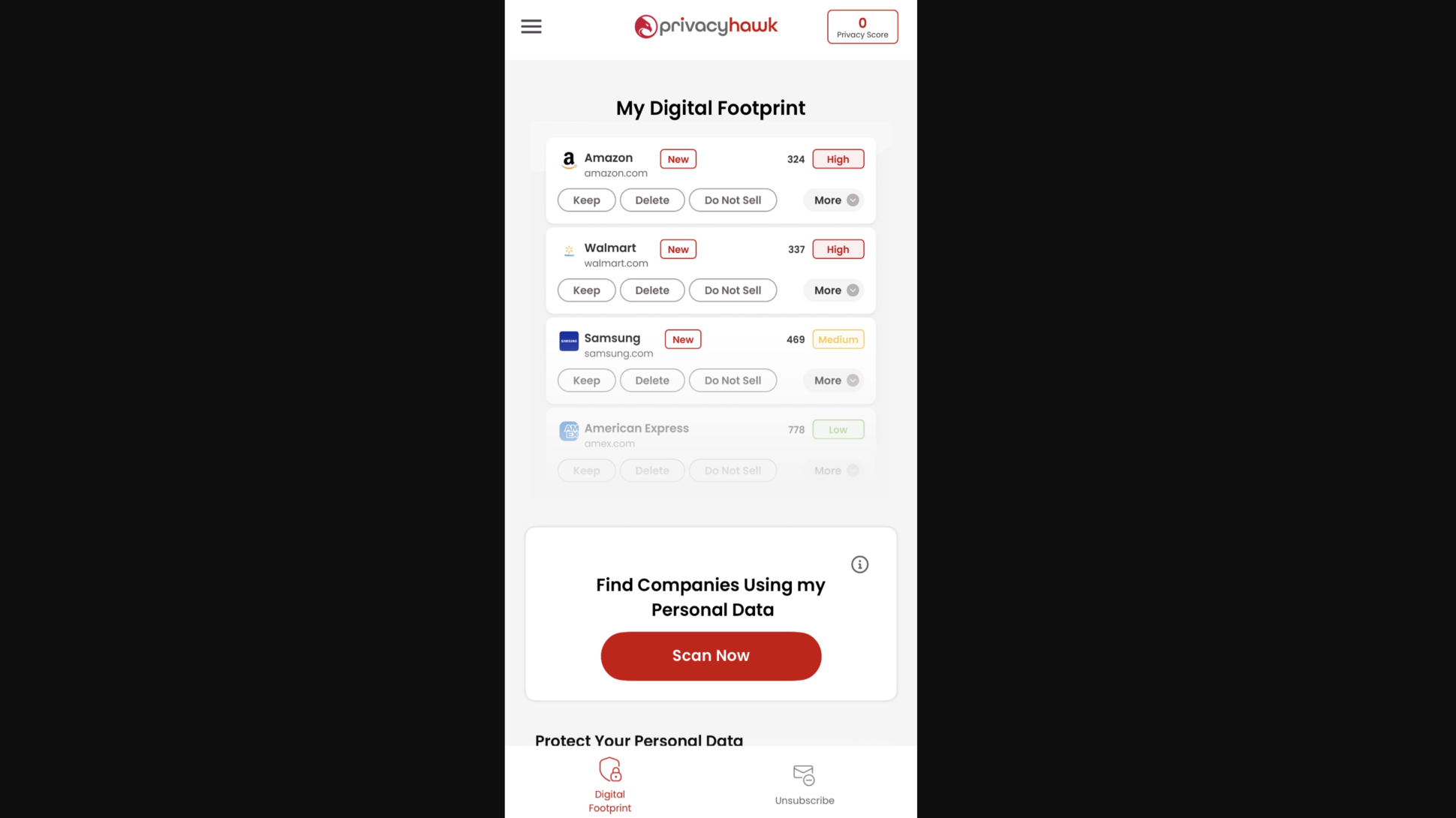
Following the initial scan, PrivacyHawk offers a deeper digital footprint analysis by requesting access to the user’s email inbox. While this step requires a higher degree of user trust, the application uses it to identify corporate entities and online accounts that store personal data, while simultaneously compiling a registry of junk mail senders to facilitate rapid unsubscribing.
Operational Mechanics: Scanning and Deletion
PrivacyHawk’s core engine monitors a network encompassing over 100 data broker websites. While this numerical coverage is modest compared to market competitors that track upwards of 300 to 500 databases, PrivacyHawk compensates through a hybrid approach of automated and manual intervention.
Once a scan concludes—a process ranging from several minutes to a few hours—the user interface presents a clear breakdown of which brokers host their information. Automated deletion requests are dispatched instantly. For recalcitrant broker sites where automated systems fail, PrivacyHawk employs human administrative and legal teams to draft and submit manual removal demands. Because data brokers operate under varying state laws and internal processing timelines, complete removal can take anywhere from 30 to 90 days. Users can monitor the granular progress of each removal ticket directly through the smartphone dashboard.
Furthermore, if a user discovers their information on a database outside of PrivacyHawk’s standard directory, they can submit a custom removal request manually through the app dashboard for staff follow-up. Subsequent to initial cleanups, PrivacyHawk performs automated monthly rescans, dispatching push notifications or emails if new listings emerge.
Interface and Usability
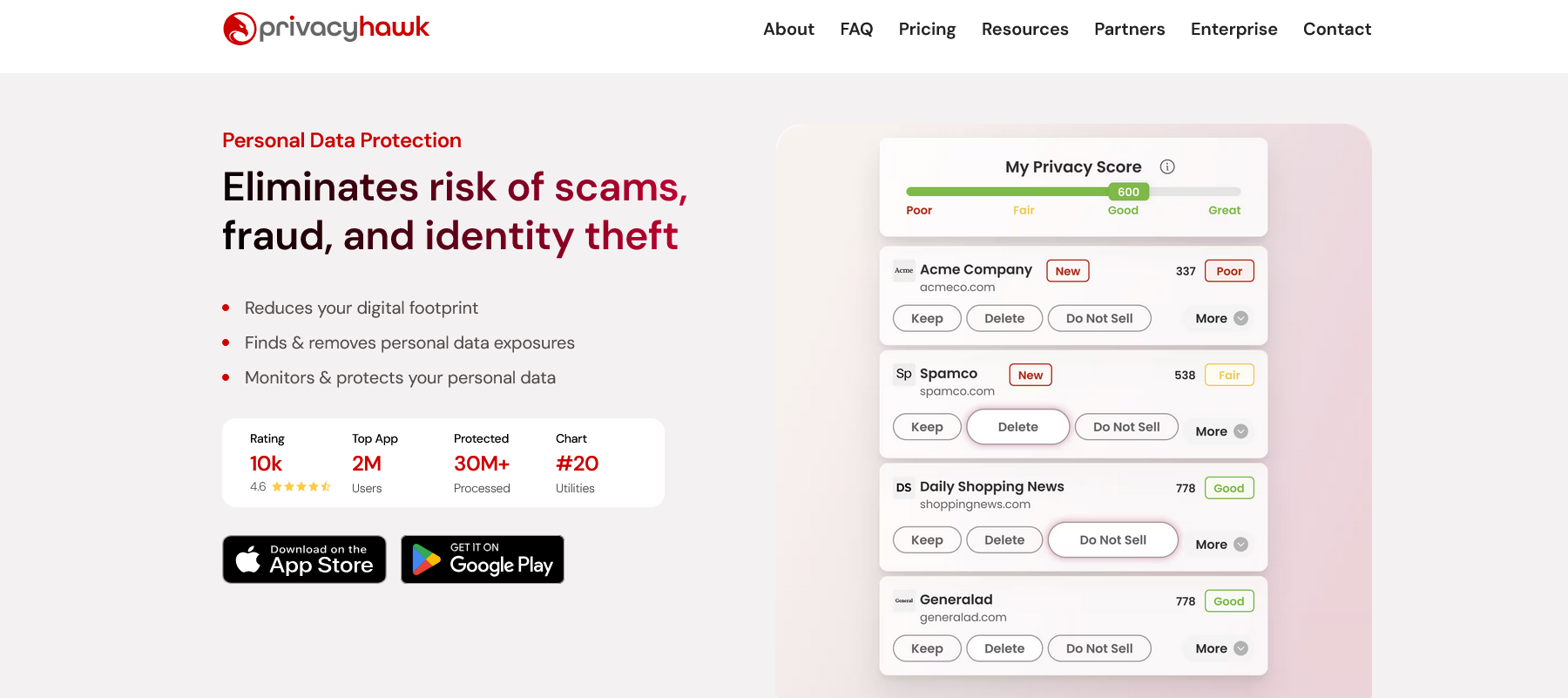
From a human-computer interaction standpoint, PrivacyHawk achieves high marks for design and navigation. The application interface utilizes a clean, modern aesthetic characterized by high-contrast typography, a white background, and bold red interactive elements.
The dashboard avoids cognitive overload by neatly categorizing features into distinct tabs for scanning progress, active removal requests, and auxiliary security tools. Whether navigating subscription management or reviewing deletion metrics, users encounter minimal friction, making the platform accessible to digital natives and older demographics alike.
Security, Privacy, and Supplementary Features
While data removal forms the bedrock of PrivacyHawk’s commercial offering, its auxiliary features elevate the software from a single-purpose utility to a comprehensive personal security suite.
Modern digital hygiene extends far beyond public directory listings. PrivacyHawk integrates robust monitoring tools that continuously scan the dark web for compromised credentials, leaked passwords, and stolen financial identifiers stemming from corporate data breaches. Additionally, the platform addresses day-to-day digital nuisances by incorporating spam call and robocall blocking features, alongside email clutter reduction tools. By consolidating identity monitoring, anti-spam mechanisms, and data removal into a single ecosystem, the platform significantly bolsters an individual’s overall digital resilience.
Customer Support Infrastructure
Customer support remains one of PrivacyHawk’s most conspicuous areas for potential improvement. Users seeking self-service assistance can access an extensive, well-documented Help Center containing troubleshooting guides, onboarding walkthroughs, and conceptual explanations regarding digital footprints.
However, direct human support channels are severely constrained. When users attempt to access live assistance via the in-app communication portal, they are greeted by an automated AI chatbot rather than a human support agent. While the chatbot handles basic informational inquiries adequately, complex account or legal removal queries often require human intervention. Given the subscription price points of the Premium and Platinum tiers, industry reviewers argue that live chat or telephone support staffing should be standard practice.
Competitive Landscape: PrivacyHawk versus OneRep
To contextualize PrivacyHawk’s market position, it is necessary to examine primary competitors such as OneRep, a prominent heavyweight in the data removal space.
OneRep boasts significantly broader raw coverage, actively monitoring a network exceeding 300 public data brokers and over 500 non-public directories, compared to PrivacyHawk’s baseline of roughly 100 sites. Furthermore, OneRep’s base pricing structures are generally more aggressive.
Despite OneRep’s superiority in sheer broker volume and database reach, PrivacyHawk counters with a more diversified feature set. While OneRep largely restricts its auxiliary offerings to email breach monitoring, PrivacyHawk delivers a holistic security package encompassing dark web surveillance, robust robocall filtering, and comprehensive identity theft protection. Consequently, analysts characterize OneRep as the superior choice for pure, unadulterated data broker elimination, whereas PrivacyHawk appeals more strongly to consumers seeking an all-in-one personal privacy toolkit.
Final Verdict and Market Implications
PrivacyHawk occupies a unique niche in the consumer cybersecurity market. Its limitations are apparent: its data broker directory is smaller than industry leaders, its customer support relies heavily on automated artificial intelligence rather than human personnel, and the absence of a traditional free trial places the onus squarely on the 30-day refund window.
Conversely, the platform excels in areas that matter most to everyday smartphone users. Its mobile-first design, exceptional user interface, and rigorous recurring scans make data removal effortless. More importantly, its integration of dark web monitoring, robocall defense, and anti-spam protocols transforms a standard removal utility into a robust digital defense shield. For users prioritizing mobile convenience and multi-layered privacy protection over sheer database volume, PrivacyHawk remains a viable and effective contender in the ongoing battle for digital sovereignty.