The architecture of artificial intelligence agents, particularly concerning how they manage conversational memory, fundamentally dictates their implementation and the deployment infrastructure built around them. A core decision lies in whether an agent operates in a stateless or stateful manner, each presenting distinct advantages and challenges for scalability and functionality. This exploration delves into these two paradigms, illustrating their practical implications with examples using open language models accessed via the Groq API.
The Foundation of Agentic Architecture: Managing State
In the rapidly evolving landscape of AI deployment, bringing intelligent agents into production environments requires careful consideration of their underlying design principles. A previous roadmap outlined the comprehensive architectural requirements for deploying AI agents, focusing on infrastructure and implementation strategies. Building upon this, a critical, granular question emerges: where does an agent’s "memory" reside? This memory, encompassing context gathered so far and conversation history, is managed differently by various agents. The chosen approach at the code level significantly influences the entire deployment architecture, impacting everything from server load to data management.
This article dissects the two primary methodologies for handling agent state: stateless and stateful design. By examining simplified, real-world implementations utilizing advanced language models served through the high-performance Groq API, we can illuminate the practical trade-offs inherent in each approach.
Initial Setup: Accessing Advanced Language Models
For developers new to leveraging large language models (LLMs) via Groq in Python, the initial step involves installing the necessary library. This is typically achieved with a simple command:
pip install groq
Following the installation, the library needs to be imported into the Python script. Crucially, authentication is required, which is managed by setting the Groq API key. This key can be obtained from the Groq developer console and then securely integrated into the code.
import os
from groq import Groq

# Retrieve your API key from https://console.groq.com/keys and set it here
os.environ["GROQ_API_KEY"] = "PASTE_YOUR_GROQ_API_KEY_HERE"

# Initialize the Groq client
client = Groq()

# Select an efficient model from Groq: Llama 3.1 8B Instant
MODEL_ID = "llama-3.1-8b-instant"
The selection of a specific model is a strategic decision. The llama-3.1-8b-instant model is particularly noteworthy for its cost-efficiency and the generous free tier offered by Groq. As of this writing, the platform provides up to 14,400 requests per day, making it an ideal choice for demonstrating and experimenting with both stateless and stateful agent designs without incurring significant costs. This accessibility allows for robust testing and development of complex agentic systems.
Stateless Agents: The "Fire and Forget" Paradigm
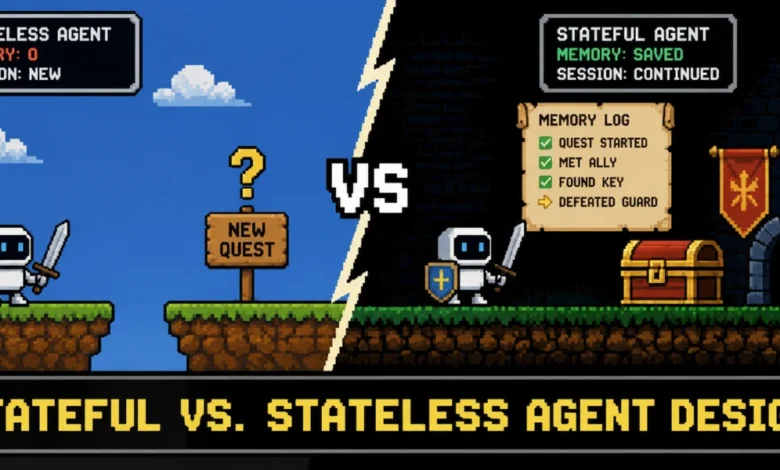
Stateless agents operate on the principle that each user interaction is an independent event. When a request arrives, the agent processes the user’s prompt, invokes the LLM inference engine, and delivers the output. Once this cycle is complete, all information related to that specific interaction is discarded; the agent retains no internal memory of past exchanges.
The Trade-off: Scalability Versus Contextual Depth
The primary advantage of stateless architectures lies in their remarkable ease of horizontal scaling. Because no user-specific memory is stored on a backend server, incoming requests can be seamlessly routed to any available agent instance. This distributed nature makes them highly resilient and capable of handling massive, fluctuating workloads.
However, this simplicity comes at a significant cost, particularly in multi-turn conversations. For the agent to maintain any semblance of conversational continuity, the client application (e.g., a web interface or mobile app) must re-transmit the entire conversation history along with every new user prompt. As conversations lengthen, this cumulative history grows exponentially. This leads to a rapid expansion of the token count required for each API call. Consequently, token usage escalates dramatically, directly impacting operational costs and potentially hitting the context window limits of the LLM, thereby degrading performance and the quality of responses.
Illustrative Example: The Stateless Agent in Action
To demonstrate the behavior and limitations of a stateless agent, consider the following Python code. This example simulates a basic agent interaction with the chosen Groq language model.
The stateless_agent function is designed to be agnostic to past interactions. It does not store any conversational memory locally. Instead, any necessary historical context must be explicitly provided as an argument and appended to the current prompt before being sent to the LLM via the client.chat.completions.create() method.
def stateless_agent(prompt: str, provided_history: list = None) -> str:
    """
    The agent relies completely on the client to provide context.
    It retains no information from past interactions in local memory.
    """
    # Initializing with a system prompt
    messages = ["role": "system", "content": "You are a helpful, concise assistant."]

    # Appending whatever history the client provided
    if provided_history:
        messages.extend(provided_history)

    # Appending the new prompt
    messages.append("role": "user", "content": prompt)

    # The LLM processes the entire chain of messages
    response = client.chat.completions.create(
        model=MODEL_ID,
        messages=messages,
        max_tokens=100
    )
    return response.choices[0].message.content.strip()
The limitations of this approach become apparent when simulating a conversation where the agent is expected to recall previous information.
# --- Testing the Stateless Agent ---
print("--- Turn 1 ---")
prompt_1 = "Hi, my name is Alice and I am learning about API infrastructure."
response_1 = stateless_agent(prompt_1)
print(f"Agent: response_1")

print("n--- Turn 2 (Without Client Context) ---")
# The agent fails here because it retained no memory of Turn 1
prompt_2 = "What is my name and what am I learning about?"
response_2 = stateless_agent(prompt_2)
print(f"Agent: response_2")

print("n--- Turn 2 (With Client Context) ---")
# The frontend MUST inject the history into the payload for the agent to succeed
frontend_payload = [
    "role": "user", "content": prompt_1,
    "role": "assistant", "content": response_1
]
response_3 = stateless_agent(prompt_2, provided_history=frontend_payload)
print(f"Agent: response_3")
The expected output from this simulation clearly illustrates the issue:
--- Turn 1 ---
Agent: Hello Alice, nice to meet you. Learning about API infrastructure can be a fascinating and rewarding topic. What specific aspects of API infrastructure would you like to explore or discuss? Are you looking for information on API management, security, deployment, or something else?

--- Turn 2 (Without Client Context) ---
Agent: Unfortunately, I don't have any information about you, including your name. Our conversation just started, so I'm here to help you with any questions or topics you'd like to learn about. Please feel free to share your name and a topic you're interested in learning about.

--- Turn 2 (With Client Context) ---
Agent: Your name is Alice, and you are learning about API infrastructure.
This output highlights a critical point: without the client or frontend application meticulously re-sending the full conversation history with each turn, the LLM lacks the necessary context to respond accurately to queries that rely on prior interactions. While the implementation appears straightforward, its effectiveness is entirely contingent on the external management of state.
Stateful Agents: Cultivating Contextual Continuity
In contrast to stateless agents, stateful agents take on the responsibility of managing their own memory. When a user interacts with a stateful agent, the client application typically sends only the newest user prompt along with a unique identifier, most commonly a session ID. The agent then uses this identifier to retrieve the relevant conversation history or contextual data from a persistent storage layer, such as a database. The new user message is appended to this retrieved history, and the combined context is sent to the LLM for processing. Upon receiving the LLM’s response, the agent updates the conversation history in its persistent storage before delivering the output to the user.
The Trade-off: Enhanced User Experience Versus Architectural Complexity
The stateful approach offers a significantly more streamlined experience from the client’s perspective. It simplifies the client-side logic, as it no longer needs to manage and transmit extensive conversational histories. This paradigm is particularly well-suited for complex, asynchronous workflows where agents might need to pause execution, await responses from external tools, or require human intervention or approval.
However, this enhanced user experience comes with increased architectural complexity and cost. Scaling stateful solutions presents greater challenges. A persistent database layer becomes an integral part of the architecture, requiring robust management and maintenance. In horizontally scaled infrastructures, where multiple agent instances might be running concurrently, strategies such as centralized memory caching (e.g., using Redis) become essential. Without such measures, the system can suffer from "localized amnesia," where a specific session’s history is confined to the single server instance that handled previous turns, leading to inconsistencies and degraded performance if subsequent requests are routed elsewhere.
Illustrative Example: The Stateful Agent with Persistent Memory
To illustrate the core principles of a stateful agent, we can implement a system that incorporates a persistent memory layer. For simplicity in this demonstration, we will use an in-memory SQLite database. The critical distinction here is that the agent itself manages its conversational memory, rather than relying on the frontend to provide it externally.
import sqlite3
import json

# Initializing an in-memory SQLite database for notebook testing
conn = sqlite3.connect(':memory:')
cursor = conn.cursor()
cursor.execute('''CREATE TABLE IF NOT EXISTS agent_memory (session_id TEXT PRIMARY KEY, history TEXT)''')
conn.commit()

def stateful_agent(session_id: str, new_prompt: str) -> str:
    """
    The agent manages its own state using a database.
    The client only sends the new prompt and their session ID.
    """
    # 1. Retrieving existing state from the database
    cursor.execute("SELECT history FROM agent_memory WHERE session_id=?", (session_id,))
    row = cursor.fetchone()

    if row:
        conversation_history = json.loads(row[0])
    else:
        # Initializing with system prompt for new sessions
        conversation_history = ["role": "system", "content": "You are a helpful, concise assistant."]

    # 2. Appending the new user prompt
    conversation_history.append("role": "user", "content": new_prompt)

    # 3. Processing the LLM call using the retrieved history
    response = client.chat.completions.create(
        model=MODEL_ID,
        messages=conversation_history,
        max_tokens=100
    ).choices[0].message.content.strip()

    # 4. Updating the state with the assistant's reply
    conversation_history.append("role": "assistant", "content": response)

    # 5. Saving the new state back to the database
    cursor.execute('''
        INSERT INTO agent_memory (session_id, history)
        VALUES (?, ?)
        ON CONFLICT(session_id) DO UPDATE SET history=excluded.history
    ''', (session_id, json.dumps(conversation_history)))
    conn.commit()

    return response
The key mechanism here is the use of a session identifier (session_id) to query and update specific conversation histories stored in the database. This allows the agent to maintain context across multiple turns without burdening the client.
Now, let’s test this stateful agent with a conversation similar to the previous stateless example, but this time prompting the agent to recall previously provided information.
# --- Testing the Stateful Agent ---
print("--- Turn 1 ---")
print(f"Agent: stateful_agent('user_123', 'Hi, I am Bob and I want to scale my AI app.')")

print("n--- Turn 2 ---")
# Notice how the client NO LONGER sends the context payload. Just the session ID.
print(f"Agent: stateful_agent('user_123', 'What was my name again?')")
The output demonstrates the agent’s ability to recall information:
--- Turn 1 ---
Agent: Hello Bob, scaling an AI app can be a complex process. May I ask:
1. What type of AI technology is your app built on? (e.g., machine learning, natural language processing, computer vision)
2. Are you using any cloud services like AWS, Google Cloud, or Azure?
3. What are your scalability goals (e.g., increase user count, reduce latency, improve response times)?
This information will help me better understand your requirements and provide more effective assistance.

--- Turn 2 ---
Agent: Your name is Bob.
This simulation, while basic, effectively illustrates the fundamental difference in how stateful agents operate. They manage their own memory, ensuring continuity and enabling more sophisticated conversational interactions without requiring the client to manage the full historical context. This example is a far cry from a large-scale production deployment but serves to clarify the core architectural distinction.
Wrapping Up: Navigating the Trade-offs for Scalable Systems
The decision between adopting a stateful or stateless architectural design for AI agents hinges on a pragmatic alignment of the chosen infrastructure with the specific workflow requirements.
-
Stateless agents excel in scenarios demanding extreme scalability and where each interaction can be treated as an isolated event. Their "fire and forget" nature simplifies load balancing and horizontal scaling. However, this comes at the expense of increased token usage and a reliance on the client to manage conversational history, which can become burdensome and costly for long-running, context-dependent interactions. Architecturally, this implies less backend complexity but potentially higher client-side overhead and API costs.
-
Stateful agents offer a superior user experience by maintaining conversational continuity and enabling more complex agent behaviors. They abstract the memory management away from the client, leading to simpler client-side implementation. The trade-off here is increased architectural complexity, requiring a robust persistent storage layer and careful consideration for scaling strategies to avoid issues like localized amnesia in distributed environments. This often translates to more sophisticated backend infrastructure and potentially higher infrastructure maintenance costs, but with the benefit of reduced per-turn token consumption and a more coherent user interaction.
The choice is not mutually exclusive in all contexts. Hybrid approaches can be employed, where certain agent functionalities might be stateless for maximum throughput, while others leverage stateful mechanisms for critical, context-aware tasks. The ultimate goal is to select the architecture that best balances performance, cost, scalability, and the desired user experience for the specific AI agent application being developed and deployed. As AI agents become more integrated into daily workflows, understanding these fundamental design choices is paramount for building robust, efficient, and scalable intelligent systems.