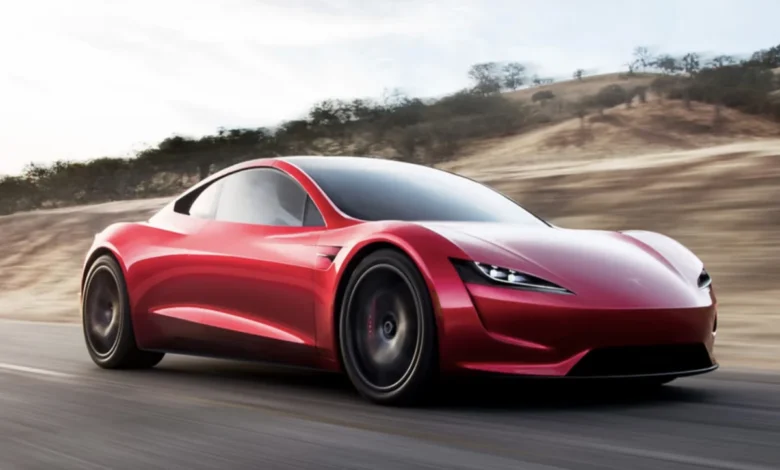
Tesla is finally set to unveil the second generation of its long-awaited Roadster on October 1, ending years of speculation and production delays.

The electric vehicle manufacturer confirmed the long-anticipated debut via a concise announcement on the social media platform X, formerly known as Twitter. Accompanying the text "Go for launch" was a graphic featuring the date "10.01," signaling a definitive reveal for the vehicle that has been in development for nearly a decade. The teaser image also included subtle visual cues suggesting the integration of cold gas thruster technology—a hallmark of Elon Musk’s aerospace firm, SpaceX—intended to push the boundaries of what a road-legal performance vehicle can achieve.
A Chronology of Delays and Anticipation
The journey of the second-generation Tesla Roadster has been one of the most protracted product development cycles in modern automotive history. First unveiled to a stunned audience in November 2017, the initial prototype promised performance metrics that seemed to defy the physics of mass-market electric vehicles: a 0-60 mph acceleration time of 1.9 seconds, a top speed exceeding 250 mph, and a range of 620 miles on a single charge.
However, the timeline for production faced constant revision. Throughout 2018 and 2019, Tesla focused its resources on the scaling of the Model 3 and the introduction of the Model Y, pushing the Roadster to the back burner. By 2021, CEO Elon Musk cited supply chain constraints and the need to prioritize the Cybertruck as reasons for further postponement.
The delays became a point of contention within the tech industry. In late 2025, the narrative surrounding the vehicle shifted from mere engineering challenges to public friction. A notable incident involved OpenAI CEO Sam Altman, who publicly expressed frustration over a $50,000 reservation fee he had held for over seven years. Musk responded by asserting that Altman had been refunded, effectively distancing the project from its earliest high-profile backers. These delays were compounded by reports, including those from The Information, suggesting that the original 2017 design had been scrapped entirely in favor of a "radical" new iteration that incorporates more advanced aerospace-grade engineering.
Engineering the Future: The SpaceX Connection
The most distinguishing feature of the upcoming Roadster is the rumored "SpaceX Package." Since the car’s initial reveal, Musk has frequently teased the inclusion of cold gas thrusters, a technology typically reserved for maneuvering spacecraft in a vacuum. These thrusters are expected to be positioned around the vehicle to improve cornering, braking, and, as Musk has famously suggested, allow the car to "fly" or perform short hops.
While the technical feasibility of such a feature remains a subject of intense debate among automotive engineers, it represents Tesla’s shift from a mass-market EV manufacturer to a company willing to experiment with fringe technologies. The integration of SpaceX components underscores a broader strategy to leverage the intellectual property across Musk’s corporate portfolio. If the production model indeed features these thrusters, it would effectively categorize the Roadster not just as a sports car, but as a hybrid between terrestrial transportation and experimental aerospace equipment.
Economic and Market Implications
The automotive industry is currently navigating a period of cooling demand for high-end electric vehicles, making the Roadster’s debut particularly significant. For Tesla, the Roadster serves as a halo product. Much like the original 2008 Roadster, which proved that electric cars could be desirable, the second generation is intended to demonstrate the technical superiority of the Tesla platform at the absolute edge of performance.

However, the financial implications are complex. With a base price originally pegged at $200,000—and a Founder’s Series reaching $250,000—the Roadster is a low-volume, high-margin vehicle. Unlike the Model Y, which drives the company’s revenue, the Roadster is a branding exercise. It aims to combat the perception that Tesla has lost its competitive edge against established European luxury manufacturers like Porsche and Ferrari, both of which have made significant strides in their own electric performance programs.
Industry analysts note that while the Roadster will not significantly impact Tesla’s quarterly earnings, it is critical for maintaining the company’s "innovation-first" reputation. By keeping the project alive, Tesla preserves its status as a disruptor, even as it pivots toward autonomous driving software and artificial intelligence as its primary growth drivers.
Production Realities and Consumer Expectations
Despite the excitement surrounding the October 1 unveiling, investors and enthusiasts should temper their expectations regarding immediate availability. Musk has previously signaled that the gap between a product reveal and full-scale production remains substantial. Based on his recent commentary, the vehicle is unlikely to enter the assembly line for at least another 12 to 18 months following the reveal.
This extended lead time is typical for Tesla’s "next-generation" platforms, which often require the development of entirely new manufacturing processes. The chassis design, the rumored use of carbon-fiber composites, and the integration of the cold gas systems necessitate a highly specialized production line that cannot be easily retrofitted into existing Gigafactories.
A New Era for the Brand
The reveal on October 1 will be the first major public test of investor confidence in Tesla’s hardware pipeline in years. In recent months, the company has pivoted heavily toward Robotaxi development and humanoid robotics. The return to the Roadster signifies a return to the company’s roots in high-performance automotive engineering.
For the consumers who have held onto their reservations—some for nearly a decade—the unveiling is a moment of truth. They are looking for more than just a fast car; they are looking for the realization of a vision that was promised when the EV market was in its infancy. Whether the final product can match the hyperbolic claims made by Musk over the years will determine if the Roadster is viewed as a masterpiece of modern engineering or a case study in over-promising and under-delivering.
As the industry prepares for the event, the focus will remain on the specifications: Will the range hold up under the stress of high-performance driving? How will the vehicle be certified for road use if it includes aerospace thrusters? And, perhaps most importantly, will Tesla finally be able to deliver a vehicle that satisfies both its most loyal early adopters and its harshest critics?
The October 1 event promises to be a pivotal moment for the electric vehicle segment. By merging the worlds of high-end sports cars and aerospace technology, Tesla is attempting to redefine the ceiling of what is possible in personal mobility. While the road to this point has been fraught with delays, shifts in strategy, and public controversy, the arrival of the Roadster will undoubtedly mark the beginning of a new, albeit experimental, chapter for the company. As the countdown to the reveal begins, all eyes will be on whether this "radical" new design can truly launch a new era for Tesla.