Chinese Espionage Group TA423 Targets South China Sea Energy Firms and Australian Entities with ScanBox Reconnaissance Framework


In a sophisticated and highly targeted cyber-espionage campaign, the China-based threat actor known as TA423 has once again emerged as a significant threat to regional stability and corporate security in the Indo-Pacific. According to a joint investigation by cybersecurity firms Proofpoint and PwC’s Threat Intelligence team, this advanced persistent threat (APT) group has spent the better part of 2022 deploying the ScanBox reconnaissance framework against a diverse array of targets. The victims primarily include domestic Australian government and media organizations, as well as offshore energy firms operating in the highly contested waters of the South China Sea. This activity, which surged between April and June 2022, highlights the persistent nature of state-sponsored espionage despite international legal pressure and public exposure.
The campaign, characterized by its use of "watering hole" attacks and deceptive phishing tactics, serves as a stark reminder of the evolving methods used by intelligence agencies to gather strategic data without the immediate need for traditional malware deployment. By leveraging the ScanBox framework—a tool with a nearly decade-long history in the Chinese cyber-espionage toolkit—TA423 has demonstrated a refined ability to conduct covert reconnaissance, fingerprinting the digital environments of its targets to facilitate future, more intrusive operations.
Profile of the Adversary: TA423 and the Hainan Connection
TA423, also tracked by the cybersecurity community as Red Ladon, APT40, and Leviathan, is widely assessed to be a state-sponsored entity operating out of Hainan Island, China. The group has long been a focal point for Western intelligence agencies. In July 2021, the United States Department of Justice (DOJ) unsealed an indictment against four individuals associated with the group, alleging that they provided long-running support to the Hainan Province Ministry of State Security (MSS). The MSS is the primary civilian intelligence and security agency for the People’s Republic of China, tasked with foreign intelligence, counter-intelligence, and political security.
The mission of TA423 is intrinsically tied to the strategic interests of the Chinese state. Historically, the group has focused on sectors that align with China’s "Belt and Road Initiative" and its maritime claims in the South China Sea. This includes targeting naval defense contractors, maritime research institutions, and the energy sector. Their operations are not limited to the Asia-Pacific region; the 2021 DOJ indictment revealed a global footprint, with victims identified in the United States, Austria, Cambodia, Canada, Germany, Indonesia, Malaysia, Norway, Saudi Arabia, South Africa, Switzerland, and the United Kingdom. Despite these public disclosures and legal actions, researchers note that the group’s operational tempo has remained largely undisrupted, indicating a high level of state resilience and a firm commitment to their intelligence-gathering mandate.
The ScanBox Framework: A Decade of Stealth
At the heart of the recent campaign is ScanBox, a customizable, multifunctional JavaScript-based reconnaissance framework. Unlike traditional trojans or ransomware that require a payload to be downloaded and executed on a victim’s hard drive, ScanBox is designed to run entirely within the victim’s web browser. This "fileless" approach makes it particularly dangerous and difficult to detect using standard endpoint protection solutions that focus on disk-based anomalies.
ScanBox has been a staple in the Chinese APT arsenal since at least 2014. Its primary function is to turn a compromised website into a "watering hole"—a trap where unsuspecting visitors are silently profiled. When a user visits a site infected with ScanBox, the JavaScript code executes automatically. It serves two main purposes: browser fingerprinting and data exfiltration.
The framework is capable of harvesting a wealth of information about the target’s system, including the operating system version, browser type, language settings, and a list of installed plugins and browser extensions. It specifically looks for older, vulnerable software like Adobe Flash, which can be used as an entry point for subsequent exploitation. Furthermore, ScanBox includes keylogging functionality, allowing the attackers to capture everything a user types within the context of the infected webpage, such as login credentials or sensitive communications.
Anatomy of the Campaign: Phishing and Watering Holes
The 2022 campaign observed by Proofpoint and PwC utilized a multi-stage approach to lure victims into the ScanBox trap. The initial infection vector was a series of highly targeted phishing emails. These messages were crafted with professional themes such as "Sick Leave," "User Research," and "Request Cooperation." To enhance the appearance of legitimacy, the attackers often posed as employees of a fictional entity named the "Australian Morning News."
The phishing emails directed recipients to visit a website—australianmorningnews[.]com—which the attackers claimed was a legitimate news portal. In reality, the site was a malicious infrastructure controlled by TA423. To maintain the illusion of a functioning news site, the attackers scraped content from reputable sources like the BBC and Sky News, presenting real-time headlines to the visitor.
While the user browsed the seemingly benign news articles, the ScanBox framework was silently delivered to their browser. This technique is a classic example of a watering hole attack, where the adversary compromises a site likely to be visited by their specific targets. By creating a fake news site tailored to Australian interests, TA423 was able to narrow its focus to individuals working within the Australian government and media sectors, as well as those involved in regional energy policy.
Technical Sophistication: WebRTC and NAT Traversal
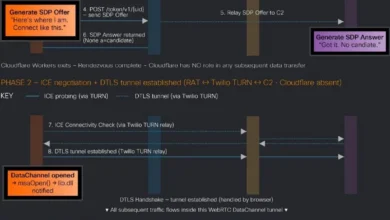
A notable technical aspect of the ScanBox modules used in this campaign is the implementation of WebRTC (Web Real-Time Communication). WebRTC is a standard protocol that allows web browsers to perform real-time communication, such as voice and video calls, over application programming interfaces (APIs). TA423 utilizes this technology to enhance its reconnaissance capabilities.
Specifically, the ScanBox framework leverages STUN (Session Traversal Utilities for NAT) servers. In modern networking, most devices are behind a Network Address Translator (NAT), which hides the internal IP address of a computer from the public internet. By using STUN servers, ScanBox can discover the victim’s actual public-facing IP address and port numbers. This process, known as Interactive Connectivity Establishment (ICE), allows the attackers to establish a more direct line of communication with the victim’s machine, even if it is protected by firewalls or NAT gateways. This level of technical depth ensures that the reconnaissance data is accurate and that the attackers can bypass common network security barriers to identify the specific geographic and organizational origin of their targets.
Chronology of Events and Strategic Timing
The timeline of this campaign is significant when viewed through the lens of regional geopolitics.
- April 2022: Initial phishing lures are detected. The focus is primarily on Australian organizations. This coincides with a period of increased diplomatic tension between Canberra and Beijing over security pacts in the Pacific.
- May 2022: The campaign expands its scope to include offshore energy firms. These firms are often involved in drilling and exploration in areas of the South China Sea that are subject to overlapping territorial claims.
- June 2022: Researchers observe a peak in activity. The use of "Australian Morning News" as a lure becomes more frequent. This period also saw heightened tensions regarding the Taiwan Strait, a perennial flashpoint in the region.
- July 2022 and Beyond: Following the publication of the research, the infrastructure associated with the campaign was largely taken offline, though analysts warn that TA423 frequently cycles their domains and lures to avoid long-term detection.
Sherrod DeGrippo, Vice President of Threat Research and Detection at Proofpoint, emphasized that the group’s focus on naval and energy issues is a constant priority. The timing suggests that TA423 is tasked with providing the Chinese government with "situational awareness" during periods of diplomatic friction, ensuring that Beijing has a clear picture of the key players and assets active in contested zones.
Geopolitical Implications and the Future of Regional Espionage
The targeting of Australian entities and South China Sea energy firms is not incidental. Australia has become an increasingly vocal critic of China’s maritime expansion, and its involvement in the AUKUS security pact has made it a primary target for Chinese intelligence gathering. Similarly, the energy sector in the South China Sea is a matter of national security for China, which seeks to dominate the region’s vast natural resources.
The use of ScanBox for reconnaissance rather than immediate destructive action suggests a long-term strategy. By fingerprinting the systems of high-value targets, TA423 is essentially "mapping the battlefield." The information gathered today—such as which employees use outdated browsers or which organizations have specific security configurations—will be used to tailor future exploits that can deliver more potent malware, such as remote access trojans (RATs) or data exfiltrators.
Cybersecurity experts suggest that organizations in the targeted sectors must adopt a "zero-trust" posture. Since ScanBox relies on JavaScript, organizations can mitigate the risk by implementing strict script-blocking policies and ensuring that all browsers are kept up to date with the latest security patches. Furthermore, the use of phishing lures based on local news highlights the need for continuous employee awareness training regarding sophisticated social engineering tactics.
In conclusion, the activities of TA423 / Red Ladon represent a persistent and evolving challenge to international norms. The 2022 ScanBox campaign demonstrates that even after being identified and indicted by global superpowers, state-sponsored actors will continue to refine their craft. As long as the South China Sea remains a zone of territorial dispute and Australia remains a key strategic player in the Indo-Pacific, TA423 will likely continue its mission of digital espionage, using every tool at its disposal to gain an information advantage for the Chinese state.