I Watched A Humanoid Robot Clean My Apartment: It Felt Like A Taste Of The Future

The intersection of domestic labor and artificial intelligence reached a novel milestone on the streets of San Francisco, where emerging technology startups are shifting the boundaries of consumer robotics. Among them is Tau Robotics, an enterprise currently conducting live-market beta testing by deploying humanoid robots directly into residential apartments for cleaning services. While these machines offer a fascinating glimpse into a sci-fi-inspired domestic future reminiscent of classic television families, the current reality highlights a nuanced mix of technological promise, heavy remote-human supervision, and the early stages of a profound labor market transition.
The Rise of Consumer Humanoid Robotics
For decades, popular culture has promised a world where mechanical domestic helpers shoulder the burdens of sweeping, scrubbing, and laundering. In recent years, automated vacuums and lawnmowers have become commonplace, yet true humanoid robots capable of navigating unpredictable human spaces have remained largely confined to research laboratories and controlled industrial facilities.
Tau Robotics aims to bridge that gap by commercializing the process. By offering discounted residential cleaning services—initially priced at $30 per hour, later moving to structured packages ranging from $60 to $100—the startup has effectively transformed ordinary apartments into real-world data collection hubs. The core economic value proposition for the company is not immediate profit from cleaning services, but rather the acquisition of complex multimodal behavioral datasets. Every counter wiped, floor mopped, and shirt folded by a remote operator translates into critical training parameters for Tau’s foundational AI models.
Anatomy and Mechanics of the Tau Cleaning Assistant
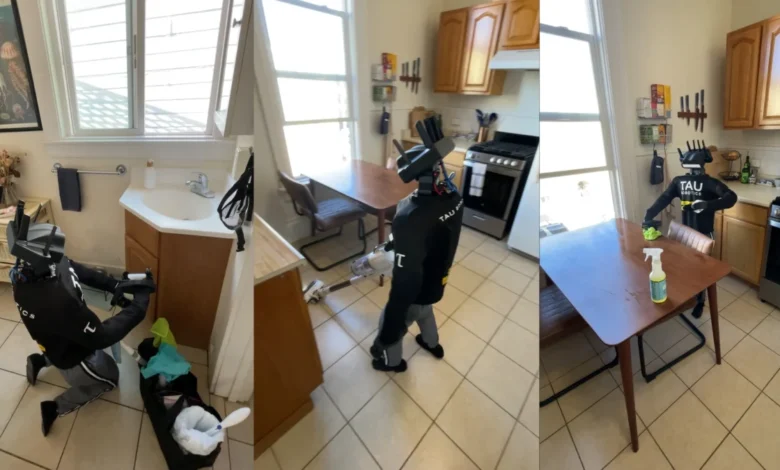
Standing at roughly four and a half feet tall, the Tau robot is specifically engineered for cost-efficiency and functional utility rather than anthropomorphic perfection. Eschewing delicate and expensive human-like hands, the startup equips its units with durable, 3D-printed claw end-effectors that prove surprisingly effective for grasping domestic objects.
A 3D-printed head housing prominent antennae facilitates continuous communication with the company’s central headquarters. For indoor mobility, the robots are outfitted with specialized grippy socks designed to protect sensitive hardwood floors from scuffs and scratches while maximizing traction.
However, beneath the charming exterior lies a heavy dependence on human intervention. Unlike fully autonomous navigation systems found in commercial autonomous vehicles such as Waymo, Tau’s current generation functions more like an advanced, teleoperated radio-controlled device. Many intricate tasks rely heavily on kinematic guidance, a process wherein a remote human operator executes the physical motion while onboard sensors record and transmit the precise telemetry back to the robot’s neural network.
A Field Account: Deployment and Operational Realities
Observing the technology in practice reveals both the remarkable agility of modern robotics and the substantial engineering hurdles that remain. Upon arrival at a residential building, delivered via a standard transport van, the robot’s initial encounter with structural obstacles underscores the fragility of current stabilization algorithms.
Navigating outdoor staircases often resembles a delicate, unsteadied balancing act. A single successful step can be immediately followed by a backward stagger, reflecting the minor latency issues inherent to remote network connectivity. While vacuuming and mopping routines can be executed with a degree of local autonomy, complex spatial challenges—such as multi-story carpeted stairwells—frequently require manual intervention by accompanying company personnel.
During domestic operations, the robots demonstrate a mix of methodical competence and beta-stage operational quirks. In a typical apartment visit, the machine can successfully cleanse kitchen countertops, sanitize fixtures, and tackle arduous tasks like toilet cleaning. The latter task showcases surprising spatial problem-solving capabilities, such as repeatedly reattaching a fallen cleaning wand head through trial-and-error contact maneuvers.
Simultaneously, the units remain susceptible to environmental and technical bottlenecks. Unseasonably high ambient temperatures have been known to cause thermal throttling not only within the onboard hardware but also within the remote monitoring stations utilized by human pilots. Minor errors—such as dripping faucets, displaced non-fragile items, or the inability to right fallen objects—illustrate that the technology is firmly in an iterative developmental phase.
Industry Context and the Broader Automation Landscape
The deployment of humanoid cleaning units arrives at a time of significant maturation within the broader robotics and artificial intelligence sectors. Companies globally are racing to solve the "general-purpose robot" problem, transitioning machines from rigid factory assembly lines to unstructured, human-centric environments.
According to industry analysts, the global market for service robotics is projected to expand significantly over the coming decade, driven by labor shortages in domestic services, hospitality, and institutional maintenance. Proponents argue that introducing automation into high-turnover, physically demanding sectors can alleviate occupational safety risks and fill persistent employment gaps.
Cornelia Weinzierl, co-founder of Tau Robotics, emphasizes the acute market demand for relief in labor-intensive industries. Cleaning is characterized by high burnout rates, physical strain, and chronic worker shortages. Looking ahead, startups in this space envision expanding remote-piloted and semi-autonomous humanoid platforms into other high-risk or physically challenging domestic and commercial domains, including specialized sanitization, mold remediation, and home healthcare assistance.
Socioeconomic Implications and Labor Market Concerns
As consumer robotics inch closer to commercial viability, economists and policy experts are increasingly examining the broader societal implications of widespread automation. While technologies like self-driving cars and teleoperated cleaning units offer convenience and efficiency, they also present difficult questions regarding employment displacement.
Unlike white-collar automation driven by generative text and data models, physical robotics directly intersects with blue-collar and service-sector livelihoods. The large-scale deployment of inexpensive, autonomous cleaning and maintenance robots could eventually threaten the financial security of millions of domestic workers globally. Critics point out that current labor protections and social safety nets in many industrialized nations, including the United States, are largely unprepared to absorb the structural unemployment that could accompany rapid advancements in embodied artificial intelligence.
Furthermore, the collection of high-resolution visual and spatial data inside private residential spaces raises complex privacy concerns. Consumers participating in beta programs essentially trade personal data privacy for discounted technological novelty, raising regulatory questions about how domestic sensor data is stored, utilized, and protected against unauthorized access.
Outlook and Future Trajectory
Tau Robotics faces a formidable scaling challenge. Training a neural network to seamlessly interpret and execute the infinite variations of household organization requires massive volumes of diverse training data. Having completed only a few hundred residential deployments to date, the company is merely at the inception of a long developmental journey.
Nevertheless, the sight of a four-foot-tall humanoid robot successfully navigating an apartment, mopping floors, and maintaining domestic hygiene signals a tangible shift in how humans interact with technology. While fully autonomous, unassisted domestic humanoids remain a goal for the future, current field tests demonstrate that the boundary between science fiction and everyday reality is steadily narrowing. As connectivity improves, hardware durability increases, and machine learning models absorb millions of hours of operational data, the prospect of mechanical assistance in the home is transforming from an abstract vision into an unfolding economic and technological reality.