Meta Officially Launches Meta One Subscription Tiers Across Flagship Apps, Integrating Advanced AI and Monetization Tools for Creators and Businesses

Following months of anticipation and initial exploratory rollouts, Meta has officially debuted its comprehensive ecosystem of subscription tiers under the umbrella of "Meta One." Rolling out globally, the initiative restructures how billions of users interact with the company’s powerhouse applications—including Facebook, Instagram, and WhatsApp. Designed to cater to a diverse demographic ranging from casual users seeking enhanced creative tools to power users, digital creators, and commercial enterprises, Meta One introduces targeted functionality tailored to modern digital demands.
The launch follows an initial roadmap unveiled by company executives earlier in the year, signaling a strategic shift for Meta as it diversifies revenue streams away from traditional advertising models while leaning heavily into the commercialization of generative artificial intelligence.
Background Context and Evolution of the Initiative
The foundation for Meta One was laid earlier this year, most notably in May, when Meta leadership first signaled a pivot toward tiered app experiences. During preliminary testing phases, product leads detailed introductory offerings such as Facebook Plus, Instagram Plus, and WhatsApp Plus. These early iterations were designed to test consumer appetite for paid enhancements, offering low-cost entry points focused primarily on personal expression, aesthetic customization, and minor visibility boosts.
For instance, early tests of Instagram Plus highlighted features like vibrant, animated reactions—such as the "Super Heart"—and weekly story "spotlights" intended to increase content reach. WhatsApp Plus established a modest entry point at $2.99 per month, with Facebook and Instagram variants following at $3.99 per month.

However, rather than maintaining a patchwork of independent add-ons, Meta has consolidated these concepts into a unified architecture. Meta One categorizes services explicitly by user intent: personal expression, AI-driven productivity, and professional scaling for creators and businesses. This structural evolution marks a significant milestone in the tech giant’s operational history, transforming its historically free social platforms into hybrid ecosystems where premium, compute-heavy features reside behind a paywall.
Breakdown of the Core and Premium Tiers for Individuals
At the heart of the consumer-facing side of Meta One are the Core and Premium plans, engineered specifically for individual users and AI enthusiasts. As artificial intelligence becomes increasingly embedded in daily workflows and social interactions, Meta is capitalizing on the high operational costs associated with advanced machine learning models.
The Core and Premium tiers provide subscribers with access to compute-intensive AI capabilities that extend far beyond standard, free-tier offerings. Users who subscribe to these advanced tiers unlock heightened creative freedom, enabling more complex media generation directly through Meta AI. Furthermore, subscribers gain immediate access to exclusive in-app features, such as the advanced "Restyle" tool on Instagram, which utilizes generative models to dynamically alter user-uploaded imagery and video content based on textual prompts or pre-set artistic filters.
While basic communication and social networking remain free of charge, Meta is betting that a distinct segment of its user base is willing to pay a recurring fee for superior creative control, faster processing speeds for AI tasks, and exclusive personalization tools. Industry analysts note that this mirrors similar strategies deployed across the software-as-a-service (SaaS) industry, where foundational services remain accessible while heavy compute loads are monetized.
Empowering Creators and Small Businesses

Beyond personal use, a critical pillar of the Meta One rollout involves targeted plans for creators and small-to-medium-sized businesses (SMBs). Historically, growing an audience or managing a commercial enterprise across Meta’s platforms required navigating complex business suites, separate administrative accounts, and external third-party software. Meta One aims to eliminate these friction points by consolidating professional tools directly within the native app interfaces.
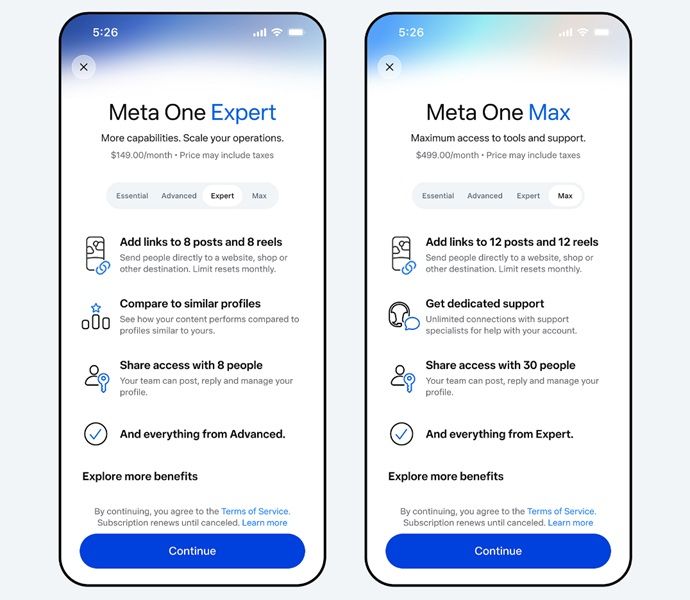
The commercial and creator tiers—starting at $14.99 per month—bundle several high-value utilities into a single package. Subscribers receive a verified badge, a verified business channel on WhatsApp, and robust anti-impersonation protection, addressing long-standing security concerns for public figures and brands. More importantly, these plans introduce the Meta Business Agent, a 24/7 intelligent assistant accessible directly through WhatsApp designed to handle customer inquiries, automate messaging, and streamline client communications without requiring human intervention around the clock.
In addition to back-end automation, Meta One provides businesses and creators with an enhanced profile layout. This redesigned interface places crucial commercial information—such as operational hours, physical locations, and official website links—front and center. Visibility features have also been upgraded; the system is designed to send automated follow invitations to users who actively engage with a creator’s content, while appending a prominent "bold follow button" directly onto Reels to optimize conversion rates from passive viewers to dedicated followers.
Market Implications and Industry Analysis
The commercial rollout of Meta One represents a critical juncture for the social media landscape. For years, platforms like Facebook and Instagram operated under a singular, ad-supported business model where user data was leveraged to target advertisements. By introducing robust subscription tiers, Meta is actively diversifying its revenue model, reducing its vulnerability to macroeconomic fluctuations in the digital advertising market.
However, the strategy is not without its risks and controversies. Consumer advocacy groups and regular users have frequently expressed skepticism regarding the paywalling of features that were once standard or freely available. Critics argue that charging fees for aesthetic enhancements, verification badges, or basic algorithmic visibility creates a stratified digital experience, potentially disadvantaging creators and users who cannot or choose not to pay monthly fees.
Conversely, financial analysts have largely praised the move as a necessary and logical evolution. As the costs of hosting massive infrastructure and training next-generation artificial intelligence models continue to soar, monetization of power-user features provides a sustainable path forward. By focusing the higher-priced tiers on commercial entities and professional creators—who can directly measure the return on investment through increased sales and audience reach—Meta has structured the pricing tiers to align with professional utility rather than mandatory social participation.
Looking Ahead
As Meta One officially rolls out globally, the company will closely monitor adoption rates across the various tiers. The success of this initiative will likely serve as a bellwether for the broader tech industry, determining whether multi-billion-user social networks can successfully transition into hybrid platforms that blend advertising revenue with consumer and enterprise subscriptions. For now, users must evaluate whether the advanced AI capabilities, professional tools, and enhanced visibility justified by Meta One align with their digital needs and budgets.
Related posts: