The Evolution of Semantic Information Retrieval
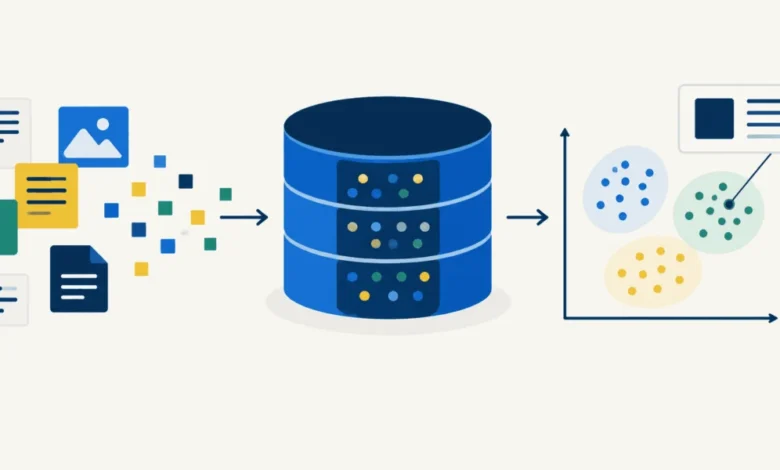
Traditional databases, such as relational SQL systems or keyword-based engines like Elasticsearch, rely on exact string matching. If a user queries for "energy source," these systems search for the literal presence of those characters. Vector databases, by contrast, rely on the mathematical representation of meaning. Through the use of embedding models—such as the sentence-transformers library—text is converted into high-dimensional numerical vectors. In this vector space, documents that share semantic meaning are positioned in proximity to one another. Searching, therefore, ceases to be a process of word matching and becomes a process of geometric calculation: finding vectors that point in the same direction as the query vector.
Chronology of the Implementation Process
The implementation follows a logical progression, starting from environmental configuration and ending with performance analysis at scale. The process begins with the establishment of the workspace using the sentence-transformers library to handle the transformation of natural language into vector embeddings. Once the infrastructure is initialized, the developer moves through the following phases:
- Environment Setup: Configuring the development environment with essential dependencies, including NumPy for high-performance matrix operations and
sentence-transformersfor encoding. - Indexing: Building the database by encoding the initial corpus of documents. This step demonstrates that regardless of document length, every input is normalized into a fixed-dimension vector—typically 384 dimensions for standard models—resulting in a predictable, memory-efficient index.
- Basic Retrieval: Executing the first semantic query. Unlike traditional systems, this step reveals how a vector database retrieves documents that do not share a single word with the user’s query, provided the underlying concepts are related.
- Semantic Nuance: Testing the system against queries that share no vocabulary with the corpus. This highlights the model’s ability to map "sourdough" to "fermentation" or "superheroes" to "exoskeletons," confirming that the database truly understands intent rather than syntax.
- Score Interpretation: Analyzing cosine similarity scores. This phase explains that a vector database returns the "top k" results regardless of relevance, necessitating the implementation of score thresholds to filter out noise.
- Metadata Filtering: Implementing constraints to narrow search results. By filtering for specific categories (such as "bio" or "music"), the system demonstrates how hybrid searches combine semantic intent with rigid logical filters.
- Filter Logic Constraints: Ensuring that the database maintains integrity when user-defined filters result in fewer than "k" results, demonstrating the importance of handling empty result sets gracefully.
- Data Integrity and Guard Rails: Implementing robust error handling to ensure that document, metadata, and vector arrays remain in perfect alignment, preventing the corruption of the index.
- Persistence Management: Saving the index as a combination of compact
.npyfiles for raw numerical data and.jsonfiles for metadata, ensuring that the database can be reloaded without re-processing the entire corpus. - Scalability Analysis: Benchmarking the system against larger synthetic datasets to measure the computational cost of scanning versus ranking at scale.
Technical Foundations and Performance Data
The scalability analysis reveals the efficiency of this approach. When scaling from 1,000 to 100,000 documents, the memory footprint increases linearly—approximately 146.5 MB for 100,000 documents at 384 dimensions. More importantly, the search performance remains remarkably fast. While the initial "warm-up" time for NumPy’s thread pool can cause latency in small tests, the actual matrix multiplication—the "scan" phase—remains in the single-digit millisecond range even as the dataset grows. This confirms that the primary bottleneck in a production vector database is often not the search itself, but the memory overhead and the complexity of the indexing algorithms used for massive-scale operations.
Industry Implications and Broader Impact
The methodology presented in this 10-step guide serves as a critique of the "black box" nature of current enterprise AI infrastructure. By demonstrating that the fundamental operation of a vector database is essentially a matrix-vector dot product, the article illustrates that the underlying mechanics are accessible to anyone with a basic understanding of linear algebra.
For organizations currently relying on expensive, managed vector database services, this realization carries significant weight. While enterprise-grade databases offer advanced features like Approximate Nearest Neighbor (ANN) search, distributed indexing, and real-time updates, the core functionality—finding similarity—is a commodity. The ability to build a functional, performant, and transparent vector index from scratch using standard libraries suggests that developers can now prototype, test, and potentially deploy custom, lightweight search solutions without needing to immediately commit to heavy, external dependencies.
Summary of Findings
The final takeaways from this technical exercise emphasize that the core of semantic search is elegant in its simplicity. By scaling all embeddings to a unit length of 1, the calculation of cosine similarity is reduced to a straightforward dot product. This mathematical optimization allows for the rapid ranking of vast collections of data, provided the bookkeeping—maintaining the synchronization of metadata, text, and vectors—is handled with rigor.
As the industry continues to push toward more sophisticated RAG architectures, the ability to understand these "under the hood" mechanisms becomes a vital skill. Whether a project requires 25 documents or 25 million, the fundamental design principle remains constant: the vector space is the source of truth, and the database is merely the engine that navigates that space. By mastering these ten steps, developers gain the foundational knowledge required to build, debug, and scale the next generation of AI-driven search applications.