Beyond Prediction: How Agentic Reasoning Transforms Traditional Machine Learning Systems

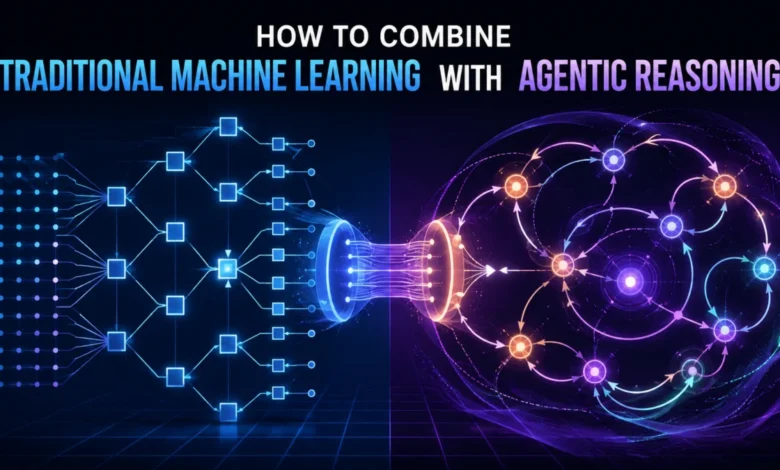
For over a decade, the field of artificial intelligence has been dominated by the paradigm of supervised learning—a process where models are trained to map specific inputs to precise outputs. While these systems have achieved superhuman performance in domains ranging from medical imaging to high-frequency trading, they remain fundamentally constrained by their static nature. As the industry shifts toward more complex, autonomous workflows, the limitations of "input-output" models have become increasingly apparent. The emerging solution lies in the integration of traditional machine learning (ML) with agentic reasoning, a architectural evolution that allows AI systems to plan, adapt, and execute multi-step tasks in real-world environments.
The Foundation: The Power and Constraints of Traditional ML
Traditional machine learning is built upon the efficacy of pattern recognition. Since the proliferation of deep learning frameworks in the early 2010s, organizations have invested heavily in models designed to solve discrete problems. A fraud detection model, for instance, processes millions of transaction logs to assign a probability score to a potential breach. A demand forecasting model analyzes seasonal historical data to optimize supply chain inventory.
These models are the backbone of modern enterprise AI because they are computationally efficient, highly interpretable, and mathematically rigorous. According to recent industry benchmarks, a well-tuned gradient-boosted decision tree or a specialized neural network can process thousands of requests per second with latency measured in milliseconds. However, this speed comes at the cost of flexibility. Once a model is deployed, its "worldview" is frozen at the moment of its final training epoch. It cannot interrogate its own input, request missing documentation, or pivot its strategy when it encounters an anomaly outside its training distribution. It is a closed system, incapable of independent action.
Identifying the Limitations: The "Action Gap"
The disconnect between predictive capability and operational reality is most evident in complex business processes. Consider the lifecycle of a modern insurance claim. A traditional model can assess the probability of fraud based on policy data, but the model cannot resolve the claim. The process requires a human to cross-reference multiple databases, check for contradictory police reports, verify repair invoices, and ultimately draft a formal decision.
This creates an "action gap." Industry analysts note that while companies have achieved high levels of automation in data classification, the actual execution of workflows remains heavily reliant on manual intervention. This is not merely an inconvenience; it is a scalability bottleneck. When a system lacks the ability to handle multi-step reasoning, every "edge case"—a scenario where the input is ambiguous or incomplete—must be routed to a human operator, drastically increasing operational overhead.
The Rise of Agentic Reasoning: A Paradigm Shift
Agentic reasoning represents a fundamental shift in how AI is architected. Unlike traditional ML, which functions as a static function, an agentic system is designed to function as an autonomous participant. Centered around a Large Language Model (LLM) or a specialized reasoning engine, these agents operate within a feedback loop: they perceive their environment, formulate a plan, select appropriate tools to execute that plan, and observe the outcomes to refine their next steps.
This transition from "prediction" to "orchestration" is supported by four pillars of capability:
- Decomposition: The ability to break down a high-level goal, such as "resolve this insurance claim," into a structured task list.
- Tool Integration: The capacity to interface with external APIs, SQL databases, or legacy software, effectively extending the agent’s reach beyond its internal training data.
- Iterative Adaptation: If an initial search for evidence returns null results, the agent does not error out. Instead, it re-evaluates its query parameters and tries a different approach, mirroring the behavior of a human analyst.
- Action Execution: The ability to move beyond generating text to modifying the state of the world, such as updating a customer record or triggering a payment disbursement.
The Hybrid Architecture: A Strategic Synthesis
The most successful AI deployments in 2025 and 2026 have moved away from the "all-in-one" model approach toward a hybrid architecture. In this framework, the strengths of traditional ML and agentic reasoning are segmented.
Traditional ML remains the engine of choice for specialized, high-volume pattern recognition. There is no benefit to having a reasoning agent try to perform pixel-level segmentation on a medical scan; a Convolutional Neural Network (CNN) remains significantly more efficient and accurate for that task. Conversely, there is no benefit to using a static model to manage a dynamic customer service conversation.
In a hybrid system, the agent acts as the "manager." It identifies the need for a specific prediction, invokes the ML model as a tool, interprets the resulting probability score, and incorporates that score into its broader reasoning trace. This ensures that the system maintains the precision of traditional ML while gaining the cognitive flexibility of an agent.
Implications for Enterprise Strategy
The adoption of agentic systems has profound implications for corporate AI strategy. Historically, companies focused on "model accuracy" as the primary metric of success. With the advent of agentic architectures, the new benchmark is "process efficiency."
Research from leading technology firms suggests that integrating agentic workflows can reduce human-in-the-loop dependencies by as much as 60-70% in administrative and technical support roles. By automating the connective tissue between predictive insights and real-world actions, organizations can shift human talent toward high-level strategy rather than routine data triage.
However, this transition is not without risk. The move toward agentic systems introduces new complexities in governance and auditability. Because agents are dynamic and iterative, their decision-making processes are not always linear, making it harder to replicate specific outcomes for compliance audits. As these systems move into regulated sectors like finance and healthcare, the development of "explainable agentic traces"—logs that detail why an agent chose a specific tool or action—is becoming a critical area of research.
Conclusion: Toward a More Capable Future
The evolution of AI is moving away from the isolated, static model toward a more holistic, collaborative ecosystem. Traditional machine learning will continue to serve as the specialized "knowledge" of the system, providing the reliable statistical foundation upon which businesses depend. Agentic reasoning provides the "will"—the ability to apply that knowledge across time, adapt to changing circumstances, and execute the actions necessary to achieve business goals.
For organizations looking to extract deeper value from their data, the goal should not be to replace existing ML infrastructure, but to wrap it in an agentic layer. By doing so, they bridge the gap between knowing what is likely to happen and ensuring that the organization is prepared to act on that knowledge in real time. As we look toward the next phase of AI deployment, the companies that succeed will be those that view their models not as final answers, but as essential tools in a larger, more intelligent, and more autonomous workflow.