Unlocking the Black Box: Interpreting and Analyzing Large Language Model Embedding Spaces with Probing Classifiers and Explainable AI

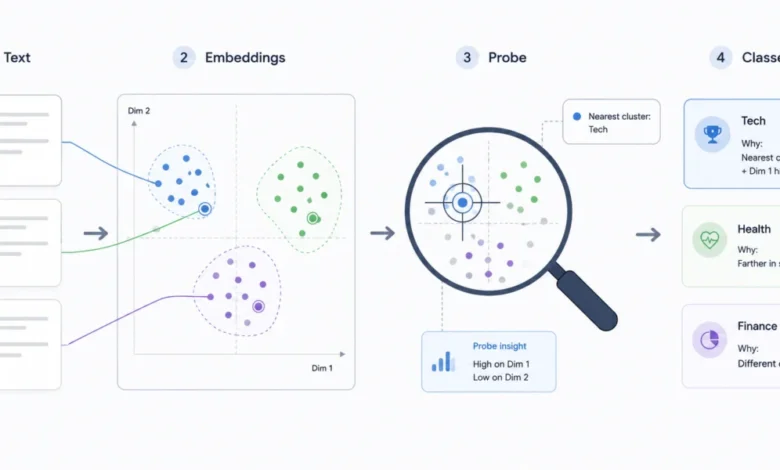
The rapid integration of Large Language Models (LLMs) into modern data pipelines has fundamentally transformed the landscape of natural language processing (NLP). While these models offer unprecedented capabilities in text classification and semantic understanding, their architectural complexity often relegates them to the status of "black boxes." As organizations increasingly rely on LLMs to convert unstructured text into dense numerical vector representations—or embeddings—the challenge of transparency has become critical. By employing diagnostic techniques such as probing classifiers, UMAP visualization, and SHAP (SHapley Additive exPlanations) values, data scientists are now developing methodologies to audit these latent spaces, ensuring that the semantic information captured by LLMs is both reliable and explainable.
The Evolution of Text Representation
Historically, text classification relied on manual feature engineering, such as Bag-of-Words or TF-IDF, which prioritized frequency over context. The advent of deep learning and, subsequently, the transformer architecture introduced the concept of embeddings—high-dimensional vectors that capture nuanced semantic relationships. When a model like an LLM processes a sentence, it maps the text into a multi-dimensional geometric space where similar concepts reside in close proximity. However, because these embeddings are generated through billions of parameters, understanding which specific dimensions contribute to a model’s final decision has remained an elusive objective. This lack of interpretability poses significant risks in sensitive sectors such as legal analysis, medical diagnosis, and financial sentiment monitoring, where justification for model output is a regulatory necessity.
The Methodology of Probing
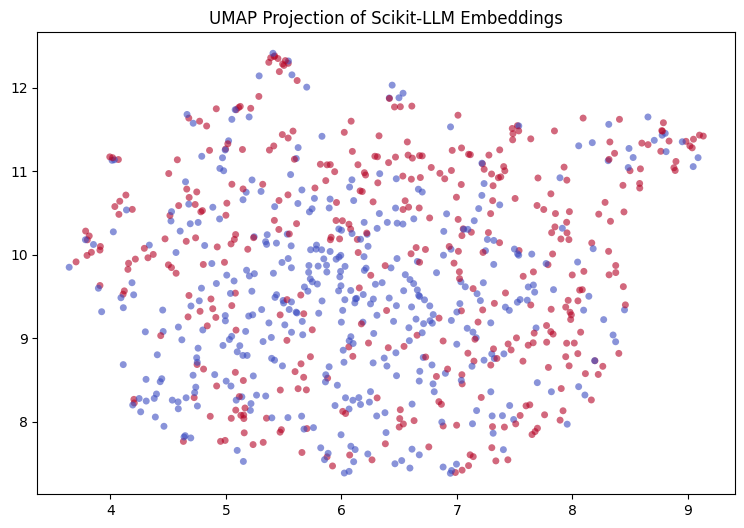
A "probing classifier" serves as a diagnostic bridge between the high-dimensional output of an LLM and the desired classification task. By training a simple, interpretable model—such as a logistic regression classifier—on the embeddings produced by an LLM, practitioners can evaluate the quality of those embeddings. If a linear model can achieve high accuracy on the embedding space, it stands to reason that the LLM has successfully distilled the necessary features for the task. Conversely, if a linear probe fails, it suggests that the information is either absent or requires a more complex, non-linear interpretation.
The process of implementing this audit begins with the configuration of a local environment. Using the Scikit-LLM framework, developers can leverage local LLM distributions via Ollama, which allows for cost-effective, private, and high-speed execution. By utilizing standard datasets like the IMDB movie review corpus, researchers can establish a baseline. In a typical experimental setup involving 1,000 stratified samples, the workflow involves tokenizing raw text, passing it through an embedding model—such as the efficient all-minilm—and feeding the resulting vectors into a logistic regression model. The performance metrics, specifically precision and recall, serve as a proxy for the LLM’s effectiveness in extracting sentiment-relevant features.
Visualization and Dimensionality Reduction
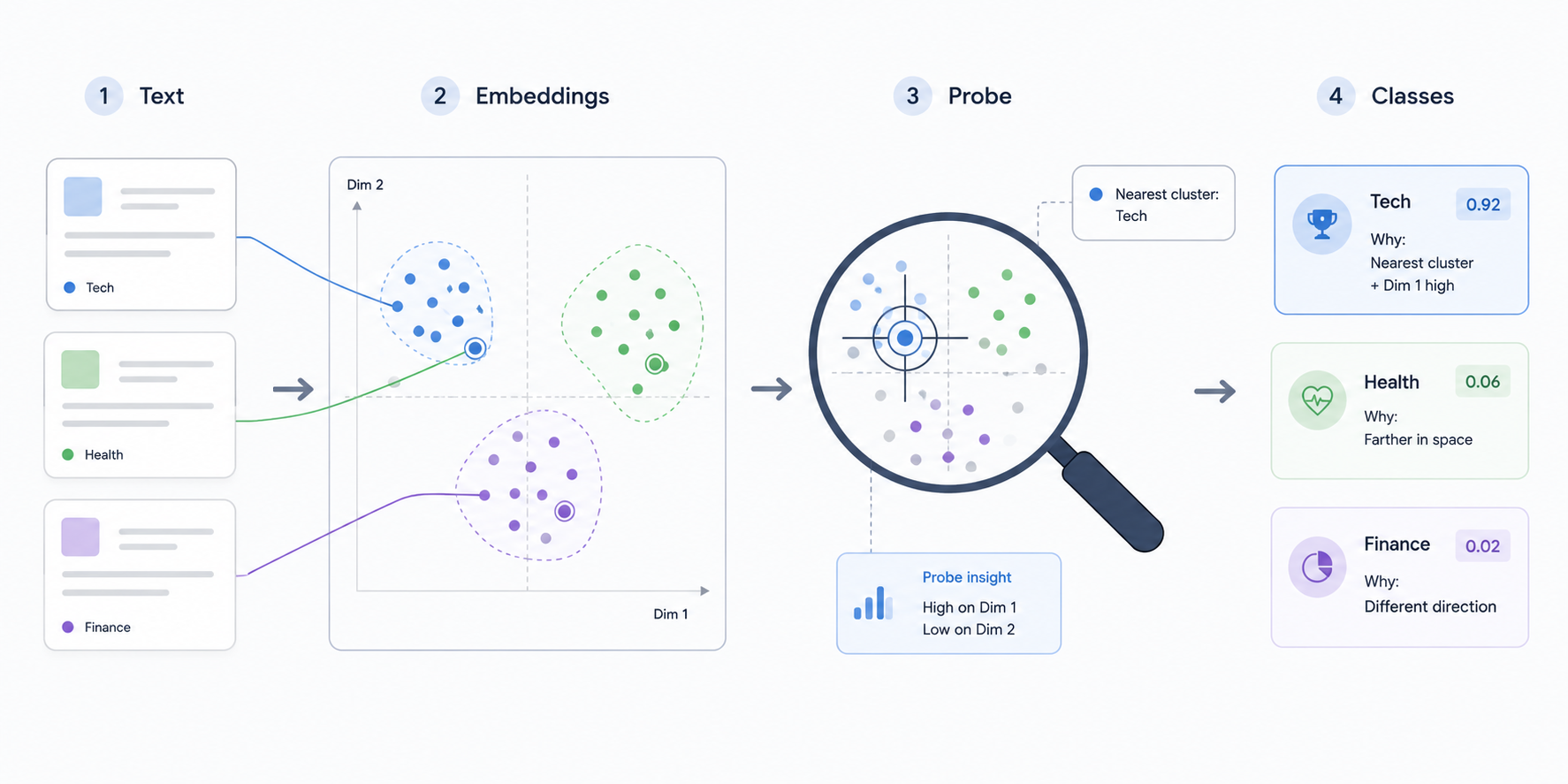
While accuracy metrics provide quantitative assurance, visual intuition is required to understand the structure of the embedding space. UMAP (Uniform Manifold Approximation and Projection) is currently the industry standard for dimensionality reduction. Unlike older techniques such as t-SNE, UMAP preserves both the local and global structures of the data, allowing researchers to see how clusters of text interact in two-dimensional space.
In the context of binary classification, a UMAP projection of LLM embeddings should ideally show a spatial separation between classes. If the "positive" and "negative" clusters overlap significantly, it suggests that the embedding model may be struggling to distinguish between the semantic nuances of the two groups. Observation of these clusters often reveals "noise"—misclassified instances that can be traced back to ambiguous language or domain-specific jargon that the LLM failed to encode correctly.
Quantifying Influence with SHAP Values
The final layer of this diagnostic process is the application of SHAP values. Rooted in cooperative game theory, SHAP provides a mathematically rigorous way to assign importance to each feature (or dimension) within an embedding vector. When applied to the probing classifier, SHAP identifies which dimensions are the primary drivers of a classification.
For instance, in a sentiment analysis task, a SHAP summary plot might reveal that specific latent dimensions act as "sentiment polarizers." If a high value in dimension 208 consistently correlates with negative predictions, that dimension can be interpreted as a surrogate for negative linguistic markers. This allows researchers to move beyond the "black box" description and begin to understand which components of the neural network are essentially "voting" for a particular outcome.
Broader Implications for AI Governance
The shift toward interpretable AI is not merely a technical preference but a growing requirement for corporate and government compliance. As the European Union’s AI Act and other global regulatory frameworks begin to demand transparency in automated decision-making, the ability to explain how a model arrived at a conclusion will become a prerequisite for deployment.
The integration of tools like Scikit-LLM, UMAP, and SHAP represents a maturation of the field. It signals a move away from "performance at any cost" toward a model of "verifiable intelligence." By treating LLM embeddings as data sources that require rigorous validation, the AI community is establishing a standard for accountability.
Looking Ahead
The timeline for this diagnostic approach is accelerating. As LLMs become more specialized, the probes used to test them must also evolve. Researchers are currently exploring how to apply these techniques to multimodal models, where text, image, and audio embeddings must be probed simultaneously to ensure cross-modal consistency.
Furthermore, the democratization of these tools—facilitated by open-source libraries that mirror the familiar Scikit-Learn API—means that interpretability is no longer restricted to large enterprise research labs. Developers building small-to-medium applications can now perform "embedding audits" as part of their standard CI/CD (Continuous Integration/Continuous Deployment) pipelines.
In conclusion, the ability to probe, visualize, and explain embedding spaces is a fundamental necessity for the next generation of AI development. As we continue to delegate complex cognitive tasks to machine learning models, our capacity to understand their internal logic will determine the trust society places in these systems. Through the use of probing classifiers and explainable AI techniques, the opaque processes of LLMs are gradually becoming transparent, paving the way for more robust, reliable, and ethically sound artificial intelligence applications.
Related posts: