Vercel Security Breach Linked to Third-Party AI Tool Compromise as Threat Actors Demand Two Million Dollar Ransom


Cloud development giant Vercel has officially confirmed a significant security incident involving unauthorized access to its internal systems, a breach that has been traced back to the compromise of a third-party artificial intelligence integration. The incident, which came to light in mid-April 2026, has sent ripples through the software development community given Vercel’s central role in the modern web ecosystem as the creator of Next.js and a primary hosting provider for millions of applications. While the company maintains that its core services and open-source projects remain untampered with, a subset of customer data was exposed after threat actors exploited a vulnerability in a Google Workspace OAuth application. The breach has been further complicated by claims from a high-profile threat actor who is allegedly seeking a $2 million ransom in exchange for stolen internal data, including API keys and employee records.
Context and the Role of Vercel in Modern Infrastructure
To understand the gravity of the breach, one must look at Vercel’s footprint in the technology sector. Founded by Guillermo Rauch, Vercel has become the de facto standard for deploying React-based applications through its Next.js framework. Next.js is utilized by major global enterprises, including platforms like TikTok, Hulu, and Twitch, to handle server-side rendering and static site generation. Beyond the framework, Vercel provides a sophisticated CI/CD (Continuous Integration/Continuous Deployment) pipeline, serverless functions, and edge computing capabilities.
Because Vercel acts as the "glue" between source code (often hosted on GitHub or GitLab) and the live production environment, its security is paramount. A compromise at the platform level potentially provides attackers with a "god-mode" view of thousands of web applications, including access to the environment variables that store database credentials, encryption keys, and third-party API tokens.
Chronology of the Security Incident
The timeline of the breach suggests a sophisticated multi-stage attack that leveraged the weakest link in the corporate security chain: third-party integrations. According to statements from Vercel leadership and technical bulletins, the incident unfolded over several days before being publicly disclosed on April 19, 2026.
The initial point of entry was not Vercel’s own infrastructure but rather Context.ai, an AI platform used by Vercel employees. A security failure at Context.ai allowed threat actors to compromise a Google Workspace OAuth application. By gaining control over this application, the attackers were able to hijack the Google Workspace account of a Vercel employee.

Once inside the employee’s account, the threat actors navigated through Vercel’s internal environments. They specifically targeted the management of environment variables. While Vercel employs robust encryption for variables marked as "sensitive," the attackers discovered a loophole involving variables designated as "non-sensitive." By enumerating these unencrypted variables, the attackers were able to move laterally and escalate their privileges, eventually gaining access to a broader range of internal data and deployment snapshots.
On April 19, Vercel issued its first security bulletin, acknowledging the unauthorized access and noting that they had engaged external incident response experts. Shortly thereafter, the company updated its advisory to include specific technical indicators, such as the Google OAuth App ID involved in the breach, advising administrators to audit their own workspaces for similar connections.
Technical Analysis: OAuth and Environment Variables
The Vercel breach highlights two critical areas of modern cybersecurity: OAuth security and the classification of sensitive data. OAuth (Open Authorization) is a standard that allows third-party services to access user data without sharing passwords. However, if a third-party app is compromised, it can act as a persistent back door into the primary organization. In this case, the "110671459871" OAuth application became the vehicle for the initial intrusion.
The second technical failure involved the handling of "non-sensitive" environment variables. In cloud development, environment variables are used to configure applications for different stages (development, preview, production). Vercel offers a feature where users can toggle a "sensitive" flag. Variables marked sensitive are encrypted at rest and masked in logs. Variables not marked as such are stored in a way that allows for easier debugging and visibility.
Vercel CEO Guillermo Rauch admitted that while core systems were protected by defense-in-depth mechanisms, the attackers successfully "enumerated" these non-sensitive variables to gain further access. This suggests that even data deemed "non-sensitive" can, when aggregated, provide enough context for an attacker to reconstruct access paths to more critical systems.
Claims by Threat Actors and Extortion Attempts
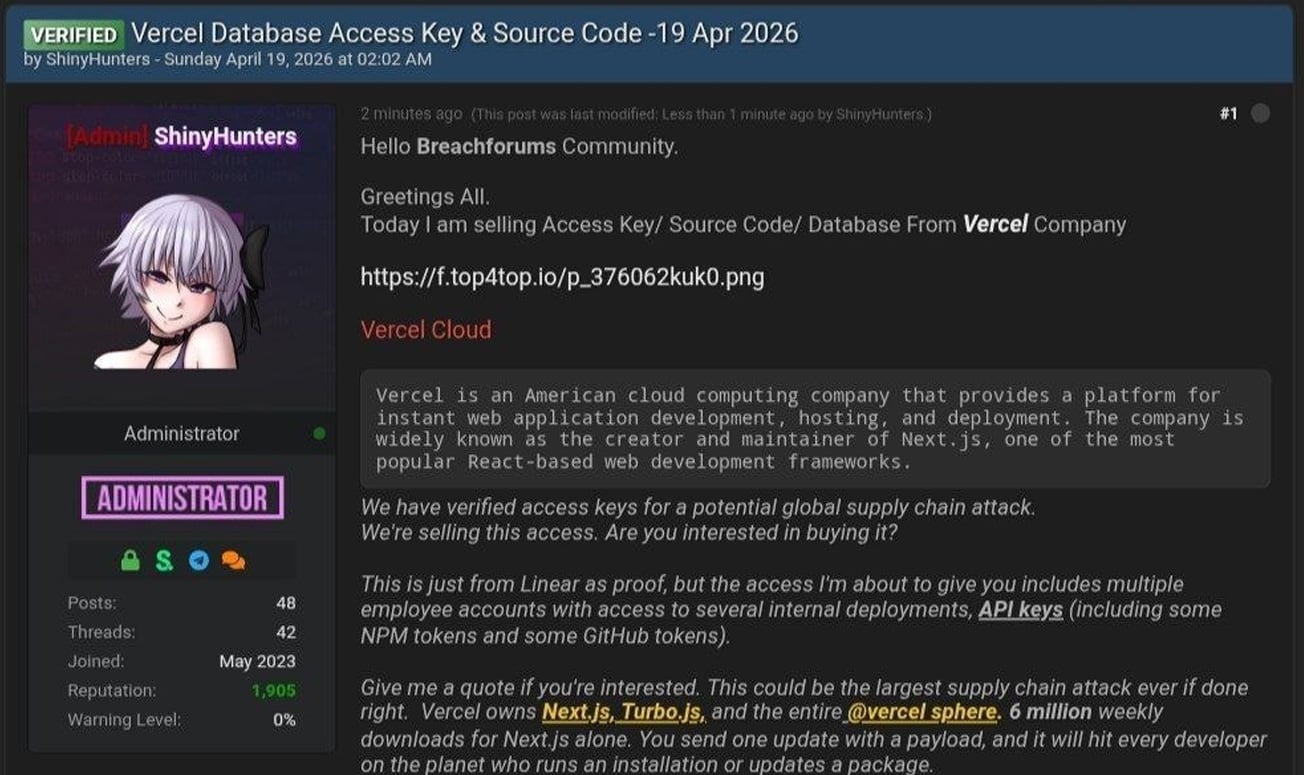
As Vercel was working to remediate the technical breach, a threat actor operating under the alias "ShinyHunters" appeared on a prominent hacking forum and Telegram channels to claim credit for the attack. ShinyHunters is a well-known name in the cybercrime world, previously linked to massive data breaches at companies like Ticketmaster and Santander. However, there is currently conflicting information within the hacking community; some associates of the group have denied involvement, suggesting the attacker may be an individual using the "ShinyHunters" brand to increase leverage.

The attacker posted evidence of the breach, including:
- Employee Records: A text file containing 580 records of Vercel employees, including names, internal email addresses, and account activity timestamps.
- Internal Dashboards: Screenshots of what appeared to be Vercel’s internal Enterprise management console.
- Source Code and Tokens: Claims of having stolen NPM tokens, GitHub tokens, and access to internal deployments via the project management tool Linear.
The threat actor further alleged that they had initiated contact with Vercel to negotiate a ransom. According to messages shared on Telegram, the demand stands at $2 million. The attacker threatened to leak the full cache of stolen data, which they claim includes database backups and proprietary source code, if the payment is not made. Vercel has not officially confirmed whether it is engaging in negotiations, though the company’s bulletin states it has notified law enforcement, a step that usually precedes a firm refusal to pay.
Official Response and Customer Guidance
Vercel has taken a proactive stance in its public communication, providing regular updates as the investigation progresses. The company has confirmed that its core open-source repositories—including Next.js and Turbopack—were not modified or compromised during the incident. This is a crucial distinction, as a "poisoned" version of Next.js could have resulted in a global supply chain disaster affecting millions of websites.
To mitigate ongoing risks, Vercel has implemented several changes to its platform:
- Dashboard Enhancements: A new overview page for environment variables has been rolled out to help developers quickly identify which variables are encrypted.
- Management Interface: Improved controls for managing sensitive variables to encourage better security hygiene.
- Mandatory Reviews: Vercel is strongly advising all customers to review their current environment variables and migrate any secrets—such as API keys, database passwords, or private tokens—to the "sensitive" category.
The company also recommends that Google Workspace administrators search their logs for the specific OAuth App ID associated with the Context.ai breach to ensure no other accounts have been compromised via the same vector.
Broader Implications for the Tech Industry
The Vercel incident serves as a stark reminder of the risks inherent in the "AI gold rush." As companies rush to integrate third-party AI tools like Context.ai into their workflows, they inadvertently expand their attack surface. The complexity of modern software supply chains means that a vulnerability in a small, specialized AI tool can lead to the compromise of a massive infrastructure provider.
Furthermore, the breach underscores the danger of the "non-sensitive" data classification. In a security-first environment, the assumption should be that all configuration data is potentially sensitive. The ability of the attackers to escalate their access through simple enumeration of unencrypted variables will likely lead to a shift in how cloud platforms handle default encryption settings.
As the investigation continues, the focus will remain on whether the attackers truly possess the high-level API keys and source code they claim to have. If the stolen GitHub and NPM tokens are authentic and active, the potential for future supply chain attacks remains a lingering threat. For now, Vercel’s rapid disclosure and technical transparency have been praised by some in the security community, even as the company faces the difficult task of securing its perimeter against an increasingly sophisticated class of extortionists.
Vercel has requested that anyone with further information regarding the incident contact their security team or law enforcement. The company has pledged to maintain its security bulletin as a live resource for impacted customers until the remediation process is complete.