The Wokyis G5 and G7 Retro Docks Transform Mac Studio and Mac Mini Workflows with Integrated Displays and Thunderbolt 5 Connectivity

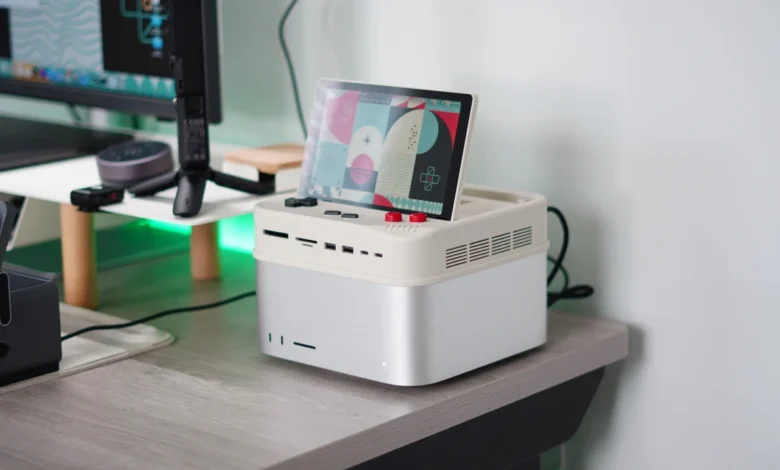
The release of the Wokyis G5 and G7 docking stations marks a significant evolution in peripheral hardware designed for Apple’s high-performance desktop lineup. By bridging the gap between modern high-speed connectivity and the aesthetic sensibilities of 1980s computing, Wokyis has introduced a series of modular docks tailored for the M4 Mac mini and the Mac Studio. These devices are not merely aesthetic tributes to early personal computing; they are sophisticated 16-in-1 hubs that integrate NVMe SSD storage, high-resolution displays, and a robust array of professional-grade ports into a unified, desk-saving footprint.
![This unique retro dock adds a flip-up display, Thunderbolt 5, & 8TB storage to your Mac [Video]](https://9to5mac.com/wp-content/uploads/sites/6/2026/09/wokyis_2x1_400kb.jpg?quality=82&strip=all&resize=1200,628)
Evolution of the Retro-Dock Concept
The inception of the retro-themed dock concept began as a niche interest for power users seeking to reclaim the character lost in the minimalist, "sterile" design language of modern computing. Last year, the initial rollout of a retro-style dock for the M4 Mac mini set a new standard for how hardware manufacturers could cater to the enthusiast market. The original unit provided a 5-inch display and basic port expansion, establishing a proof-of-concept that resonated with creative professionals.
The newly announced Wokyis G5 and G7 models represent a major iteration of this platform. The G5 is designed specifically for the footprint of the M4 Mac mini, while the G7 serves the larger chassis of the Mac Studio. Both units prioritize high-bandwidth data transfer, with the flagship G7 model boasting 80 Gbps Thunderbolt 5 capabilities, allowing users to leverage external NVMe SSDs at speeds approaching those of internal drive arrays.
![This unique retro dock adds a flip-up display, Thunderbolt 5, & 8TB storage to your Mac [Video]](https://9to5mac.com/wp-content/uploads/sites/6/2026/09/1CEFFF5C-94EE-4C5A-8F65-B99038804E62_1_105_c.jpeg?quality=82&strip=all&w=800)
Chronology and Market Introduction
The product development cycle for the G5 and G7 has been characterized by a focus on "pro-level" functionality. Following the successful reception of the previous generation, Wokyis initiated a pre-order phase via the crowdfunding platform Kickstarter in September 2026. This strategy allows the manufacturer to gauge demand while securing the necessary capital for mass production.
Global shipments are scheduled to commence in October 2026. This timeline aligns with the broader industry trend of hardware manufacturers releasing modular accessories in the wake of major Apple product announcements, ensuring that the new docks are available to consumers immediately after they acquire the latest Mac mini or Mac Studio iterations.
![This unique retro dock adds a flip-up display, Thunderbolt 5, & 8TB storage to your Mac [Video]](https://9to5mac.com/wp-content/uploads/sites/6/2026/09/99559A04-E0E2-4336-91EE-1AB2B68D3340_1_105_c1.jpeg?quality=82&strip=all)
Technical Specifications and Performance Data
The Wokyis G7 is a 16-in-1 docking solution that includes a 7-inch IPS panel, which acts as a secondary, auxiliary display for macOS. This display operates at a resolution of 1280 x 800 pixels and is fully recognized by the operating system as an external monitor. This integration allows users to offload specific tasks—such as system monitoring, chat applications, or video playback—to the dock, freeing up the primary display real estate for intensive production work.
Key technical attributes of the G7 include:
![This unique retro dock adds a flip-up display, Thunderbolt 5, & 8TB storage to your Mac [Video]](https://9to5mac.com/wp-content/uploads/sites/6/2026/09/B8F9A0A2-AF4A-4BAA-9EF7-9F4FE3609C78_1_105_c.jpeg?quality=82&strip=all&w=800)
- Connectivity: Thunderbolt 5 support with 80 Gbps throughput for the flagship model, alongside 10 Gbps options for the standard G5.
- Storage: Integrated NVMe SSD enclosure, enabling massive storage expansion without the prohibitive costs associated with Apple’s internal storage upgrades.
- Tactile Interface: Physical buttons for media playback, screen brightness, volume, and shortcut macros for system commands like screenshots and copy-paste functions.
- Port Density: The unit features a comprehensive suite of inputs, including a CF Express card slot for high-end photography and videography workflows, multiple USB-C ports, and a microSD card reader.
Thermal management has also been addressed, with each package including high-quality thermal tape for SSD installation, ensuring that high-speed data transfers do not lead to thermal throttling—a common issue with compact external storage solutions.
The Economics of Storage Expansion
A critical driver for the adoption of these docks is the cost-to-performance ratio. As of late 2026, the premium charged by Apple for higher-tier internal SSD storage remains a significant financial hurdle for creative professionals. By incorporating an NVMe enclosure into the dock, Wokyis provides a viable alternative that allows users to source their own high-speed storage modules.
![This unique retro dock adds a flip-up display, Thunderbolt 5, & 8TB storage to your Mac [Video]](https://9to5mac.com/wp-content/uploads/sites/6/2026/09/3C4CABCF-CE9C-411A-A4F7-BD3438C699D1_1_105_c.jpeg?quality=82&strip=all&w=800)
Even as global NAND flash prices fluctuate, the ability to hot-swap or upgrade storage independently of the computer itself provides a level of future-proofing that is rarely found in integrated desktop systems. This modularity is particularly advantageous for editors who handle 4K or 8K raw video, as it allows them to dedicate the NVMe drive entirely to project files while keeping the OS and applications on the internal drive.
Professional Utility and Workflow Integration
Beyond the visual appeal, the primary value proposition of the Wokyis G5 and G7 lies in its role as a centralized desk hub. By consolidating various adapters, card readers, and storage enclosures into a single, powered device, the dock minimizes cable clutter and reduces the strain on the Mac’s limited rear ports.
![This unique retro dock adds a flip-up display, Thunderbolt 5, & 8TB storage to your Mac [Video]](https://9to5mac.com/wp-content/uploads/sites/6/2026/09/326D4586-0642-483C-8FE2-098FC82AE742_1_105_c.jpeg?quality=82&strip=all&w=800)
In professional workflows, such as those involving Final Cut Pro or DaVinci Resolve, the secondary display has proven effective for real-time monitoring. For instance, an editor can dedicate the 7-inch screen to the secondary output of the software, using it for color-grading reference or as a persistent timeline view, which keeps the main interface clean. The physical controls on the front of the unit serve as a tactile shortcut interface, reducing the need to switch between the mouse and keyboard for basic system adjustments.
Broader Industry Implications
The success of products like the Wokyis G5 and G7 highlights a growing trend where users seek to personalize their workspace with hardware that bridges the gap between utility and form. As computers become more powerful and compact, the space around the machine becomes a focal point for customization.
![This unique retro dock adds a flip-up display, Thunderbolt 5, & 8TB storage to your Mac [Video]](https://9to5mac.com/wp-content/uploads/sites/6/2026/09/BEE45C0E-E3F3-49E8-87C8-6D5412BFD649_1_105_c.jpeg?quality=82&strip=all&w=800)
However, these docks also represent an interesting shift in the peripheral market. They suggest that there is a significant, underserved segment of the professional market that desires more than just a standard black box. They want their tools to feel personal and intuitive. By leveraging the nostalgia of the 1984 Macintosh aesthetic, Wokyis is tapping into a demographic that values both the history of computing and the high-performance requirements of modern creative software.
Industry analysts note that while such docks are specialized, they address a genuine pain point for Mac Studio and Mac mini users: the lack of accessible, front-facing ports and the high cost of proprietary storage. As Apple continues to move toward more streamlined, port-limited designs, third-party manufacturers are likely to fill the void with increasingly sophisticated docking solutions.
![This unique retro dock adds a flip-up display, Thunderbolt 5, & 8TB storage to your Mac [Video]](https://9to5mac.com/wp-content/uploads/sites/6/2026/09/C5283C8B-C1FE-4689-9C2D-E2667B594B92_1_105_c.jpeg?quality=82&strip=all&w=800)
Conclusion and Availability
The Wokyis G5 and G7 are positioned as high-end accessories for the modern professional. While they cater to a specific aesthetic, their underlying performance—particularly the Thunderbolt 5 integration and the inclusion of high-speed NVMe support—positions them as functional tools rather than just desktop novelties.
With pre-orders currently live on Kickstarter and a tiered pricing structure that includes early-bird discounts, the market response will likely dictate the future of this retro-modern design language. For professionals looking to optimize their workflow and reclaim their desk space, the Wokyis lineup offers a compelling balance of legacy charm and forward-looking performance. The transition from a "sterile" desktop environment to a highly personalized, efficient workstation is, for many, worth the investment in these specialized peripherals.