Eighty-Five-Year-Old WWII German Enigma Message Cracked by AI Tool GTP-Astra in Record Time

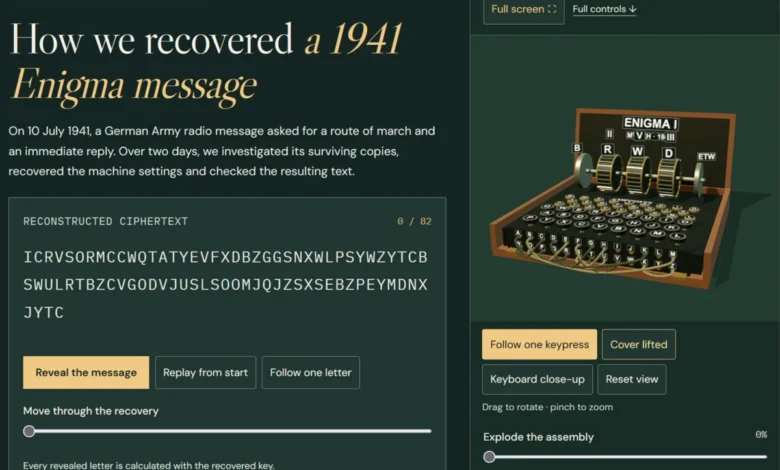
An enduring cryptographic puzzle from the height of the Second World War has finally yielded its secrets, courtesy of artificial intelligence. A historical German Army Enigma transmission dating back 85 years—commonly referred to as the MVUEH message—has been successfully decrypted by an advanced AI system named GTP-Astra in a mere 48 hours. According to findings published by the Crypto Cellar, this formidable cryptographic milestone marks a significant intersection of modern machine learning capabilities and historical codebreaking, collapsing a workload that traditionally occupied human experts for weeks or even months into a single weekend.
The intercepted transmission, designated by its ciphertext beginning with the letters MVUEH, was originally dispatched by the German Army to the notorious SS-Totenkopf (Death’s Head) Division on July 10, 1941. This date coincided with the zenith of Nazi military expansion during the opening phases of Operation Barbarossa, the massive Axis invasion of the Soviet Union. Despite the message being publicly accessible to amateur and professional codebreaking enthusiasts online since 2005, its underlying plaintext remained an impenetrable enigma for nearly two decades. The recent breakthrough by GTP-Astra not only closes a minor chapter in WWII historiography but also signals a profound shift in how historical ciphers, and potentially modern data security challenges, may be analyzed in the future.
Chronology of an Unsolved WWII Cipher
The historical arc of the MVUEH message spans more than eight decades, transitioning from a frontline wartime order into a digital-era artifact of cryptographic endurance.
In July 1941, the Wehrmacht and SS units were rapidly pushing deep into Soviet territory. Communication security was paramount, and the German military relied extensively on the Enigma cipher machine to secure tactical and strategic orders. The MVUEH signal was intercepted by Allied monitoring stations during this chaotic period, logged, archived, and eventually filed away as unreadable due to the vast number of possible rotor settings and plugboard configurations used by the cryptographic device.
For more than six decades, the encrypted text remained dormant in archival collections. However, the advent of the internet age catalyzed a collaborative, crowdsourced approach to historical codebreaking. In 2005, a collection of uncracked Enigma messages—including the MVUEH transmission—was shared with online enthusiasts and amateur cryptographers through specialized digital archives like the Crypto Cellar. Despite the combined efforts of hobbyist codebreakers equipped with modern personal computers, the message resisted all traditional brute-force and analytical methods, largely due to missing contextual metadata, short message lengths, and the exponential mathematical complexity inherent in the Enigma’s wiring mechanics.
The stalemate persisted until the recent deployment of GTP-Astra, a specialized artificial intelligence framework. Tasked with analyzing the historical cipher, Astra bypassed traditional linear analytical bottlenecks. Within two days of processing, the system successfully derived the correct rotor configurations, ring settings, and plugboard connections, outputting the coherent German plaintext that had eluded humanity for 85 years.
The Technical Challenge of the Enigma Machine
To understand the magnitude of GTP-Astra’s achievement, it is necessary to examine the cryptographic architecture of the Enigma machine, a device that once formed the backbone of secure Axis communications.
Invented at the end of the First World War by Arthur Scherbius, the Enigma machine resembles a heavy typewriter equipped with a lampboard and a set of interchangeable rotors. When an operator pressed a key, an electrical current flowed through a series of wheels, constantly altering the electrical path. Every time a letter was typed, at least one rotor would step, changing the substitution cipher dynamically. For instance, pressing the letter ‘A’ might illuminate ‘D’ on the first keystroke, but on the second keystroke, ‘A’ might translate to ‘Q’.
The complexity of the wartime Enigma models utilized by the German Army and Air Force (Heer und Luftwaffe) was staggering. Typically, operators selected three rotors from a pool of five (and later eight), arranged them in any order, and adjusted their internal ring settings. Furthermore, a plugboard (Steckerbrett) at the front of the machine allowed pairs of letters to be swapped manually before and after the electrical current passed through the rotors.
Mathematically, the number of possible key combinations for a standard wartime Enigma machine was astronomical, running into the hundreds of millions of millions (approximately $1.5 times 10^20$ possible settings). While historical codebreakers at Bletchley Park, led by figures like Alan Turing, successfully constructed electromechanical computers known as "bombes" to exploit operational flaws, human error, and predictable message headers (such as weather reports or daily administrative sign-offs), short or non-standard tactical transmissions lacking known cribs (probable words) remained extraordinarily difficult to decode retroactively.
When applied to the MVUEH message, human researchers typically relied on heuristic analysis, linguistic pattern recognition, and specialized software tools like Enigma Simulacra. Even with optimized algorithms, verifying hypotheses and testing permutations manually or semi-manually required extensive trial and error, making the process a labor of love spanning weeks or months per difficult intercept.
Reactions and Insights from the Cryptographic Community
The speed at which GTP-Astra unlocked the 1941 transmission has left researchers at the Crypto Cellar profoundly astonished. Experts associated with the project noted that the AI achieved in 48 hours what would conventionally demand weeks or even months of intensive human labor.
"What Astra managed to do in just two days would take a human researcher weeks or even months," remarked researchers from the Crypto Cellar collective in their initial assessment. Currently, the team is working backward through the AI’s operational logs, struggling to fully comprehend the specific heuristics, pattern-matching shortcuts, and optimization strategies the machine employed to arrive at the solution so rapidly.
Unlike a standard brute-force algorithm that systematically tests every conceivable combination until a match is found—an approach that, even with modern computing, can be resource-intensive—artificial intelligence systems like Astra often utilize contextual learning, probabilistic modeling, and pattern inference. By identifying subtle statistical anomalies or structural linguistic markers within the encrypted ciphertext that mirror historical German military syntax, the AI appears to have dynamically narrowed down the search space, bypassing the exhaustive computations that bog down traditional software.
This unexpected methodology has sparked intense discussion among computational historians and computer scientists. The central question is not merely that the message was decoded, but how the neural architecture navigated an environment historically governed by pure combinatorial mathematics.
Broader Implications for Historical Preservation and Modern Security
The successful AI decryption of the MVUEH message carries dual implications, casting light both on the future of historical research and the evolving landscape of modern cryptography.
From a historical perspective, the application of advanced artificial intelligence to archival wartime intercepts opens unprecedented avenues for historical discovery. There remain thousands of intercepted Axis and Allied signals from World War II that were archived, ignored, or deemed permanently uncrackable due to missing context or resource constraints. As specialized AI tools become more accessible to historians and archival institutions, a vast backlog of historical data could soon be systematically reviewed, potentially shedding new light on tactical movements, intelligence operations, and the daily realities of military units like the SS-Totenkopf Division.
However, the feat also serves as a sobering reminder regarding the relentless advancement of computational power and algorithmic intelligence. While the Enigma machine is a rudimentary, mechanical precursor to modern digital encryption—and utterly distinct from contemporary cryptographic standards such as AES-256 or RSA—the underlying lesson remains potent. Problems that were once thought to require prolonged human cognitive effort and collaborative networks can now be bypassed by machine intelligence scaling at exponential rates.
As cryptographers look toward an uncertain future dominated by quantum computing and advanced machine learning, the cracking of the MVUEH message stands as a symbolic bridge between the analog cryptography of the 20th century and the automated computational power of the 21st. For now, researchers at the Crypto Cellar will continue poring over Astra’s digital footprints, eager to document the exact cognitive pathways an artificial intelligence used to solve a puzzle that baffled generations of human codebreakers.