Google DeepMind and Google Research Unveil WeatherNext 3, a Landmark Global Weather AI Model

Weather touches nearly every facet of modern human activity, steering everything from daily personal routines to macro-level global operations. While simple decisions like carrying an umbrella or postponing a weekend outing are trivial, high-stakes weather events carry profound economic and societal consequences. Prolonged droughts, aggressive heatwaves, sudden shifts in wind patterns, and torrential downpours have cascading impacts on global agriculture, intricate supply chains, renewable energy generation grids, and national macroeconomic stability. For decades, predicting these phenomena relied heavily on numerical weather prediction (NWP) models—complex, supercomputer-driven physics simulations that, despite their utility, suffer from systemic computational lags and resolution limits.
The advent of artificial intelligence in recent years has fundamentally altered this landscape, harnessing historical climate data to generate faster and significantly more accurate global predictions than traditional methodologies. Yet, a persistent hurdle has remained: forecasting hyper-local, rapidly evolving atmospheric shifts. Previous iterations of AI weather models frequently lacked the necessary spatial resolution to distinguish micro-climates and struggled to ingest real-time observational feeds, such as raw satellite data.
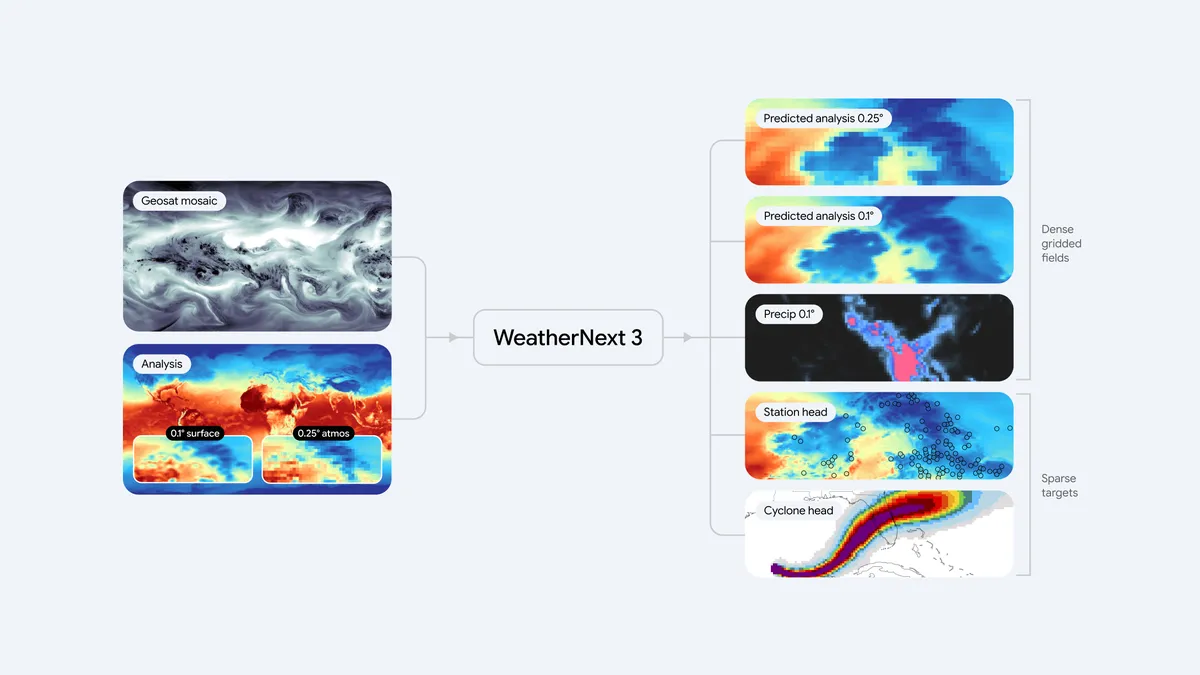
To bridge this gap, Google DeepMind and Google Research have officially announced WeatherNext 3. According to independent, live evaluations conducted by Brightband, WeatherNext 3 stands as the most advanced and accurate global weather forecasting model developed to date. By learning directly from live, real-time observations and deploying a flexible Functional Generative Network (FGN) mesh transformer architecture, the model delivers timely, hyper-localized forecasts. Ingesting raw satellite mosaics allows WeatherNext 3 to produce fresh, high-resolution global predictions every single hour, which are now being integrated seamlessly across core Google products including Search, Gemini, Maps, Google Maps Platform, and Cloud infrastructure.
Evolution of Weather Forecasting: From Traditional Physics to Generative AI
The historical trajectory of meteorological science has been defined by a constant race between computational power and atmospheric complexity. Traditional forecasting models rely on Navier-Stokes equations and fluid dynamics to simulate the Earth’s atmosphere. While these numerical weather prediction models have saved countless lives by providing early warnings for major weather systems, they possess inherent bottlenecks. Chief among these is the data lag—often stretching to six hours—required to ingest, process, and compute physics-based simulations across massive supercomputing clusters. This delay introduces predictive biases, particularly for highly volatile variables like rapid-onset precipitation or localized surface temperature spikes.
The introduction of machine learning to meteorology shifted the paradigm by treating forecasting as a pattern-recognition problem trained on historical reanalysis datasets. While initial AI models demonstrated the ability to forecast planetary-scale wind and pressure patterns in a fraction of a second, they often produced overly smoothed or pixelated representations. They struggled to resolve fine topographical details—such as mountain ranges, valleys, and coastal boundaries—that dictate local weather experiences. Furthermore, because these models typically relied on historical NWP outputs rather than direct physical observations, they inherited the limitations and biases of their training data.
WeatherNext 3 represents a definitive evolutionary leap by breaking away from indirect NWP dependency. By directly ingesting raw, live geostationary satellite imagery and training on sparse weather station observation networks, the model establishes a continuous feedback loop with the physical world. This structural shift allows WeatherNext 3 to bypass traditional computational constraints, resulting in a system that mirrors real-time atmospheric reality with unprecedented fidelity.
Unprecedented Spatial Resolution and Hourly Temporal Frequency
The practical utility of any meteorological forecast hinges on its resolution across both time and space. WeatherNext 3 fundamentally redefines these parameters by generating hourly forecasts at multiple spatial scales while maintaining strict physical consistency from broad planetary wind streams down to localized topography.
The model visualizes surface variables—such as ambient temperature and moisture levels—at a sharp 5-kilometer resolution. Other crucial surface parameters are captured at a 10-kilometer resolution, while high-altitude atmospheric variables like wind speed are rendered at 25 kilometers. Measured globally, WeatherNext 3 delivers a weather picture roughly five times sharper than its predecessor, WeatherNext 2, which operated on a uniform 25-kilometer grid with 6-hour update cycles.
This spatial sharpness is paired with a continuous, hourly update cadence. Critical weather events, such as severe convective storms and fast-moving cold fronts, can materialize with little warning. Traditional models, restricted by their multi-hour processing windows, often fail to capture these sudden genesis events until they are already underway. By refreshing hourly with the latest geostationary satellite mosaics, WeatherNext 3 provides emergency responders, aviation authorities, and municipal planners with the early, granular insights required to mount effective, proactive responses.
Moreover, the model’s ability to train directly on sparse weather station observation data solves a long-standing equity issue in global meteorology. Historically, regions across Latin America, Africa, and the Asia-Pacific have been underserved by high-resolution forecasting due to the immense capital and supercomputing expenditures required to run traditional regional models. By deploying a global 5-kilometer grid that natively accounts for regional topography without exorbitant local computing costs, WeatherNext 3 extends high-fidelity meteorological intelligence to billions of people and local enterprises in previously neglected markets.
Breakthrough Precision in Precipitation Forecasting
Precipitation forecasting has long been considered the ultimate stress test for global weather models. Rain, snow, and ice systems are driven by chaotic, fast-moving cloud microphysics that occur on tiny spatial scales, making them exceptionally difficult for traditional physics simulations to track accurately. Consequently, prior AI forecasts frequently produced blurry, diffused rainfall estimates or missed the distinct boundaries of severe storms entirely.
To overcome this persistent weakness, Google’s research teams trained WeatherNext 3 on two exceptionally rigorous sources of precipitation data: NASA’s satellite-based Integrated Multi-satellite Retrievals for GPM (IMERG) and proprietary global precipitation reanalysis derived from satellite radar.
The empirical results of this training methodology represent a massive leap forward in hydrological forecasting. In rigorous medium-range global evaluations against established baselines, WeatherNext 3 demonstrated a Continuous Ranked Probability Score (CRPS) improvement of up to 60 percent against IMERG data, a 30 percent improvement against multi-radar multi-sensor (MRMS) data, and a 10 percent improvement against traditional rain gauge measurements during early lead times. Visual comparisons of probability of precipitation forecasts clearly illustrate that while older models output generalized, pixelated precipitation footprints, WeatherNext 3 successfully mirrors actual satellite ground truth, sharply defining the convective bands of complex weather systems.
Empowering the Global Clean Energy Transition
Beyond traditional public safety and daily planning, WeatherNext 3 incorporates variables specifically engineered to support the burgeoning renewable energy sector. As global power grids transition away from fossil fuels toward variable renewable sources like wind and solar, grid operators face acute forecasting challenges. Unlike coal or natural gas plants, which can be ramped up or down on demand, wind and solar generation depend entirely on atmospheric conditions.
WeatherNext 3 directly addresses this operational vulnerability by introducing precise predictive metrics tailored for clean energy assets. The model forecasts 100-meter wind speeds—mirroring the hub-height of modern industrial wind turbines—providing wind-energy developers with exact output estimations. Simultaneously, it generates high-resolution forecasts for cloud cover and downward solar radiation, enabling large-scale solar farms to anticipate incoming atmospheric shading and calculate precise ground-level light availability.
These specialized variables are vital for global clean energy integration. By allowing grid operators and utility providers to accurately predict power generation fluctuations hours in advance, WeatherNext 3 helps match supply with consumer demand, minimizing energy waste, preventing localized grid overloads, and stabilizing energy markets during periods of volatile weather.
Ecosystem Integration and Broader Implications
To maximize the real-world utility of these technical advancements, Google is systematically weaving WeatherNext 3 into its expansive product ecosystem and planetary-scale platforms. The model’s outputs are now integrated into Google Search, Gemini, Maps, Google Maps Platform, and Cloud services, putting advanced weather intelligence directly into the hands of billions of everyday consumers, businesses, and enterprise developers.
The broader implications of this technological leap are profound. In the agricultural sector, farmers can leverage hyper-local temperature and precipitation data to optimize irrigation schedules, apply treatments efficiently, and protect sensitive crops against sudden frosts. In logistics and supply chain management, autonomous routing systems can dynamically circumvent emerging severe weather corridors, reducing transit delays and fuel consumption. For emergency management agencies, the combination of hourly updates and 5-kilometer resolution offers a vital early-warning buffer against extreme weather events intensified by global climate change.
Despite these advancements, developers and scientists emphasize that the Earth’s atmosphere will inherently retain a degree of chaotic unpredictability. Official weather forecasts, severe weather alerts, and public safety advisories should always be cross-referenced with local meteorological agencies and national weather services. Nevertheless, by breaking free from the constraints of traditional numerical modeling and grounding artificial intelligence in continuous, real-world observations, WeatherNext 3 marks a decisive step toward a future where digital forecasts finally match the complex reality unfolding on the ground.