Yelp personalization categories lifestyle app aims to revolutionize how users discover and experience local businesses. By tailoring search results, recommendations, and content displays to individual user preferences and lifestyle choices, Yelp can enhance user engagement and satisfaction. This approach promises a more relevant and personalized experience, differentiating Yelp from competitors and creating a more compelling user journey.
This exploration delves into the core components of such a personalization strategy, examining UX design, data analysis, content categorization, app features, competitive analysis, and visual design considerations. The focus is on creating a robust and effective personalization system that resonates with diverse user demographics and preferences.
User Experience (UX) Design Considerations
Personalization is key to creating a compelling user experience in a lifestyle app like Yelp. By tailoring content and recommendations to individual user preferences, Yelp can significantly improve engagement and satisfaction. This approach fosters a deeper connection between users and the platform, making it more valuable and relevant to their daily lives.Understanding and catering to diverse user needs and preferences is crucial for building a successful lifestyle app.
Personalization allows Yelp to adapt to the unique tastes and interests of different demographics, enhancing their overall experience and encouraging continued use.
Personalization Enhancing User Experience
Personalization in a lifestyle app like Yelp can greatly enhance the user experience for different demographics. For instance, a young professional seeking trendy restaurants might receive recommendations for popular brunch spots or late-night bars in their neighborhood, while a family with children might see options for kid-friendly eateries and activities. This tailored approach ensures that the app’s content remains relevant and engaging for users with diverse needs and interests.
Personalized Search Results
Yelp can personalize search results based on user preferences and past activity. For example, if a user frequently searches for Italian restaurants in the downtown area, future searches might prioritize those restaurants and similar establishments. Additionally, incorporating location data can lead to even more relevant results. If a user frequently visits a specific neighborhood, the app can suggest restaurants or activities in that area.
Further, Yelp can use browsing history to predict user interests and provide recommendations for related topics. This proactive approach ensures a more targeted and satisfying search experience.
Personalized UX Elements
Various UX elements can be personalized to improve the user experience. Recommendations can be tailored to specific user preferences, such as dietary restrictions, cuisines, or price ranges. Category displays can be organized based on user interests, showing the most relevant options first. Content displays can be adjusted to prioritize information most valuable to the user, like reviews from users with similar tastes or location-specific details.
User Flow Diagram
The following user flow diagram illustrates a personalized Yelp search experience. Users begin by entering their search criteria. The app then analyzes their past activity and preferences to personalize the search results. Recommendations are displayed alongside the search results, tailored to the user’s interests. The user can then refine their search or explore suggested options.“`[User Flow Diagram Image Description: A simplified diagram depicting a user’s journey through a personalized Yelp search.
The diagram starts with a user inputting search criteria (e.g., “Italian restaurant near me”). The app processes this input, referencing the user’s past activity and preferences to provide personalized search results. These results are presented alongside tailored recommendations. Users can further refine their search or explore the suggested options. The diagram shows different possible user paths, including clicking on a recommendation or further filtering the search results.
This visually depicts the flow of a personalized Yelp search.]“`
Comparison of Personalized and Non-Personalized Search Experiences
| Feature | Personalized | Non-Personalized |
|---|---|---|
| Search Results | Relevant to user’s interests, considering past activity and preferences | Less relevant, potentially showing results that don’t match the user’s interests |
| Recommendations | Tailored to user preferences, suggesting items based on past behavior and interests | Generic, providing general recommendations without considering individual preferences |
| Content Display | Customized to user’s needs, prioritizing relevant information and filtering out less important details | Standard, presenting all information without prioritization or filtering |
Data Analysis and Personalization Strategies
Yelp’s lifestyle app can leverage user data to create highly personalized experiences. This goes beyond simply recommending nearby restaurants; it’s about understanding user preferences and anticipating needs, from finding the perfect yoga studio to discovering the latest farmers’ market. Sophisticated data analysis and personalization strategies are key to this. This approach can significantly enhance user engagement and satisfaction, ultimately driving app adoption and usage.Data-driven personalization enables Yelp to understand user interests and tailor recommendations accordingly, improving the app’s overall value proposition.
I’ve been digging into Yelp’s new personalization categories lifestyle app, and it’s pretty cool how they’re tailoring recommendations. Interestingly, Android 12 hints at the Pixel Fold using Google’s Tensor chip, as this article points out , which could potentially impact the app’s performance and future development. This could mean faster loading times and more sophisticated features for the Yelp personalization categories lifestyle app, making it even more useful for users.
By providing relevant content and features, Yelp can cultivate a strong user base and a deeper relationship with its community. This results in a richer and more fulfilling experience for the user.
Data Sources for Personalization
Yelp has a wealth of data sources that can be harnessed for personalization. These include user reviews, check-in history, ratings, and location data. Analyzing these sources can reveal valuable insights into user preferences and behaviors. For example, a user who frequently checks in to coffee shops and consistently rates cafes highly likely has a strong preference for coffee-related experiences.
Methods for Analyzing User Data
Several methods can be employed to analyze user data and identify patterns and preferences. Clustering algorithms can group users with similar characteristics, while association rule mining can uncover relationships between different activities or interests. For instance, a user who frequently visits art galleries might also be interested in attending local music concerts. Analyzing these patterns allows for the development of targeted recommendations and content.
Personalization Algorithms
Yelp can implement various personalization algorithms to deliver tailored recommendations. Content-based filtering, for example, recommends items similar to what a user has previously enjoyed. Collaborative filtering analyzes the preferences of similar users to suggest items they might also like. Hybrid approaches combining these methods can offer even more refined and accurate recommendations.
Privacy and Data Security
Protecting user privacy and ensuring data security is paramount in any personalization strategy. Transparency about data usage and user control over their data are crucial. Strict adherence to privacy regulations like GDPR is essential. Failure to prioritize these elements can damage user trust and reputation.
Privacy Considerations for Yelp Lifestyle App
- Data Minimization: Collecting only the necessary data required for personalized recommendations, avoiding excessive data collection.
- Data Anonymization: Implementing measures to anonymize user data to prevent identification and ensure privacy.
- User Control: Providing users with granular control over their data, including the ability to access, modify, and delete their information.
- Data Security: Implementing robust security measures to protect user data from unauthorized access, use, disclosure, alteration, or destruction.
- Transparency: Clearly communicating to users how their data is being used for personalization and providing options for opting out.
Content Categorization and Organization
Organizing user preferences and lifestyle choices is crucial for a personalized Yelp experience. A well-structured categorization system allows the app to recommend relevant businesses and experiences, improving user engagement and satisfaction. Effective categorization goes beyond simple tags; it involves a hierarchical approach that captures the nuances of individual lifestyles.
A robust categorization system allows Yelp to group users with similar interests, facilitating targeted recommendations and tailored content. This, in turn, increases the likelihood of users finding places that genuinely align with their lifestyle preferences.
Structured Approach for Categorizing User Preferences
A hierarchical structure, combining broad lifestyle categories with specific subcategories, is the most effective way to represent user preferences. This allows for a nuanced understanding of the user, enabling a more targeted recommendation system. The system should be flexible enough to accommodate evolving interests and lifestyle changes.
I’ve been digging into the new Yelp personalization categories lifestyle app, and it’s pretty cool. While exploring the app, I stumbled upon news that an Apple Watch workaround to avoid an import ban, as reported on this site , is apparently approved. It got me thinking about how these kinds of creative solutions could potentially impact the design and features of future lifestyle apps, like Yelp’s.
Hopefully, this app will be more useful and engaging with these improvements in mind.
Types of Lifestyle Categories
Yelp can offer a variety of lifestyle categories to capture diverse user preferences. These categories can be broadly grouped into themes, enabling a comprehensive representation of user interests.
- Foodie: This category encompasses users with a strong interest in food, including those focused on specific cuisines, dietary restrictions, or culinary experiences. Examples include “Fine Dining Enthusiast,” “Budget-Conscious Eater,” or “Vegan Explorer.”
- Adventurer: This category caters to users seeking new experiences, including travel, outdoor activities, and exploring different parts of the city or world. This could include “Nature Lover,” “Urban Explorer,” “International Traveler.”
- Homebody: This category groups users who prefer cozy and relaxing experiences, like home cooking, reading, or enjoying local amenities. Subcategories could include “Cozy Crafter,” “Bookworm,” or “Local Lounger.”
- Family-Oriented: This group focuses on users with families and children. Subcategories could include “Family Fun Finder,” “Kid-Friendly Eater,” “Family Outing Enthusiast.”
- Health & Wellness: This category encompasses users prioritizing health and well-being. Examples include “Yoga Enthusiast,” “Fitness Fanatic,” “Health-Conscious Eater.”
Hierarchical Structure for Lifestyle Categories and Subcategories
A hierarchical structure allows for a more granular representation of user preferences. This facilitates targeted recommendations by enabling a deeper understanding of user interests.
| Category | Subcategory 1 | Subcategory 2 |
|---|---|---|
| Foodie | Fine Dining | Vegetarian |
| Adventurer | Outdoor Enthusiast | City Explorer |
| Homebody | Cozy Corner Seeker | Bookworm |
Comparing and Contrasting Categorization Methods
Different approaches to categorizing users based on activities yield varying levels of granularity and accuracy. Yelp should consider several approaches, potentially combining them for a comprehensive view of user preferences.
- Activity-Based Categorization: This approach focuses on the types of activities users engage in, such as dining, exploring, or relaxing. This can be effective in identifying broad interests but may not capture the depth of user preferences.
- Location-Based Categorization: This method leverages user location data to categorize users based on the areas they frequently visit or the types of businesses they patronize. This can be helpful in recommending local businesses but may not accurately reflect user preferences beyond the immediate area.
- Review-Based Categorization: This approach analyzes user reviews to identify recurring themes and preferences. This method can capture nuanced aspects of user interests, but it requires substantial data analysis.
Presenting Categories in a User-Friendly Manner
A user-friendly presentation of categories is essential for effective user engagement. The categories should be presented clearly, concisely, and intuitively, enabling users to quickly understand and select their preferences.
- Clear and Concise Labels: Category names should be easy to understand and relevant to user interests. Avoid jargon or overly technical terms.
- Visual Representation: Using icons, images, or other visual cues can help users quickly identify and select categories.
- Interactive Elements: Providing interactive elements, like checkboxes or sliders, allows users to refine their preferences and tailor their experience.
App Features and Functionality
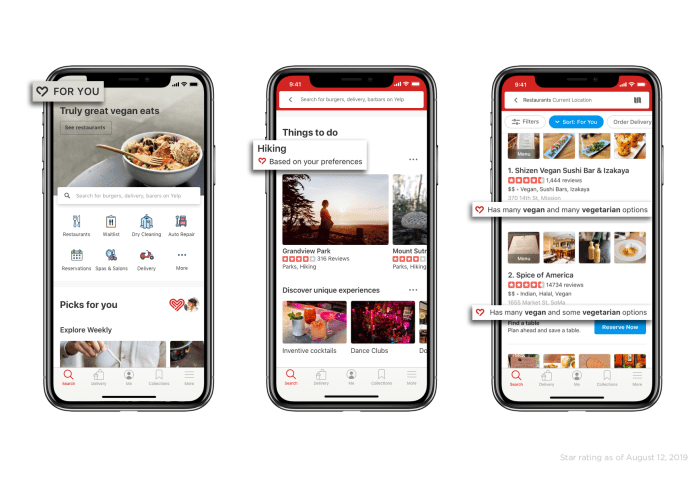
The Yelp app’s core strength lies in its ability to connect users with local businesses. To enhance this experience, personalization is crucial. This section details the features and functionality that will empower Yelp to provide a more tailored and engaging experience for its users. By incorporating personalized recommendations, search results, and notifications, Yelp can foster deeper user engagement and satisfaction.
Personalized Recommendations and Search Results
The Yelp app will leverage user data, including past searches, reviews, and location history, to provide highly personalized recommendations and search results. For example, if a user frequently searches for Italian restaurants in the vicinity of their work, the app can suggest similar restaurants in the area, along with new options based on the user’s past preferences. Further, the search results themselves can be tailored.
Instead of simply listing results alphabetically, the app can prioritize restaurants that align with the user’s interests and preferences. This will allow users to quickly find the perfect spot based on their specific needs.
I’ve been digging into Yelp’s new personalization categories for lifestyle apps, trying to figure out how they’re going to improve user experience. It’s fascinating how these algorithms work, but it got me thinking about other areas where similar targeting could be applied. For example, the massive military investment in anduril archer vtol aircraft military investment might be using similar tech to pinpoint specific needs and desires within the defense industry.
Ultimately, the goal for both Yelp and these high-tech military ventures seems to be about providing highly tailored services to meet unique needs, and that’s pretty cool.
Personalized “My Favorites” Section
A dedicated “My Favorites” section will allow users to save businesses they frequently visit or wish to revisit. This section will offer more than just a simple save function. Users can categorize their favorites (e.g., “Dinner Spots,” “Coffee Shops,” “Weekend Getaways”). They can also add notes, such as dietary restrictions or preferred seating arrangements. This organized approach to favorites will provide a quick and intuitive way to find previously enjoyed places.
Users can easily access and revisit these saved places, simplifying their dining and leisure experiences.
Personalized Notifications for Relevant Events and Deals
Personalized notifications will be critical in keeping users informed about events and deals relevant to their interests. If a user frequently visits a specific coffee shop, the app can notify them of any upcoming events at that location, like live music or special promotions. Additionally, the app will notify users of discounts and deals at businesses that align with their past preferences, saving them time and effort in discovering valuable offers.
These notifications will be customized to each user’s preferences, ensuring they only receive information that is truly relevant.
Personalized Itineraries for Users, Yelp personalization categories lifestyle app
The app will incorporate features that allow users to create personalized itineraries for trips or outings. These itineraries can be built based on user preferences, such as cuisine types, activities, and budget. For instance, if a user is planning a weekend getaway to San Francisco and enjoys seafood and museums, the app can suggest a personalized itinerary that includes a seafood dinner at a popular restaurant and a visit to a renowned museum, complete with estimated travel times and potential traffic information.
This will enable users to easily plan and organize their trips, leaving less room for last-minute stress.
Features and Personalization Capabilities
| Feature | Personalization |
|---|---|
| Search Results | Display tailored results based on user history and preferences, prioritizing relevant businesses based on past searches, reviews, and location. |
| Recommendations | Suggest businesses aligned with user’s interests and preferences, leveraging past behavior and feedback to provide more relevant suggestions. |
| Notifications | Alert users to relevant events, deals, and promotions at businesses matching their past activity and preferences. |
| Itineraries | Generate personalized travel plans based on user preferences, such as cuisine types, activities, and budget. These plans can incorporate estimated travel times, potential traffic information, and suggestions for relevant businesses. |
Competitive Analysis: Yelp Personalization Categories Lifestyle App
Personalization is no longer a luxury but a necessity in the digital age. Understanding how competitors approach personalization is crucial for developing a winning strategy. This analysis delves into the personalization approaches of Yelp’s key competitors, highlighting unique selling points, and drawing inspiration for differentiation.Yelp’s competitive landscape extends beyond simple restaurant reviews. It faces pressure from other lifestyle apps, each with its own approach to curating user experiences.
A comprehensive competitive analysis is vital to identifying opportunities for Yelp to enhance its personalization and solidify its position within the marketplace.
Comparison of Yelp’s Personalization with Other Lifestyle Apps
Yelp’s current personalization efforts, while substantial, can be strengthened by examining the strategies of competitors like TripAdvisor. TripAdvisor, focusing on travel experiences, emphasizes curated itineraries and personalized recommendations based on past travel history. In contrast, Yelp primarily personalizes based on user location and past review activity, with room for improvement in areas like interests and lifestyle preferences.
Unique Selling Points for Yelp’s Personalization
Yelp possesses unique strengths that can be leveraged for personalization. Its vast database of local businesses and user reviews provides a rich source of data for sophisticated personalization. Leveraging this data to recommend businesses based on user interests, dietary restrictions, and even lifestyle preferences (e.g., pet owners, families) represents a significant opportunity for Yelp. This approach differentiates it from competitors who might focus more on broader travel or experience recommendations.
Successful Personalization Strategies in Other Apps
Many apps effectively personalize user experiences. Spotify, for example, leverages user listening history to recommend new music and create personalized playlists. Netflix employs a sophisticated algorithm based on viewing history and user ratings to suggest movies and shows. These strategies demonstrate the effectiveness of personalized recommendations and content discovery, providing insights into what works and what doesn’t.
Features from Competitor Apps for Yelp’s Inspiration
Yelp can draw inspiration from various features employed by competitor apps. Features like TripAdvisor’s itinerary creation tools could be adapted to Yelp’s platform, allowing users to create personalized restaurant experiences for events or occasions. Furthermore, features that enable users to save their favorite restaurants and create customized lists based on dietary preferences or cuisines, as seen in some food delivery apps, are promising avenues for personalization.
This integration would enhance Yelp’s value proposition.
- TripAdvisor’s itinerary creation tools: Yelp could adapt these to help users create personalized restaurant experiences for events or occasions.
- Food delivery apps’ personalized restaurant lists: Enabling users to create customized lists based on dietary preferences or cuisines would be beneficial.
- Spotify’s personalized music recommendations: Yelp could use this model to recommend restaurants based on user interests and preferences.
Differentiation through Personalization
Yelp can differentiate itself by focusing on hyper-local recommendations that consider niche interests. This could include recommendations based on user-specified preferences, such as vegan options, specific cuisines, or restaurants with outdoor seating. By understanding the nuances of local preferences and integrating these into personalized recommendations, Yelp can stand out from competitors offering broader, less targeted suggestions. A more targeted approach could create a stronger user connection.
Visual Design and Interface
Personalization in a lifestyle app goes beyond just recommending restaurants. A truly engaging experience requires a visually appealing and intuitive interface tailored to each user’s unique preferences. This involves carefully selecting colors, fonts, and imagery that resonate with the individual user, enhancing the overall user experience.A visually consistent and personalized interface is key to creating a strong user experience.
It’s not just about aesthetics, but about making the app feel truly tailored to the individual user. The goal is to create an app that is both beautiful and functional, reflecting the user’s interests and needs.
Personalized Color Schemes
A user’s favorite colors can be subtly incorporated into the app’s design. For example, the background of the user’s profile page or the highlights on their personalized recommendations could subtly reflect their preferred color palette. This creates a strong visual connection and enhances user engagement. Consider using a gradient color scheme for background or a user-selected accent color for buttons and highlights, allowing a user to customize the overall look of the app.
Customizable Fonts
Users can choose their preferred fonts for different sections of the app. For example, a user might select a more playful font for the “Explore” section and a more formal font for their personal recommendations. This caters to individual preferences, making the experience more visually appealing and reflective of the user’s personality.
Personalized Imagery
Images and icons can be selected based on user preferences. For example, a user who loves nature might see more images of parks and outdoor activities, while a user interested in urban exploration might see more cityscapes. This personalization allows the user to see content they are more likely to engage with.
Personalized Dashboard for Profile Management
The user dashboard allows for complete profile management. This includes sections for adjusting preferences, editing profile information, viewing past searches, and managing saved favorites. A visually appealing dashboard should include easily navigable menus and clearly labeled sections. Users can easily update their profile details and preferences without difficulty.
Incorporating User-Generated Content
User-generated content, like reviews and photos, can be integrated into personalized feeds. This can be achieved by filtering content based on user interests and location. For example, a user interested in vegan cuisine might see more user-generated content from vegan restaurants. Visual cues, such as different colored badges for different types of user-generated content (e.g., photos, reviews), can make the feed more visually engaging and informative.
Visual Representations of Personalized Recommendations
Recommendations can be visually appealing and easily understood. For example, a restaurant recommendation could be presented with a visually appealing thumbnail of the restaurant’s exterior, along with its rating and a brief description. Highlighting the restaurant’s special features, such as a patio or a specific cuisine, can further improve the visual appeal. Animated elements can also be used to emphasize recommendations.
Mock-up of a Personalized Yelp Homepage
| Category | Restaurant | Rating | Distance | Image |
|---|---|---|---|---|
| Italian | La Dolce Vita | 4.5 | 1.2 mi | (Placeholder for image of La Dolce Vita) |
| Mexican | El Rancho | 4.2 | 0.8 mi | (Placeholder for image of El Rancho) |
| Vegan | The Green Grocer | 4.7 | 1.5 mi | (Placeholder for image of The Green Grocer) |
Final Thoughts
Ultimately, a personalized Yelp experience hinges on a thoughtful combination of user data analysis, effective categorization strategies, and a user-friendly app design. By leveraging user preferences and behaviors, Yelp can curate a more relevant and enriching experience, ultimately boosting user engagement and satisfaction. The key is to strike a balance between personalization and user privacy, ensuring a secure and trustworthy platform.