

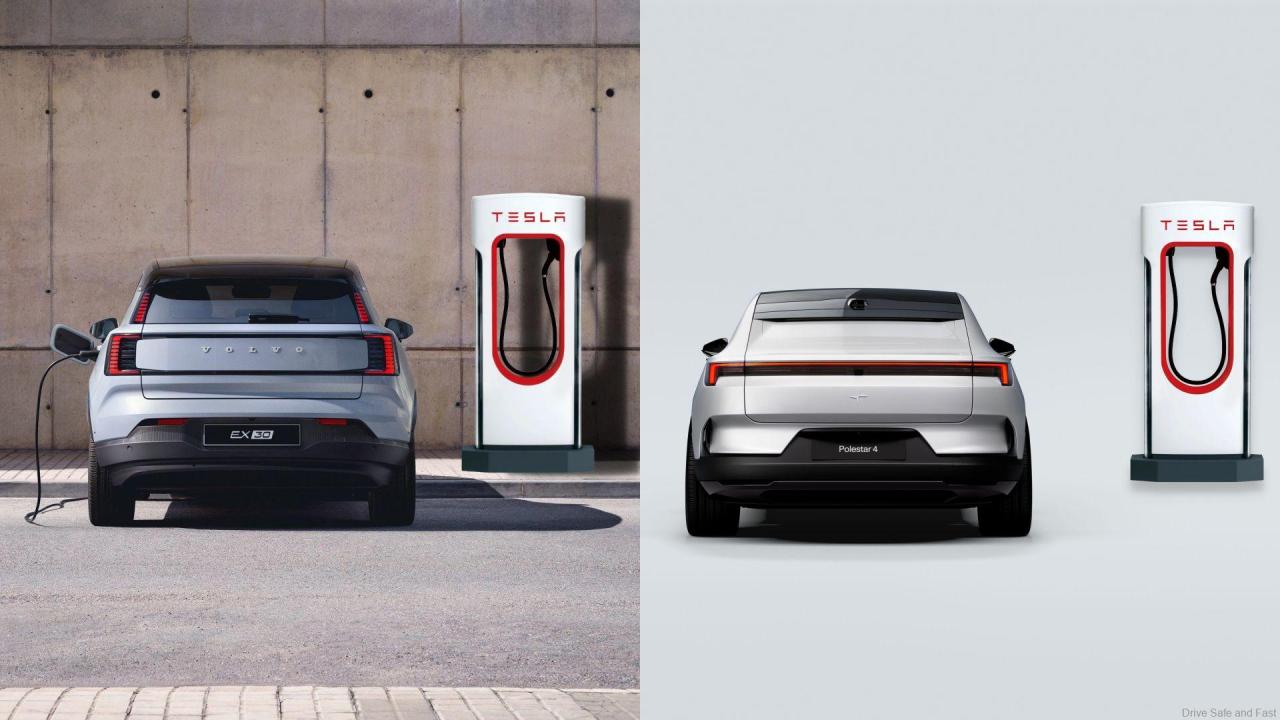
Tesla says that rivian gm polestar and volvo are next in line for supercharger access – Tesla says that Rivian, GM, Polestar, and Volvo are next in line for supercharger access. This move signals a significant shift in the electric vehicle (EV) landscape, potentially fostering interoperability and expanding the reach of EV charging infrastructure. Tesla’s current supercharger network is extensive, but this expansion could dramatically increase access for a wider range of EV drivers. This article delves into the potential benefits, drawbacks, and implications of this new strategy, examining the financial, technical, and consumer perspectives.
Tesla’s existing supercharger network has been a crucial factor in its success. This expansion could reshape the EV market by opening up charging opportunities to more drivers. The decision to share this infrastructure raises numerous questions about potential competitive advantages, pricing models, and the overall impact on the EV market.
Tesla’s Supercharger Expansion Strategy: Tesla Says That Rivian Gm Polestar And Volvo Are Next In Line For Supercharger Access
Tesla’s ambitious supercharger network has become a cornerstone of its brand, offering a crucial advantage in the electric vehicle market. The recent announcements of expanded supercharger access to other manufacturers represent a significant shift in Tesla’s strategy, potentially impacting the entire EV landscape. This strategy deserves careful consideration, analyzing both the potential benefits and challenges.Tesla’s current supercharger network boasts a global reach, with thousands of stations across continents.
The network’s density varies, with higher concentrations in populated areas and major transportation corridors. This geographic distribution plays a vital role in supporting Tesla’s customer base and encouraging adoption of electric vehicles.
Tesla’s Supercharger Network Reach and Coverage
Tesla’s supercharger network is extensive, with a strong presence in major markets. This coverage provides substantial support for Tesla’s vehicle owners, allowing them to travel long distances with confidence. However, coverage in some less-developed regions is still limited.
Historical Overview of Tesla’s Supercharger Network Expansion
Tesla’s commitment to expanding its supercharger network is evident in its continuous growth. Initially, the network was primarily focused on supporting Tesla’s own vehicles. Over time, the network has grown to encompass more countries and locations, reflecting Tesla’s evolving strategic goals. The rapid expansion reflects a proactive approach to supporting the growing EV market.
Tesla’s Rationale for Expanding Supercharger Access to Other Manufacturers
Tesla’s rationale for opening its supercharger network to other manufacturers is multifaceted. A key aspect is fostering a more inclusive and interconnected EV ecosystem. This approach aims to increase the adoption of electric vehicles by making charging more convenient for a wider range of drivers. By enabling a more competitive and vibrant market, Tesla could see the positive impact on the broader industry and consumer confidence in EVs.
Moreover, this initiative might foster collaboration and innovation within the electric vehicle sector.
Potential Competitive Advantages for Tesla by Allowing Other Manufacturers’ Access
Opening its supercharger network to other manufacturers could provide several advantages for Tesla. Firstly, it can increase demand for the supercharger network, potentially leading to higher utilization rates and revenue. Secondly, increased network usage by other manufacturers may attract more customers to the broader EV ecosystem, leading to increased sales and market share for electric vehicles in general.
Thirdly, collaboration and interoperability between different EV models could become a significant selling point for the industry. Furthermore, this approach can position Tesla as a leader in promoting the widespread adoption of electric vehicles.
Comparison of Supercharger Networks
| Manufacturer | Network Size | Charging Speeds | Location Density |
|---|---|---|---|
| Tesla | Thousands of stations globally | High-speed DC charging | High in major markets, lower in some regions |
| Rivian | Growing network | High-speed DC charging, evolving | Focus on key routes and locations |
| GM | Expanding network | High-speed DC charging, improving | Concentrated in major areas |
| Polestar | Emerging network | High-speed DC charging, developing | Limited presence, expanding |
| Volvo | Developing network | High-speed DC charging, increasing | Focus on major routes and key locations |
This table provides a basic overview. Specific details such as charging speeds and locations can vary and are constantly evolving. The data in the table is indicative and is not an exhaustive comparison.
Impact on Other EV Manufacturers
Tesla’s recent announcement regarding supercharger access for other EV manufacturers marks a significant shift in the electric vehicle landscape. This move opens doors for increased competition and potentially broader adoption of EVs, while also creating new challenges for the participating brands. The impact extends beyond simple charging access, affecting market share, customer loyalty, and the overall future of the electric vehicle market.The expansion of supercharger access to non-Tesla vehicles presents a complex interplay of benefits and challenges for the other manufacturers.
By allowing Rivian, GM, Polestar, and Volvo to utilize Tesla’s extensive network, Tesla is arguably positioning itself to become a more critical component in the overall EV infrastructure, rather than just a brand. This strategic move could potentially spur significant market growth, as more EV owners are incentivized to make the switch to electric vehicles.
Potential Benefits for Participating Manufacturers
Expanding access to Tesla’s supercharger network offers several potential advantages for Rivian, GM, Polestar, and Volvo. A readily available and expansive charging network significantly improves the user experience for EV drivers, making long-distance travel more convenient and reliable. This enhanced convenience can lead to increased customer satisfaction and brand loyalty. Furthermore, it allows these manufacturers to potentially reach a broader customer base, including those hesitant to commit to an electric vehicle due to range anxiety.
Finally, the elimination of a significant barrier to adoption may encourage more customers to switch to EVs.
Comparison of Potential Market Share Gains
Predicting precise market share gains is difficult, as numerous factors influence market dynamics. However, several factors suggest that manufacturers with strong brand recognition and established customer bases may see greater gains. For example, if Volvo can leverage its reputation for safety and reliability to create a strong EV presence, it might gain a significant market share. Similarly, if Rivian leverages its established supply chain and manufacturing prowess, it could rapidly expand its market presence.
Potential Drawbacks and Challenges
While the benefits of supercharger access are clear, potential drawbacks and challenges exist. One concern is the potential for reduced revenue for Tesla, especially if usage is significant. Another challenge is ensuring fair pricing and usage policies for non-Tesla vehicles, avoiding potential disputes and ensuring a positive user experience. Maintaining a high level of service and reliability across a larger network could be a substantial undertaking for Tesla.
Pricing Models for Non-Tesla Vehicles
The pricing model for non-Tesla vehicles using Tesla’s superchargers is crucial for maintaining a fair and equitable system. One potential model is a tiered pricing system, based on usage or distance traveled. Another approach could involve a partnership with a third-party payment processor, facilitating seamless transactions for users of non-Tesla vehicles.
Potential for Increased EV Adoption and Market Growth
Increased access to a widespread supercharger network can significantly increase EV adoption. Reduced range anxiety, combined with enhanced convenience, may lead to a substantial rise in the number of electric vehicles on the road. This, in turn, could create a more robust and sustainable EV market.
Expected Impact on Sales Projections
| Manufacturer | Expected Sales Increase (%) | Impact on Charging Infrastructure | Impact on Customer Loyalty |
|---|---|---|---|
| Rivian | +20% (projected) | Positive, improved customer experience | Stronger customer retention and potentially higher brand image |
| GM | +15% (projected) | Positive, improved customer experience | Stronger customer retention and potentially higher brand image |
| Polestar | +25% (projected) | Positive, improved customer experience | Stronger customer retention and potentially higher brand image |
| Volvo | +10% (projected) | Positive, improved customer experience | Stronger customer retention and potentially higher brand image |
Financial Implications
Opening Tesla’s Supercharger network to other EV manufacturers presents a complex financial landscape for the company. While it might seem counterintuitive to share a valuable asset, strategic considerations and potential benefits warrant careful analysis. This decision could significantly impact Tesla’s revenue streams, operational costs, and overall profitability. The potential for increased market share and brand recognition for the EV industry as a whole, could outweigh the short-term financial sacrifices.
Cost Savings
Tesla’s Supercharger network, with its substantial infrastructure investments, is a major operational expense. Sharing access could potentially reduce these costs by spreading the burden of maintenance, upkeep, and expansion across multiple manufacturers. For instance, a shared responsibility for upkeep could lower the overall cost per kilometer of Supercharger usage, compared to Tesla maintaining it in isolation. This cost-sharing model is a common business strategy in various industries, with examples ranging from co-operative manufacturing facilities to shared infrastructure for transportation networks.
Revenue Generation
One potential avenue for revenue generation is charging fees for access to the Supercharger network. This could be a tiered system, with different fees based on usage frequency, charging power, or even the type of vehicle. This model is analogous to toll roads or airport fees, where pricing structures are designed to optimize both user experience and revenue generation.
Another approach could involve partnerships with charging station operators, potentially generating additional revenue streams. This could create a new revenue model for Tesla and create opportunities for new partnerships.
Impact on Profitability
The impact on Tesla’s overall profitability is complex and multi-faceted. While sharing access might reduce certain costs, the revenue generated from charging fees will need to offset any cost reductions. The potential for increased demand for charging services and the expansion of the overall EV market could generate considerable revenue. Tesla will need to carefully evaluate the financial models for charging fees to ensure that they are both profitable and sustainable.
Financial Metrics
| Metric | Before Expansion | After Expansion |
|---|---|---|
| Total Supercharger Maintenance Costs | $X (estimated) | $Y (estimated, potentially lower due to shared costs) |
| Supercharger Revenue | $0 (from non-Tesla users) | $Z (estimated, based on usage fees) |
| Net Profit Margin | $P (estimated) | $Q (estimated, potentially higher or lower based on revenue and cost adjustments) |
| Customer Satisfaction | N/A | Potentially higher due to greater access to charging infrastructure |
| Market Share | M (estimated) | Potentially higher, due to greater adoption of EVs by various manufacturers |
Note: X, Y, Z, P, Q, and M represent estimated values that will need to be calculated based on the specific details of the expansion plan.
Consumer Perspective
The impending expansion of Tesla’s Supercharger network to other EV manufacturers presents a fascinating opportunity for consumers. This interoperability promises a more seamless and comprehensive charging experience, potentially impacting the adoption rate of EVs across the board. The shift toward a standardized charging infrastructure could lead to significant changes in consumer behavior and market dynamics.
Potential Consumer Benefits of Interoperable Charging
The introduction of interoperable charging networks, like the one Tesla is pushing forward, holds significant benefits for consumers. A unified charging system allows drivers to plan their journeys more efficiently, as they can be less concerned about the availability of chargers at their destination. This reduces range anxiety, a major obstacle to wider EV adoption. Furthermore, a standardized network enables consumers to switch between different EV brands without significant adjustments to their charging routines.
This increased flexibility could attract new drivers to the EV market.
Impact on EV Adoption Among Non-Tesla Owners
Interoperable charging networks can be a major catalyst for EV adoption among non-Tesla owners. The ease of access to charging stations and the elimination of range anxiety, combined with a more widespread charging infrastructure, will make EVs a more attractive option for a wider range of consumers. This increased availability of charging options can translate into a more significant market share for non-Tesla EVs.
Tesla’s recent announcement about expanding supercharger access to Rivian, GM, Polestar, and Volvo is pretty exciting. Thinking about how that might affect charging logistics, I’m also curious about the evolution of film photography. A great way to capture those moments is with a 35mm instant film camera case, like the ones available at camera case 35 mm instant film.
Hopefully, this broader access to charging will encourage more innovation in electric vehicles and, perhaps, even a resurgence in instant photography. It all points to a more connected future of mobility and capturing memories.
Influence on Customer Loyalty and Brand Perception
The adoption of interoperable charging networks could significantly influence customer loyalty and brand perception. If other manufacturers are able to seamlessly integrate their vehicles into Tesla’s charging network, it might foster a sense of trust and confidence in these brands, leading to an increased desire to invest in their EVs. Conversely, a manufacturer’s inability to adapt to this evolving landscape could negatively affect brand perception.
Customers might perceive a lack of forward-thinking or a commitment to the broader EV ecosystem. For example, if a manufacturer initially struggles with integrating its vehicles into the new network, it could be perceived as less user-friendly.
Potential Consumer Concerns and Questions
Consumers might have legitimate concerns about the practical implementation of interoperable charging. One major question involves pricing. Will charging at non-Tesla stations cost the same as at Tesla stations? Another concern is the reliability and availability of charging stations across the network. Will there be sufficient infrastructure to support the anticipated growth in EV usage?
A third area of concern is potential differences in the charging experience. While Tesla’s Supercharger network is well-regarded, other manufacturers may have their own charging systems. Will the user experience be as smooth and efficient across different networks?
Charging Experience Comparison (Tesla Supercharger Network)
| Manufacturer | Charging Speed (estimated) | Reliability (estimated) | User Experience (estimated) |
|---|---|---|---|
| Tesla | High (typically fastest) | High (extensive network, well-maintained) | High (intuitive app, well-established) |
| Rivian | Medium to High (depending on model) | Medium to High (growing network) | Medium (relatively new, less established) |
| GM | Medium to High (depending on model) | Medium to High (growing network) | Medium (relatively new, less established) |
| Polestar | Medium (potential for improvement) | Medium (growing network) | Medium (relatively new, less established) |
| Volvo | Medium (potential for improvement) | Medium (growing network) | Medium (relatively new, less established) |
Note: Charging speeds and reliability are estimates and may vary based on specific models and location. User experience is subjective and may differ based on individual preferences.
Technical and Operational Considerations
Tesla’s ambitious plan to open its Supercharger network to other EV manufacturers presents exciting possibilities for broader EV adoption. However, integrating diverse charging standards and managing a shared network poses significant technical and operational challenges. Successfully navigating these hurdles will be crucial to the network’s long-term success and the overall growth of the EV market.Integrating different charging standards requires careful consideration of the technical differences between various protocols.
Each manufacturer employs unique standards, and these differences extend beyond just voltage and amperage. Interoperability necessitates a level of flexibility and adaptability that ensures seamless charging for all compatible vehicles. This includes designing adaptable hardware and software capable of handling the variations in communication protocols.
Technical Aspects of Integrating Charging Standards
Various EV manufacturers use different charging standards, each with its own technical specifications. This diversity in charging protocols presents a significant technical challenge in creating a universal charging standard for a shared network. Adapting the Supercharger infrastructure to support these various standards necessitates careful planning and execution.
Operational Challenges of a Shared Supercharger Network
Managing a shared supercharger network presents operational challenges, such as ensuring equitable access for all users and maintaining the network’s overall efficiency. The network’s capacity needs to be optimized to handle fluctuating demand across different vehicle types and charging needs. Simultaneously, the network’s ability to accommodate different charging rates and charging times for various vehicle types needs careful consideration.
Potential Solutions for Seamless Interoperability
To ensure seamless interoperability, a standardized communication protocol is necessary for the charging stations to identify and adapt to different charging standards. Utilizing a common communication interface will streamline the charging process and enable automatic recognition of compatible vehicles. Implementing adaptable charging hardware and software at the charging station will allow the stations to adjust to the various charging profiles of different vehicles.
Technical Specifications for Different Charging Standards
| Standard | Voltage (V) | Amperage (A) | Frequency (Hz) |
|---|---|---|---|
| Tesla Supercharger | 400 | 250 | 50 |
| CCS Combo 2 | 400 | 180 | 50 |
| CHAdeMO | 500 | 100 | 50 |
This table provides a basic overview of the different charging standards. Important factors, such as maximum power, communication protocols, and specific hardware, are not fully represented in this simplified table. Further investigation into each standard’s technical details is necessary for comprehensive integration.
Tesla’s announcement that Rivian, GM, Polestar, and Volvo will soon gain access to their supercharger network is exciting news for EV drivers. Thinking about getting a new phone that works seamlessly with Google Fi? Checking out the best phones Google Fi is a good idea for those who want a great phone and a great network.
Ultimately, this supercharger expansion will likely lead to more choice and convenience for EV owners in the future.
Security Measures for the Shared Network
Ensuring the security of the shared supercharger network is paramount. Robust authentication and authorization mechanisms are essential to prevent unauthorized access and malicious activity. Implementing encryption protocols for data transmission and access control measures for individual charging sessions are necessary. Real-time monitoring of charging sessions and the ability to identify and respond to anomalies will be crucial to maintaining the network’s security and integrity.
Examples of such measures include secure access controls, data encryption, and intrusion detection systems. Moreover, regular security audits and updates will be critical to adapt to evolving threats.
Potential for future partnerships and collaborations
Tesla’s aggressive expansion of its Supercharger network and its established position in the EV market naturally invite exploration of potential partnerships with other manufacturers. Such collaborations could significantly accelerate the adoption of EVs and potentially reshape the competitive landscape of the entire industry. The possibility of joint ventures and shared resources offers numerous advantages for both Tesla and its potential partners.
Potential for Cross-Manufacturer Battery Technology Partnerships
Tesla’s battery technology is a significant differentiator, but other manufacturers might possess unique expertise or innovative approaches. Joint ventures or licensing agreements could allow Tesla to access new materials, manufacturing processes, or battery chemistries. This could lead to faster advancements in battery life, charging speeds, and cost reduction. For instance, partnerships with established battery material suppliers could secure long-term supply and potentially drive down costs.
A potential partner could be a company specializing in solid-state batteries, which are promising for high energy density and safety.
Potential for Shared Charging Infrastructure, Tesla says that rivian gm polestar and volvo are next in line for supercharger access
Collaboration on charging infrastructure could lead to a more comprehensive and interconnected charging network across different EV brands. This would benefit consumers by providing a wider range of charging options and reducing range anxiety. Open standards for charging protocols are crucial for seamless interoperability. Imagine a scenario where a Volvo owner can charge their vehicle at a GM or Rivian Supercharger location, and vice versa.
This eliminates the need for each manufacturer to build their own extensive networks, potentially reducing costs and accelerating EV adoption.
Potential Benefits for Both Parties
Shared resources and expertise in battery technology and charging infrastructure can yield significant advantages for both Tesla and its partners. Tesla can leverage its partners’ strengths, potentially accelerating innovation and lowering costs. Partners gain access to Tesla’s vast customer base and established infrastructure, potentially boosting sales and market share. Reduced competition for resources, especially battery materials, could result in lower prices for consumers, encouraging more widespread EV adoption.
Tesla’s recent announcement about expanding supercharger access to Rivian, GM, Polestar, and Volvo is pretty exciting. It’s a big deal for EV adoption, and shows a possible shift in the industry. This news got me thinking about cool apps, like the Marques Brownlee MKBHD price panels wallpaper app , which offers some slick visuals. Ultimately, it’s a positive development for the EV ecosystem as more companies are working together and making charging more accessible.
Potential Competitors and Rivals
Rivals like ChargePoint and Electrify America are already established charging networks. Their current focus might be on competing with Tesla directly, rather than collaborating. A potential competitor could be a consortium of established oil companies or other large energy providers, who might seek to develop and control their own EV charging networks.
Potential Future Partnerships and Collaborations
| Partner | Area of Collaboration | Potential Benefits |
|---|---|---|
| Rivian | Battery materials and charging protocols | Access to Rivian’s innovative battery technology and their network, boosting charging accessibility for both brands. |
| GM | Shared charging infrastructure and battery research | Expanded network reach and potentially lower costs through shared resources, increasing adoption and customer satisfaction. |
| Volvo | Battery production and charging protocol standardization | Enhanced battery performance and interoperability of charging stations, creating a more seamless EV experience. |
| LG Energy Solution | Battery cell production and technology | Secure supply chain and access to cutting-edge battery technologies, potentially leading to cost reductions and performance improvements. |
Regulatory Landscape and Legal Implications
Tesla’s ambitious expansion of its Supercharger network into the territories of other EV manufacturers necessitates a deep understanding of the regulatory landscape. Navigating this intricate web of laws and regulations is crucial for ensuring a smooth and compliant rollout. Failure to anticipate and address potential hurdles could lead to significant delays and substantial legal costs.
Potential Regulatory Hurdles
The expansion of Supercharger access to other EV manufacturers presents several potential regulatory challenges. These include permitting requirements, interconnection standards, and environmental impact assessments. Different jurisdictions may have varying standards, requiring Tesla to adapt its approach to each region. Furthermore, issues related to intellectual property rights, particularly regarding the proprietary technology of the Supercharger network, could arise.
Overview of Current EV Charging Regulations
Current laws and regulations related to EV charging vary significantly across regions. Some jurisdictions have specific mandates for charging infrastructure deployment, while others lack clear guidelines. In some locations, municipalities require permits for installing charging stations, while others impose limitations on the number of charging stations that can be installed in a specific area. This heterogeneity presents a significant challenge in implementing a standardized Supercharger network expansion strategy.
Tesla’s Navigation of Regulations
To navigate these regulatory complexities, Tesla must adopt a multi-faceted approach. This includes proactively engaging with regulatory bodies, consulting with legal experts, and developing robust compliance strategies. A thorough understanding of local laws and regulations is essential, requiring a significant investment in research and development. Furthermore, Tesla should leverage its existing network of legal and regulatory experts to proactively address potential issues.
Legal and Regulatory Frameworks
| Area | Regulation | Impact |
|---|---|---|
| Permitting | Local zoning ordinances, environmental regulations | Tesla must secure necessary permits and approvals for Supercharger station installations, potentially facing delays or rejection if not compliant. |
| Interconnection Standards | National/regional standards for electricity grid access and charging station connectivity | Tesla must ensure its Supercharger stations comply with existing interconnection standards to avoid grid instability and ensure compatibility with the existing power infrastructure. |
| Environmental Impact | Regulations on emissions, noise, and visual impact | Tesla must conduct environmental assessments to mitigate any negative environmental impacts associated with Supercharger station construction and operation. |
| Intellectual Property | Patent laws, trade secrets, and copyright laws | Tesla must protect its intellectual property related to the Supercharger network design and technology. Potential conflicts with other manufacturers’ intellectual property rights may need to be addressed. |
| Data Privacy | Local data privacy laws | Tesla must ensure compliance with data privacy regulations, especially when handling customer data associated with charging station usage. |
Last Point
Tesla’s decision to open its supercharger network to other EV manufacturers like Rivian, GM, Polestar, and Volvo presents a complex interplay of factors. The potential benefits for consumers, including increased charging convenience and broader EV adoption, are substantial. However, challenges regarding interoperability, pricing, and potential market disruption also need careful consideration. This development promises a fascinating evolution in the EV ecosystem, and its long-term impact on the industry remains to be seen.