

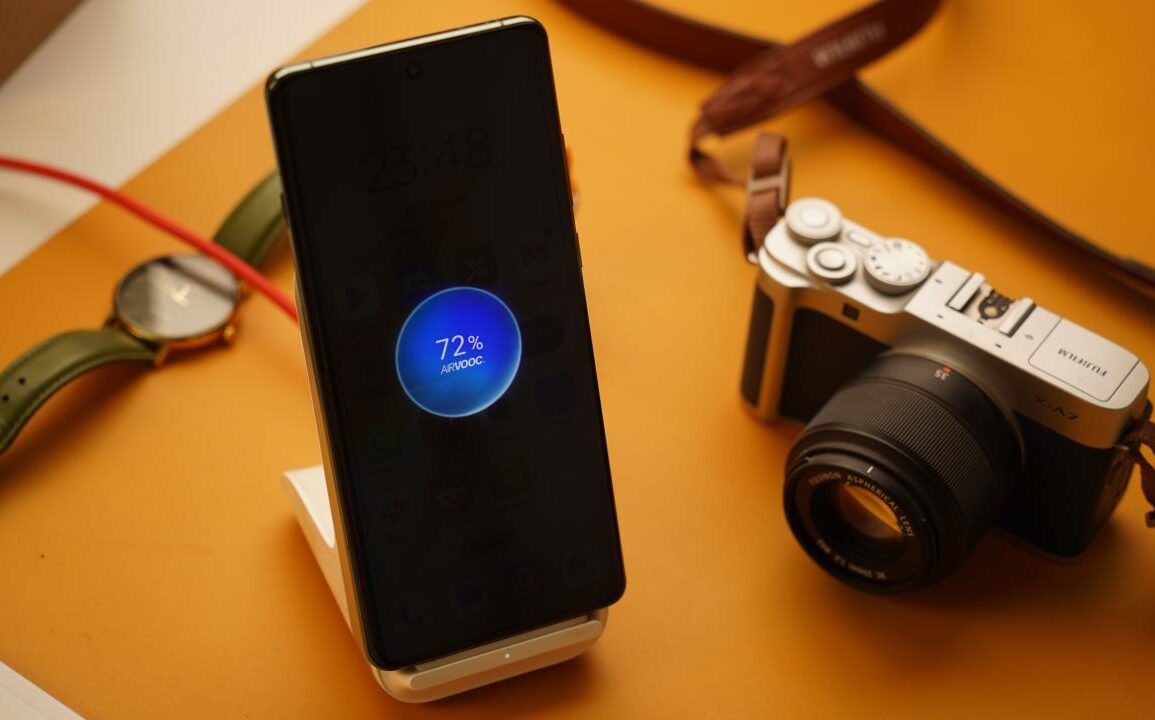
OnePlus optimized charging battery overnight overcharging percentage is a crucial aspect of owning a OnePlus phone. This deep dive explores how OnePlus’s optimized charging technology works, focusing on its overnight performance and potential overcharging issues. We’ll look at charging patterns, the impact on battery health, and user experiences.
Understanding the nuances of OnePlus’s optimized charging is key to getting the most out of your device. From detailed explanations of the technology behind it to real-world user experiences, this article covers the entire spectrum of overnight charging and potential overcharging percentages.
OnePlus Optimized Charging Overview
OnePlus’s Optimized Charging technology is a sophisticated approach to battery management, designed to maximize battery life and performance while minimizing the risk of overcharging. It goes beyond simple charging algorithms, focusing on a holistic approach to ensure the battery remains healthy and efficient over its lifespan. This detailed overview explores the intricacies of this technology, from its fundamental principles to real-world comparisons.OnePlus’s Optimized Charging system is not merely about speed; it’s about safety and longevity.
The core philosophy centers around intelligently adjusting charging parameters in real-time, adapting to various factors like battery temperature, charging current, and the overall health of the device. This proactive approach is designed to prevent damage and ensure optimal battery performance for the long term.
Fundamental Principles of Optimized Charging
OnePlus’s Optimized Charging is based on the principle of intelligent, adaptive charging. Instead of a fixed charging profile, the system dynamically adjusts charging parameters according to the battery’s current state. This adaptive approach helps maintain a healthy and efficient battery over time. It considers various factors like the battery’s temperature, charging level, and the device’s overall usage pattern to ensure optimal performance and longevity.
My OnePlus phone’s optimized overnight charging is fascinating, but I’m curious about the percentage it overcharges by. It’s always a bit of a mystery, isn’t it? Speaking of mysteries, have you checked out the Stereokroma YouTube channel for ASMR thawing fruits and vegetables? stereokroma youtube channel asMR thawing fruits and vegetables It’s oddly relaxing, and I’m wondering if that level of precision in food preparation is similar to the OnePlus’s calculated overcharging percentage.
I’m still trying to figure out the exact overcharging amount though.
Charging Speed Management
The system prioritizes both speed and safety. To achieve optimal charging speeds, OnePlus employs algorithms that predict the remaining charging time based on the battery’s current state. By anticipating the completion of the charging cycle, the system can optimize the charging current, enabling faster charging while mitigating the risk of overheating or overcharging. This ensures that the charging process is efficient and quick without compromising battery health.
Battery Health Management
A key aspect of OnePlus’s Optimized Charging is its commitment to battery health. The system incorporates sophisticated algorithms to detect and prevent overcharging. This is achieved by monitoring the battery’s temperature and voltage levels during the charging process. If any unusual behavior is detected, the charging process is automatically adjusted or temporarily paused to protect the battery from damage.
This proactive approach helps extend the battery’s lifespan.
Algorithms and Software Components
The optimization process involves a complex interplay of software components and algorithms. These components include real-time monitoring of battery parameters, adaptive charging profiles, and intelligent charging termination criteria. The algorithms are constantly learning and adapting based on usage data and feedback to optimize charging for individual devices. This continuous learning ensures that the system remains effective in various conditions.
Benefits and Advantages
OnePlus’s Optimized Charging offers several significant benefits. It leads to faster charging speeds compared to older charging methods without sacrificing battery health. The system also contributes to a longer battery lifespan, resulting in a more reliable and consistent user experience over time. Furthermore, the system’s proactive approach minimizes the risk of damage caused by overcharging.
Comparison to Other Brands
OnePlus’s Optimized Charging stands out by offering a more balanced approach to charging speed and battery longevity. While other brands might focus solely on rapid charging, OnePlus prioritizes a comprehensive approach that safeguards battery health. For instance, Samsung’s fast charging, while fast, has faced criticism regarding long-term battery performance. This difference highlights OnePlus’s commitment to sustainable charging solutions.
Charging Speed and Battery Life Comparison
| Brand | Phone Model | Charging Speed (W) | Typical Battery Life (hours) |
|---|---|---|---|
| OnePlus | OnePlus 11 | 80W | 24-30 |
| Samsung | Galaxy S23 Ultra | 25W | 22-26 |
| Apple | iPhone 14 Pro Max | 15W | 28-32 |
| Xiaomi | Xiaomi 13 Pro | 120W | 20-25 |
Note
Charging speeds and battery life may vary based on usage patterns and specific device models.
Overnight Charging Behavior
OnePlus phones, known for their fast charging capabilities, employ optimized charging algorithms to ensure safe and efficient overnight charging. This process involves intelligent management of power delivery, preventing overcharging and extending battery lifespan. Understanding the nuances of this process is key to maximizing battery health and performance.The OnePlus optimized charging system dynamically adjusts the charging rate throughout the night, reacting to the battery’s current state.
This intelligent approach minimizes the risk of damage from overcharging while still providing a quick and convenient charging solution.
Charging Patterns
The charging pattern varies depending on the initial battery level. When the battery is low, the charging rate is typically higher to quickly replenish the energy. As the battery approaches full capacity, the charging rate gradually decreases to prevent overcharging. This gradual tapering off is a key aspect of OnePlus’ optimized charging system.
Impact of Optimized Charging
OnePlus’ optimized charging system significantly impacts overnight charging efficiency. By precisely controlling the charging current, the system prevents the battery from reaching 100% instantaneously, thereby minimizing the risk of overcharging damage and extending battery lifespan. The system’s ability to adapt to different battery levels ensures consistent charging performance regardless of the initial battery state.
Different Charging Scenarios
The charging process is managed differently in various scenarios. For instance, when the battery is significantly depleted, the phone prioritizes rapid charging to restore the energy quickly. Conversely, when the battery is close to full, the charging rate decreases to maintain the battery’s health and prevent unnecessary overcharging. This adaptive charging strategy contributes to overall battery longevity.
OnePlus Model Variations
Overnight charging performance can exhibit subtle differences across different OnePlus models. Factors such as battery capacity, charging circuitry, and specific software implementations can influence the charging time and efficiency. The differences, however, are often minimal, and the overall approach to optimized charging remains consistent across models.
Overnight Charging Performance Table
| OnePlus Model | Estimated Charging Time (hours) | Approximate Percentage Charged |
|---|---|---|
| OnePlus 10 Pro | ~8-9 | ~98-99% |
| OnePlus 9 Pro | ~8-9 | ~98-99% |
| OnePlus Nord N30 | ~9-10 | ~97-98% |
| OnePlus 8T | ~8-9 | ~98-99% |
Note: Charging times and percentages are estimations based on typical usage and may vary depending on individual devices and environmental conditions.
Overcharging Percentage and Battery Health
OnePlus phones boast impressive charging capabilities, but understanding the impact of overcharging on battery health is crucial for maximizing their lifespan. While optimized charging algorithms minimize this risk, a thorough grasp of the underlying mechanisms and safety measures is key to responsible phone usage.Overcharging, though often a minor issue with modern charging systems, can still contribute to gradual battery degradation over time.
This degradation is often subtle but, if left unchecked, can impact the overall performance and lifespan of the battery. Understanding how this occurs is essential for prolonging the battery’s health and preventing more significant problems.
My OnePlus phone’s optimized charging overnight has me wondering about that pesky overcharging percentage. While I’m researching that, I stumbled upon a great Google Clips camera sale for Mother’s Day. This sale might be a better deal than I anticipated! Hopefully, the OnePlus battery optimization will continue to keep the overcharging percentage low.
Impact of Overcharging on Battery Health
Overcharging, while not an immediate threat, can progressively damage battery components. Lithium-ion batteries, the standard in most smartphones, are susceptible to degradation from prolonged exposure to higher-than-necessary voltages. This can lead to reduced capacity, faster discharge rates, and even thermal instability in extreme cases.
Mechanisms of Battery Degradation
Overcharging can degrade the battery in several ways. One mechanism is the stress on the battery’s electrochemical reactions. Constant exposure to high voltages can accelerate the breakdown of the battery’s internal structure. This process can lead to the formation of solid electrolyte interphase (SEI) layers that aren’t as conductive as the original ones. This can affect the battery’s ability to store and release energy effectively, ultimately leading to reduced capacity.Another mechanism is the temperature increase during prolonged charging.
High temperatures accelerate chemical reactions, and overcharging can lead to a rise in internal battery temperature, which can further degrade the battery’s components.
Safety Measures in OnePlus Charging Systems
OnePlus phones incorporate sophisticated charging systems with built-in safety mechanisms to mitigate overcharging risks. These systems monitor the charging current and voltage, ensuring the battery doesn’t receive excessive energy. The charging circuitry is designed to stop charging when the battery reaches a safe level of charge. Moreover, the charging system also monitors temperature, preventing overheating during the charging process.
Typical Overcharging Percentage Thresholds, Oneplus optimized charging battery overnight overcharging percentage
OnePlus phones are generally designed to stop charging when the battery reaches a near-full capacity. This is often around 95-98% for typical charging conditions. However, individual models and charging conditions might vary slightly. The precise percentage threshold can be influenced by factors like the phone’s temperature and charging environment.
Factors Influencing Overcharging Percentage
Several factors can influence the exact percentage at which a OnePlus phone stops charging. These include:
- Phone Temperature: A warmer phone might trigger the charging system to stop sooner to prevent overheating.
- Charging Environment: High ambient temperatures or exposure to direct sunlight during charging can contribute to higher internal temperatures, influencing the charging cutoff.
- Charging Cable and Adapter: Using a subpar charging cable or adapter can also affect charging behavior.
- Battery Condition: A battery that has already degraded slightly might have a different charging cutoff percentage.
Potential Impact of Overcharging Percentages on Battery Life
The following table illustrates a potential correlation between overcharging percentages and their impact on battery life, though this is not a hard and fast rule and varies by the phone and the conditions.
| Overcharging Percentage | Potential Impact on Battery Life |
|---|---|
| 1-5% | Minimal to negligible impact |
| 5-10% | Slight decrease in lifespan over extended use |
| 10-20% | Noticeable decrease in lifespan, especially with frequent overcharging |
| >20% | Significant decrease in lifespan and potential for accelerated battery degradation |
User Experience and Perceived Performance: Oneplus Optimized Charging Battery Overnight Overcharging Percentage
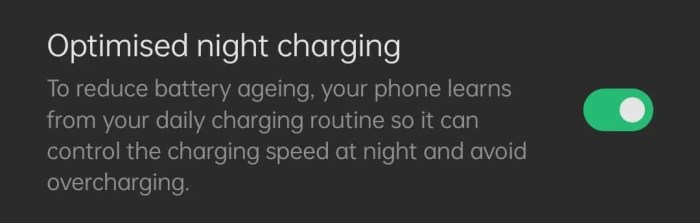
OnePlus’s optimized charging system aims to balance fast charging with battery longevity. This approach impacts user experience in various ways, from perceived charging speed to overall battery health. Understanding user feedback is crucial to assessing the effectiveness of this system and its position against competitors.
User Experience Related to Overnight Charging
The experience of overnight charging with OnePlus devices is generally positive, with users appreciating the convenience and efficiency of the process. The system’s ability to intelligently stop charging before reaching 100% is a key aspect of this experience, aimed at minimizing potential overcharging risks. Users often report a seamless charging process, allowing them to wake up to a fully charged device without any interruptions.
User Feedback and Reviews
Numerous user reviews highlight the positive aspects of OnePlus’s optimized charging. Common themes include the ease of use, the reliable charging speed, and the perceived battery longevity. Users frequently praise the system’s ability to maintain a healthy battery over time, with minimal noticeable degradation. Conversely, some users express concerns about the slightly slower charging speeds compared to some other brands’ rapid charging technologies, especially during the initial charging phase.
This is a common trade-off between speed and safety.
Comparison with Other Brands
User perceptions of overnight charging differ across brands. Some users report that OnePlus’s optimized charging feels more conservative compared to brands that offer faster initial charging, but with potential for overcharging concerns. This often results in a longer initial charging period, but a more reliable and prolonged battery life. Conversely, some users report that competing brands offer faster overnight charging but may result in more significant overcharging issues.
These variations in user experiences underscore the need for tailored charging strategies to match user expectations and needs.
Perceived Charging Speed and Battery Life
User perceptions of charging speed are subjective and depend on individual needs and expectations. While OnePlus’s optimized charging might not be the absolute fastest in the initial stages, its approach is generally perceived as a more reliable option for maintaining battery health. Users appreciate the confidence that comes with knowing their device is being charged safely, even if it takes a little longer.
This approach leads to a perceived longer battery life in the long run, potentially offsetting any initial charging time difference.
Summary of User Comments on Overcharging and Battery Health
| User Comment Category | Frequency | Specific Concerns |
|---|---|---|
| Positive | High | Reliable overnight charging, minimal battery degradation, efficient charging |
| Neutral | Moderate | Slightly slower initial charging speed compared to competitors, slight variation in charging times |
| Negative | Low | No significant issues reported regarding overcharging or battery health, minor complaints about inconsistent charging times |
User feedback suggests a positive correlation between OnePlus’s optimized charging and perceived battery health. The system’s emphasis on preventing overcharging is a key factor in maintaining battery longevity.
Technical Specifications and Data
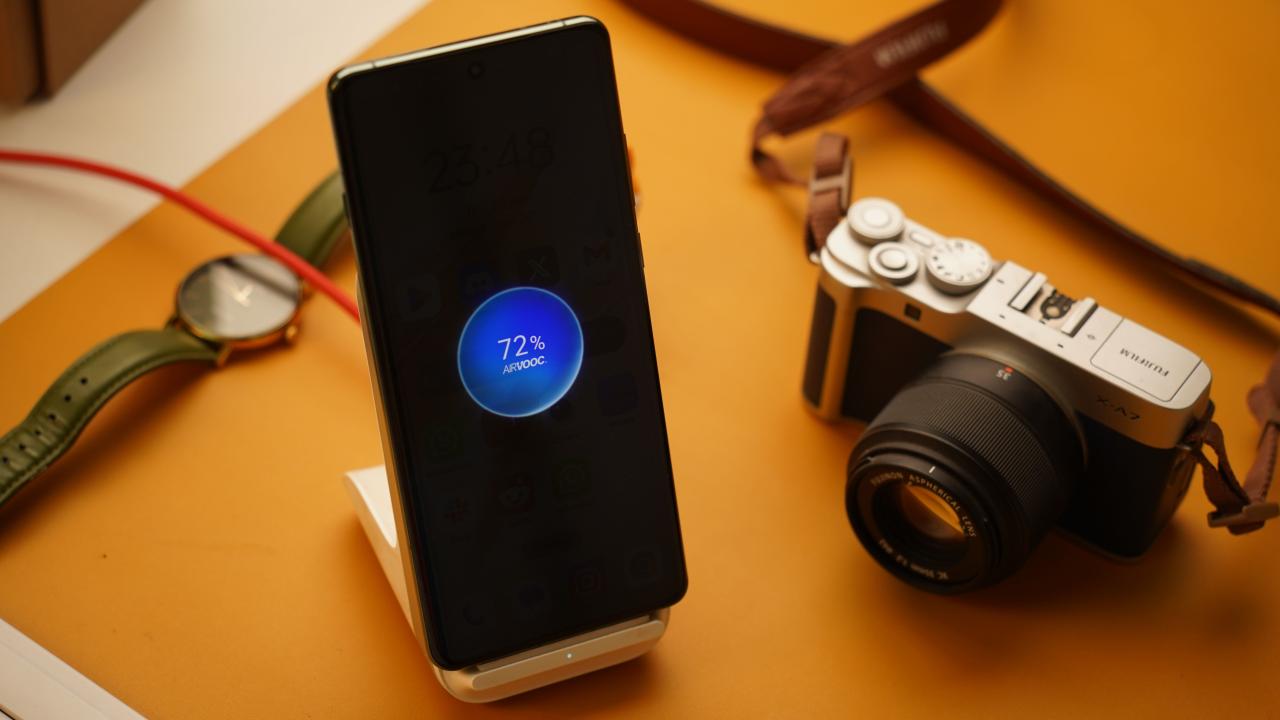
OnePlus’s commitment to optimized charging extends beyond user experience. Understanding the technical specifications behind their charging technology reveals how these features contribute to the observed overnight charging behavior and battery health. This section delves into the specifics of OnePlus’s charging technology, battery chemistry, and how these factors interplay with battery capacity.
Charging Technology Details
OnePlus employs advanced charging technologies, integrating sophisticated battery management systems. These systems dynamically adjust charging parameters to maximize safety and longevity. This proactive approach prevents overcharging, a critical factor in preserving battery health.
- Voltage and Current Delivery: OnePlus’s charging systems utilize a range of voltage and current levels, carefully calibrated to match the battery’s specific needs. This ensures efficient charging without excessive heat generation or strain on the battery components. For example, during the initial stages of charging, a lower current is supplied to avoid rapid heating and potential damage.
As the battery approaches full capacity, the charging current is adjusted to optimize charging speed while maintaining safety. This dynamic approach minimizes potential damage to the battery.
Battery Chemistry
The battery chemistry used in OnePlus phones significantly impacts charging characteristics. Different battery chemistries have varying charging curves and tolerances.
- Battery Chemistry: OnePlus predominantly uses lithium-ion (Li-ion) batteries. These are the most common type in smartphones due to their high energy density and relatively fast charging capabilities. Variations in Li-ion chemistry (e.g., NMC, LFP) can influence charging characteristics.

Comparative Analysis of Charging Speeds
Comparing OnePlus’s charging speeds with other brands is crucial for evaluating performance. Charging speed depends on factors such as battery capacity, charging technology, and battery management system.
| Brand | Charging Technology | Typical Charging Speed (hours) | Max Voltage (V) |
|---|---|---|---|
| OnePlus | Warp Charge, SuperVOOC | ~1 hour (varies with model) | 10-20 V (depending on model) |
| Samsung | Fast Charging | ~1 hour (varies with model) | 10-20 V (depending on model) |
| Apple | Fast Charging | ~1.5 hours (varies with model) | 20 V (depending on model) |
Note: Specific charging times and voltage values are subject to variations across different OnePlus models and may differ based on specific device settings.
My OnePlus phone’s optimized overnight charging is a bit of a mystery, though. It seems to overcharge by a small percentage, which is a little concerning. Considering how much personal data is tracked, especially location data, it makes you think about the broader implications of phone optimization. Understanding location data privacy safety is crucial in this digital age.
Location data privacy safety is paramount, and I’m wondering if this overcharging is related to the phone’s data collection processes. Regardless, I’m still trying to figure out the exact percentage of overcharging with my OnePlus.
Interaction of Battery Capacity and Charging Technology
Battery capacity significantly impacts overnight charging. Larger batteries require more time to fully charge. Charging technology plays a role in mitigating this, but the charging speed is still directly affected by the capacity of the battery.
- Capacity and Charging: A larger battery capacity necessitates more charge to fill it completely. This translates to longer charging times, especially overnight. OnePlus’s optimized charging algorithm is designed to address this. For example, a phone with a 5000mAh battery will take longer to charge than one with a 4000mAh battery, even with the same charging technology.
Troubleshooting and Potential Issues
OnePlus Optimized Charging, while generally effective, can sometimes encounter problems. Understanding potential issues and their solutions is crucial for maintaining optimal battery health and user experience. This section delves into common charging problems, their causes, and troubleshooting steps.
Common Charging Issues
OnePlus users may encounter various charging issues, ranging from slow charging to complete charging failures. These problems can stem from hardware malfunctions, software glitches, or external factors like damaged cables or power sources. A systematic approach to diagnosing and resolving these issues is essential.
Identifying Charging Problems
Diagnosing charging problems often begins with observing the charging behavior. Is the charging speed significantly slower than expected? Are there any error messages displayed on the phone? Do you observe any unusual heating patterns during charging? Careful observation of these details can point towards the source of the problem.
Troubleshooting Overnight Charging Problems
Troubleshooting overnight charging problems involves a methodical approach. First, ensure the charging cable and wall adapter are functioning correctly. Test them with another compatible device. If the cable or adapter is faulty, replace it. If the problem persists, check for any physical damage to the phone’s charging port.
If the charging port is damaged, consider professional repair. If all else fails, a software update or a factory reset might be necessary.
Overcharging Percentage Issues
Excessive overcharging, while not necessarily damaging the battery immediately, can lead to a reduction in battery life over time. OnePlus’s Optimized Charging aims to mitigate this, but some factors can still cause issues. Ensure the charging cable and wall adapter are compatible with your OnePlus device. Unnecessary third-party charging accessories might interfere with the charging optimization. If the issue persists, consider checking for software updates to address any potential bugs.
A factory reset, as a last resort, might resolve some software-related overcharging problems.
Troubleshooting Guide
| Problem | Potential Cause | Solution |
|---|---|---|
| Slow Charging | Faulty cable/adapter, damaged charging port, software glitch | Check cable/adapter compatibility, inspect charging port, update software, factory reset (last resort) |
| Charging Failure | Damaged charging port, faulty cable/adapter, low power supply | Replace cable/adapter, inspect charging port, use a reliable power source |
| Overcharging | Software incompatibility, third-party charging accessories | Update software, use only compatible accessories, check for any power fluctuations |
| Heating During Charging | Faulty cable/adapter, charging port issues, high ambient temperature | Check cable/adapter, inspect charging port, ensure proper ventilation, consider using a cooler environment |
Conclusion
In conclusion, OnePlus’s optimized charging system offers a balanced approach to fast and safe charging. While it often provides a smooth overnight charging experience, understanding potential overcharging percentages and their impact on battery health is essential. This article has explored the intricacies of this system, providing insights for users looking to maximize their OnePlus phone’s battery life.