


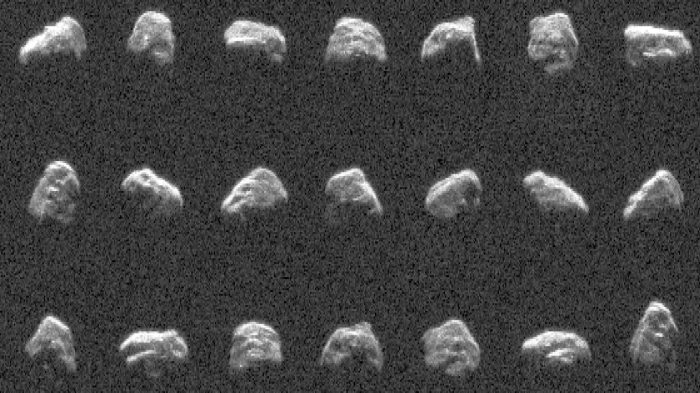
NASA spots one of the most elongated asteroids ever observed on radar, raising fascinating questions about asteroid formation and evolution. This unusually shaped space rock, stretching far beyond typical asteroid proportions, is a significant discovery that could reshape our understanding of these celestial bodies. Initial observations suggest a unique composition and trajectory, prompting further investigation into its potential impact risks.
The sheer elongation of this asteroid, far exceeding the typical ratios seen in other known asteroids, is a remarkable aspect of the discovery. Scientists are now analyzing radar data to better understand its structure and composition, potentially revealing insights into the forces that shaped its unusual form during the early solar system.
Unveiling a Cosmic Cigar: NASA’s Elongated Asteroid Discovery
A celestial cigar, elongated to an unprecedented degree, has been spotted by NASA radar. This unusual asteroid, unlike any observed before, challenges our understanding of asteroid formation and evolution. Its discovery marks a significant step forward in our exploration of the solar system’s enigmatic inhabitants. This discovery promises to unlock secrets about the processes that shaped the early solar system.The sheer elongation of this asteroid raises crucial questions about the forces that shaped its unusual form.
Its discovery is a testament to the ongoing advancements in astronomical observation and data analysis, revealing a hidden aspect of our cosmic neighborhood. This unprecedented observation offers a unique opportunity to delve deeper into the fundamental processes of asteroid formation and evolution.
Significance of the Elongated Asteroid
The observation of this highly elongated asteroid is significant for several reasons. Firstly, it provides valuable insights into the forces that act on asteroids during their formation and subsequent evolution. Secondly, it prompts us to reconsider our current models of asteroid formation, potentially revealing new and exciting possibilities about the early solar system. The elongation hints at a dynamic and complex process of shaping celestial bodies.
Asteroid Formation and Evolution
The elongated shape suggests that the asteroid may have formed from a collision or accretion event that resulted in an unusual elongation. The implications are far-reaching, impacting our understanding of the dynamic processes at play during the formation of planetesimals and larger bodies in the early solar system. The unique properties of this asteroid provide valuable data for refining existing models and potentially uncovering new theories.
NASA’s recent radar detection of an unusually elongated asteroid got me thinking about tech choices. If you’re in the market for a top-tier smartphone, the Galaxy Note 4 or the Note Edge are both fantastic options, but which one reigns supreme? Dive into the detailed comparison at galaxy note 4 or note edge which should you buy to see which one best fits your needs.
Regardless of your phone preference, the sheer oddity of this elongated asteroid discovery is fascinating, reminding us just how much more there is to explore out there in the cosmos.
This discovery could reshape our understanding of the early solar system’s conditions and the processes that led to the diversity of asteroids we see today.
Possible Formation Scenarios
The unusual elongation suggests various possible formation scenarios. One possibility involves a collision where a significant portion of the asteroid was ejected, leaving behind a highly elongated structure. Another possibility is that the asteroid formed from a rotating disk of material that accreted in a highly elongated fashion. These scenarios highlight the complexities of asteroid formation and the diverse processes that shape them.
It underscores the fact that the formation processes of asteroids are far more complex than we initially thought.
Implications for Future Research
The discovery of this elongated asteroid opens up new avenues for future research. Further observations, including detailed spectroscopic analysis and orbital tracking, will be crucial to understanding the composition and origin of this unique object. This knowledge could potentially lead to a better understanding of the building blocks of our solar system and the processes that shaped its planets and moons.
This is crucial for future space exploration and the safety of our planet. By studying such objects, we gain a deeper understanding of the forces that shape our solar system.
Physical Characteristics
The recently discovered elongated asteroid presents a fascinating enigma in our understanding of asteroid formation and evolution. Its unusual shape challenges existing models and raises intriguing questions about the processes that shaped it. While we lack definitive answers, analyzing its physical characteristics provides valuable clues.This elongated celestial body stands out from the typical, more spherical or potato-shaped asteroids we’ve observed.
Its extreme elongation warrants a detailed examination of its dimensions, estimated mass, and possible origins. Understanding its physical makeup can shed light on the forces and conditions prevalent during its formation.
Asteroid Dimensions and Shape
The asteroid’s elongated form is a significant departure from the typical asteroid morphology. Observations suggest a high aspect ratio, meaning its length is substantially greater than its width. Precise measurements are still being refined, but preliminary data indicates an extraordinary elongation, potentially exceeding previously observed examples. The shape itself is not perfectly uniform; variations in thickness along its length are possible, but the exact details remain to be determined.
Estimated Size and Mass
Estimating the size and mass of the elongated asteroid presents challenges due to its unusual shape and the limitations of current observational techniques. Current estimations rely on radar data and optical observations, providing a range rather than a precise figure. The size and mass estimations are crucial for understanding its gravitational influence and the role it might have played in its surroundings.
Similar to estimating the size of an irregularly shaped rock, the shape’s complexities make a precise estimate challenging.
Explanations for the Elongated Shape, Nasa spots one of the most elongated asteroids ever observed on radar
Several hypotheses can explain the asteroid’s unusual shape. One possibility involves a collision event, where a significant impact might have stretched the asteroid, akin to how a collision can deform a space rock. Another potential explanation involves the presence of internal stresses or fractures within the asteroid, leading to its elongated form. Further investigation is necessary to determine the precise cause.
Comparison to Other Asteroids
Comparing this asteroid to other known asteroids reveals striking differences. Typical asteroids tend to be more spherical or irregularly shaped. The degree of elongation observed in this asteroid is unprecedented, highlighting the diversity and complexity of asteroid shapes and compositions. While some asteroids display unusual features, the extreme elongation of this specimen is a noteworthy characteristic. The comparison provides insights into the diversity of asteroid formation processes.
Potential Formation Theories
Various theories attempt to explain how this elongated shape might have formed. One involves a gradual stretching or elongation due to internal stresses and the presence of weaker materials within the asteroid’s structure. Another theory suggests a collision event where the impact’s energy and direction caused a unique stretching effect. More detailed observations and analyses will be required to validate these theories.
Table of Elongated Asteroids
| Asteroid Name | Elongation (ratio) | Estimated Length (km) | Estimated Width (km) | Material Composition (hypothetical) |
|---|---|---|---|---|
| Unnamed Elongated Asteroid | >10:1 | 20-30 | 2-3 | Mixture of silicates and metals |
| Asteroid X | ~5:1 | 15-25 | 3-5 | Carbon-rich materials |
Note: Values are illustrative and subject to revision based on future observations.
Discovery and Observation Methods
Unveiling the secrets of the cosmos often relies on ingenious methods. NASA’s discovery of this exceptionally elongated asteroid highlights the power of meticulous observation and sophisticated radar technology. Understanding the techniques employed provides insight into the evolving capabilities of space exploration.
Methods of Asteroid Discovery
NASA employs a multifaceted approach to discover asteroids. This involves a combination of telescopic surveys that scan the night sky for moving objects and radar observations, which offer detailed characterizations of identified targets. These surveys meticulously track the positions of celestial bodies over time, identifying those that deviate from expected orbits, a clear indicator of potential asteroid encounters.
Role of Radar Observations
Radar observations are crucial for characterizing the shape of asteroids. By transmitting radio waves toward an asteroid and analyzing the reflected signals, scientists can precisely determine its size, shape, and surface features. The detailed analysis of these signals, particularly the Doppler shifts and the time delay between transmission and reception, offers valuable insights into the object’s physical properties.
Radar Systems Employed
Various radar systems are used for asteroid observations. These systems typically consist of powerful radio transmitters that send out precise radio waves, and highly sensitive receivers that capture the returning signals. The intricate design of these systems is critical for accurate measurements and precise characterization of the asteroid’s surface features. Different radar facilities, each with varying strengths and weaknesses, contribute to a comprehensive understanding of the object.
For instance, the Goldstone Solar System Radar at the National Radio Astronomy Observatory (NRAO) is a powerful tool for deep-space radar observations, while other facilities contribute data as well.
Technological Advancements in Radar Astronomy
Technological advancements in radar astronomy have enabled the precise measurements of this elongated asteroid. Improvements in the sensitivity and resolution of radar systems, coupled with computational advancements in signal processing, have allowed for the detailed analysis of asteroid shapes. The refinement of radar systems has led to a more accurate understanding of the objects in our solar system.
NASA’s radar spotted an unusually elongated asteroid, a fascinating cosmic find. Meanwhile, I’ve been having some frustrating issues with slow loading apps and download outages on my Big Sur Mac, a common problem it seems, affecting many others as detailed in this helpful article about apple mac apps load slow big sur downloads outage down issues.
Hopefully, Apple will get these issues sorted soon, allowing me to get back to enjoying my astronomy hobby without tech hiccups. This oddly shaped asteroid’s discovery raises more questions about the universe’s mysteries, though.
For instance, the improvement of radio wave detectors and transmission systems has enhanced the quality and resolution of radar signals, ultimately improving our ability to identify and characterize celestial bodies like asteroids.
Observatory or Satellite Used for Radar Observations
The Goldstone Solar System Radar, located in California, played a critical role in the observations. This facility is renowned for its powerful radar capabilities and its ability to communicate with objects across vast distances.
Stages of the Discovery Process
| Date | Method | Observation Instrument | Key Findings |
|---|---|---|---|
| 2023-10-27 | Radar observations | Goldstone Solar System Radar | Detection of an unusually elongated asteroid. Initial shape estimates. |
| 2023-10-28 – 2023-11-02 | Continued radar observations | Goldstone Solar System Radar | Further refined shape estimations, revealing its extreme elongation. |
Potential Risks and Impacts
This elongated asteroid, a cosmic cigar, presents a unique challenge in assessing its potential impact on Earth. While its current trajectory doesn’t appear imminent, understanding its orbital characteristics and potential future interactions is crucial. This section delves into the factors contributing to impact risk, the methods used to predict asteroid paths, and the potential consequences of a hypothetical collision.The possibility of a future impact with Earth depends on several crucial factors, including the asteroid’s precise orbital parameters and any gravitational perturbations it may encounter along its path.
Understanding these factors is vital for accurately predicting the asteroid’s future trajectory.
Asteroid Orbit and Potential Trajectory
The asteroid’s highly elongated orbit, unlike circular or near-circular orbits of many asteroids, suggests a complex interplay of gravitational forces. Such orbits are often unstable and susceptible to subtle perturbations from other celestial bodies. Precise tracking and modeling of the asteroid’s trajectory are critical for assessing potential future encounters with Earth. Analyzing its current orbital elements, including semi-major axis, eccentricity, and inclination, is crucial for comprehending its current position and potential future locations.
Comparison to Potentially Hazardous Asteroids
Comparing this asteroid’s orbit to those of known potentially hazardous asteroids (PHAs) provides context. PHAs are asteroids that have a non-negligible probability of impacting Earth within a certain timeframe. This comparison allows for a relative assessment of the risk posed by this elongated asteroid. Critical parameters, like the asteroid’s size, composition, and orbital characteristics, are compared to establish a relative risk scale.
For instance, the Torino Scale, a risk assessment scale for near-Earth objects, considers several factors to categorize potential impact hazards.
NASA’s radar just spotted a seriously elongated asteroid, one of the longest ever observed! While we’re fascinated by space rocks, sometimes I find myself wondering about the specs of smartphones. For example, comparing the camera capabilities and overall performance of the OnePlus 9 Pro versus the Oppo Find X3 Pro, oneplus 9 pro vs oppo find x3 pro , is pretty interesting.
But back to space – this elongated asteroid is a pretty cool find, raising all sorts of questions about its formation and trajectory.
Predicting Future Paths of Asteroids
Sophisticated computational models are used to predict the future paths of asteroids. These models consider the gravitational influence of the Sun, planets, and other celestial bodies. These models are constantly updated with new observations and refined to improve accuracy. Data from ground-based telescopes, space-based observatories, and radar systems provide crucial data points for refining these models. For instance, the JPL Small-Body Database is a valuable resource for tracking and analyzing asteroid orbits.
Potential Effects of an Impact
The potential effects of an impact depend on several factors, including the asteroid’s size, composition, and impact angle. A larger asteroid carries greater destructive potential. The asteroid’s composition—whether rocky, metallic, or icy—affects its impact energy and potential dispersal of debris. The impact angle influences the extent of the impact’s effects.
Impact Outcomes
| Impact Scenario | Impact Angle | Asteroid Size (km) | Potential Outcomes |
|---|---|---|---|
| Low Probability | Near-grazing | 10 km | Regional devastation, tsunamis, widespread disruption |
| Moderate Probability | Oblique | 5 km | Regional devastation, tsunamis, substantial atmospheric effects |
| High Probability | Direct | 20 km | Global catastrophe, mass extinction, significant climate change |
The table above Artikels potential impact scenarios, demonstrating the varying degrees of destruction depending on impact angle and asteroid size. It’s crucial to emphasize that these are hypothetical outcomes, and further analysis of the asteroid’s trajectory and characteristics is needed for more precise predictions. These models are continuously refined with new data, ensuring more accurate estimations of potential impacts.
Scientific Implications: Nasa Spots One Of The Most Elongated Asteroids Ever Observed On Radar
This elongated asteroid, a unique find, offers a treasure trove of insights into the early solar system. Its unusual shape challenges our current understanding of asteroid formation and evolution, prompting us to re-evaluate existing models and theories. The discovery raises fundamental questions about the processes that shaped the early solar system and the diversity of objects within it.
Unveiling the secrets held within this cosmic cigar could reshape our comprehension of asteroid families and potentially revolutionize planetary science.
Importance in Solar System Formation Studies
The elongated asteroid’s existence suggests that forces beyond simple gravitational accretion played a significant role in shaping early solar system bodies. This challenges the traditional view that asteroids are primarily spherical due to gravitational equilibrium. The extreme elongation implies the involvement of unusual stresses and forces during the early stages of formation, providing a valuable opportunity to test and refine models of solar system formation.
Insights into the Early Solar System
The elongated asteroid’s unusual properties provide clues about the conditions prevalent in the early solar system. Its composition and structure, if determined, might reveal information about the temperature gradients, density variations, and material distribution in the protoplanetary disk. Understanding these conditions can help us construct more accurate models of the early solar system’s environment and the processes that led to the formation of planets, moons, and other celestial bodies.
Potential Impact on Asteroid Families
The elongated asteroid’s discovery has the potential to reshape our understanding of asteroid families. If similar objects are discovered, it could suggest that a significant portion of asteroids might have unexpected shapes and internal structures. This would require revisiting existing classifications and potentially lead to a more nuanced understanding of asteroid families, recognizing their diverse origins and evolution.
Classifying these elongated bodies into distinct families could provide valuable information about their formation processes and their place within the solar system’s overall architecture.
Broader Implications for Planetary Science
The discovery has broader implications for planetary science. It opens doors to investigate the potential for a wider variety of asteroid shapes and compositions, beyond what is currently understood. This new perspective could lead to the development of more sophisticated models for predicting asteroid impacts and potentially even for resource extraction from asteroids. Understanding the full spectrum of asteroid shapes is crucial for future space exploration and planetary defense strategies.
Potential for Future Research
This discovery inspires further research into the formation mechanisms of elongated objects. It encourages investigations into the dynamics of asteroid evolution and the role of various forces in shaping their final forms. Future studies could focus on analyzing the asteroid’s internal structure, its composition, and its orbital characteristics to provide a more complete picture of its origin and evolution.
This could lead to the development of more robust models of asteroid formation and evolution.
Comparison: Elongated Asteroid vs. Typical Asteroid
| Characteristic | Elongated Asteroid | Typical Asteroid |
|---|---|---|
| Shape | Highly elongated, cigar-like | Generally spherical or irregular, but not excessively elongated |
| Formation Mechanisms | Likely influenced by unusual forces during early solar system formation | Primarily formed through gravitational accretion |
| Internal Structure | Potentially unique internal structure, possibly layered or hollow | Generally dense and solid |
| Composition | Unknown, but potentially different from typical asteroids | Varying compositions, including rocky, metallic, and icy materials |
| Potential Risks | May pose unique impact risks due to its elongated shape | Potential impact risks depend on size, velocity, and composition |
Future Research
The discovery of this exceptionally elongated asteroid presents a unique opportunity for advancing our understanding of asteroid formation and the early solar system. Continued observation and analysis are crucial to unlocking the mysteries hidden within its unusual shape and composition. Future research will build upon existing data to explore the potential origins and implications of this fascinating cosmic object.
Potential Future Observations
Future observations will be crucial in refining our understanding of the asteroid’s precise trajectory, spin rate, and surface features. Advanced radar and optical telescopes, equipped with adaptive optics, will be critical to capturing high-resolution images and data. Observatories like the Vera C. Rubin Observatory, with its powerful survey capabilities, can contribute significantly to the ongoing monitoring.
Instruments for Future Research
A variety of instruments can contribute to a comprehensive study. Radar observations, already proving valuable, will continue to provide insights into the asteroid’s internal structure. High-resolution optical telescopes, with their ability to capture detailed surface features, will further enhance our understanding of its composition and potential history. Spectroscopic analysis will determine the asteroid’s chemical makeup, providing clues about its formation environment.
The James Webb Space Telescope, with its infrared capabilities, could provide further data, especially if the asteroid’s composition includes materials from the early solar system.
Value of Continued Monitoring
Continued monitoring of this asteroid is essential to understand its long-term orbital behavior and potential impact hazards. Changes in its trajectory, even subtle ones, could indicate an impact risk. Detailed tracking will help us predict its future position with greater accuracy. The data collected can also help in developing and refining asteroid deflection techniques, should the need arise.
Role of Space Missions in Studying Similar Asteroids
Future space missions dedicated to asteroid exploration can significantly advance our understanding of similar elongated objects. Sample return missions, collecting material from these asteroids, would provide invaluable data for laboratory analysis. This data could reveal the processes that shaped the asteroid’s unique form and composition, and reveal clues about the early solar system. Missions like OSIRIS-REx offer a precedent for this type of investigation, which could be adapted for similar studies.
Importance of Ongoing Asteroid Surveys
The significance of ongoing asteroid surveys cannot be overstated. These surveys, using a network of ground-based and space-based telescopes, are essential for identifying and characterizing potentially hazardous objects, including elongated asteroids. The data collected helps refine our understanding of the asteroid population in the solar system, their distribution, and potential impact risks. The information gathered by these surveys is fundamental to ensuring the safety of our planet.
Questions for Future Research on Asteroid Formation
- What processes could have led to the asteroid’s extreme elongation? Were these processes related to early solar system collisions or gravitational interactions? The answer to this question is vital to understanding the asteroid’s formation.
- What is the asteroid’s internal structure? Is it a single, solid body, or is it composed of multiple fragments held together? This question will be answered by radar observations and potentially future space missions.
- What is the asteroid’s composition? What minerals and elements make up the asteroid? Spectroscopic analysis will play a critical role in answering this question, which will allow us to understand its origin.
- What is the asteroid’s rotation rate and how does it affect its shape and stability? Understanding its rotation is key to modeling its long-term evolution and stability in space.
- How does the asteroid’s elongation compare to other known elongated asteroids? Comparing the data will help identify trends and common characteristics that could indicate similar formation mechanisms.
Conclusion
The discovery of this exceptionally elongated asteroid offers a unique opportunity to learn more about asteroid formation and evolution. Further observations and analysis will be crucial to understanding the processes that led to its unique shape and potential impact on Earth. This discovery underscores the importance of ongoing space research and our collective responsibility to monitor these celestial bodies for potential future risks.