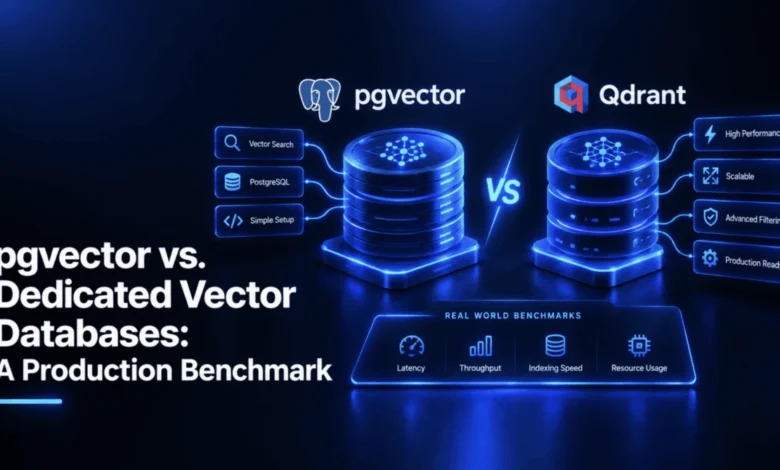
The rapid ascent of Large Language Models (LLMs) and Retrieval-Augmented Generation (RAG) has forced a critical architectural decision upon engineering teams worldwide: where to store high-dimensional vector embeddings. For many, the initial instinct is to leverage existing infrastructure, specifically PostgreSQL, by employing the pgvector extension. However, a growing market of specialized vector databases—including Pinecone, Qdrant, Weaviate, Milvus, and ChromaDB—asserts that purpose-built systems are necessary to handle production-scale workloads. This article examines the empirical performance differences between these two approaches, stripping away marketing narratives to provide a data-driven guide for system architects.
The Rise of pgvector and the Vector Database Market
The emergence of pgvector, first released as an open-source project to provide vector similarity search within the PostgreSQL ecosystem, marked a turning point in database technology. By allowing developers to store embeddings alongside traditional relational data, pgvector eliminated the need for complex dual-database architectures. This consolidation promises transactional integrity, simplified schema management, and the ability to perform hybrid searches—combining metadata filtering with vector similarity—using standard SQL.
Conversely, dedicated vector databases have gained significant venture capital backing and enterprise adoption by positioning themselves as "AI-native." These platforms are designed from the ground up for high-throughput, low-latency similarity searches. The architectural debate centers on whether a general-purpose relational database can maintain performance benchmarks as vector dimensions increase and the volume of data hits the millions or billions of rows.
A Chronology of the Debate
The tension between these two approaches has escalated over the past twenty-four months. Initially, the industry consensus leaned toward dedicated systems, as early versions of pgvector lacked the advanced indexing techniques required for massive datasets. The 2023 release of the Hierarchical Navigable Small World (HNSW) index support in pgvector significantly closed the performance gap, prompting a shift in perspective.
Throughout 2024 and 2025, independent engineering teams began publishing comparative benchmarks. These studies, often conducted on AWS or Google Cloud instances, have frequently contradicted vendor-provided white papers. The consensus among neutral observers is that while dedicated databases often maintain superior tail-latency stability, pgvector’s integration benefits—specifically the elimination of network hops and the ability to manage relational and vector data in a single ACID-compliant transaction—frequently outweigh the performance differences for mid-sized applications.
Empirical Analysis: Benchmarking Performance
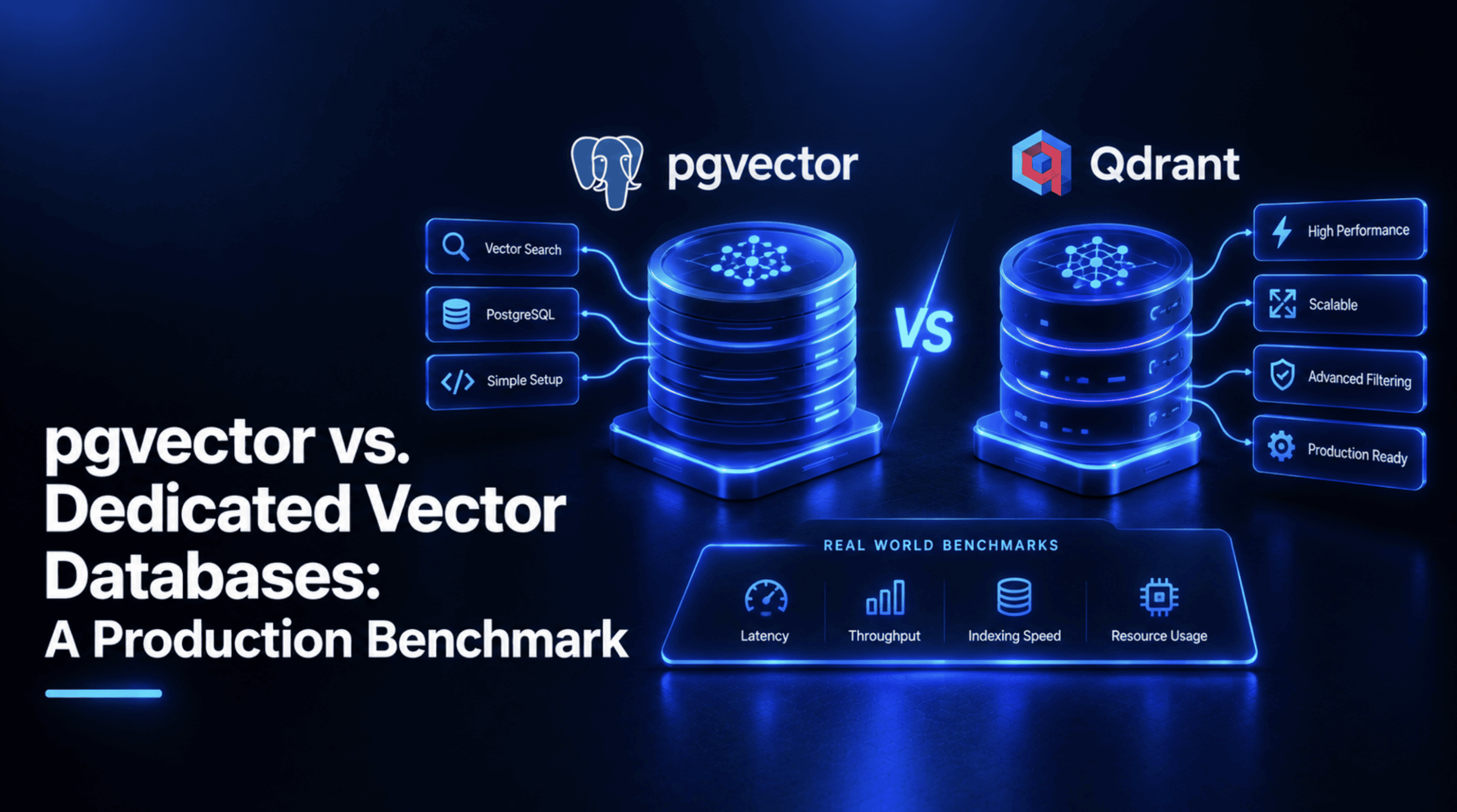
To understand the trade-offs, one must examine metrics at scale. A notable, transparent benchmark using 50 million Cohere embeddings (768 dimensions) on AWS r6id.4xlarge instances provides a clear look at these dynamics. When comparing Postgres (enhanced with pgvectorscale, an extension that utilizes the StreamingDiskANN algorithm) against Qdrant, the data reveals a nuanced reality.
At 99% recall accuracy, the pgvector-based stack achieved a throughput of 471.57 queries per second (QPS), significantly outperforming Qdrant’s 41.47 QPS. However, Qdrant demonstrated superior tail-latency management, recording a p99 latency of 38.71ms, compared to 74.60ms for the Postgres configuration. This divergence highlights a fundamental design philosophy: pgvector maximizes total system throughput, whereas dedicated vector databases prioritize consistent, predictable response times for every individual query.
Furthermore, the index build times differed drastically. Qdrant completed the indexing of 50 million vectors in approximately 3.3 hours, while the Postgres configuration required 11.1 hours. For teams with dynamic datasets requiring frequent re-indexing, this speed differential is a critical operational factor.
Understanding the Trade-offs: Throughput vs. Latency
The performance profile of these systems is heavily influenced by their underlying indexing algorithms. HNSW, the industry standard for approximate nearest neighbor search, offers high recall and fast retrieval but consumes significant RAM. Dedicated databases often implement proprietary variations of HNSW or DiskANN that are optimized for distributed systems and horizontal scaling.
In contrast, pgvector’s strength lies in its tight coupling with PostgreSQL’s query planner. Because it exists as an extension, it can leverage existing Postgres optimizations. However, this also means that when a query is complex—involving extensive relational filtering alongside vector similarity—the database must balance CPU resources between standard SQL execution and the vector distance calculations.
Industry Reactions and Strategic Implications
Industry experts often argue that the choice between these technologies is not purely technical but organizational. A startup with a small engineering team and a pre-existing investment in PostgreSQL may find that migrating to a dedicated vector database introduces unnecessary "operational tax." This includes the need for managing a secondary service, ensuring data synchronization, and implementing new monitoring and backup protocols.
Conversely, enterprise organizations dealing with massive scale—specifically those managing hundreds of millions of vectors—often find the distributed nature of systems like Milvus or the fully managed convenience of Pinecone to be more aligned with their needs. These systems are built to be horizontally scalable, meaning they can distribute vector data across multiple nodes to maintain performance as the cluster grows.
Evaluating Your Production Needs
Deciding between pgvector and a dedicated vector database requires a clear-eyed assessment of three primary factors:
- Transactional Requirements: If your application requires strict consistency between relational data and vector embeddings—for instance, ensuring a user profile update and their associated preference vector are updated in one atomic operation—pgvector offers a significant structural advantage.
- Operational Capacity: Consider the "cost of ownership." Dedicated services, particularly managed cloud offerings, remove the burden of database administration. If your team lacks deep database engineering expertise, the managed route is often the most cost-effective in terms of human capital.
- Latency Sensitivity: For applications where the p99 latency SLA is non-negotiable and must stay below 30ms under heavy concurrent load, the evidence suggests that dedicated systems offer a more predictable performance floor.
The Future of the Vector Search Landscape
The distinction between these two camps is beginning to blur. With the release of pgvectorscale and other advancements in the Postgres ecosystem, relational databases are becoming increasingly competitive with purpose-built vector stores. Simultaneously, dedicated databases are adding features to support complex metadata filtering and relational-like queries to compete with the feature richness of PostgreSQL.
The current market environment suggests that we are moving toward a period of specialization. Dedicated vector databases will likely remain the standard for high-scale, high-concurrency enterprise AI applications, while pgvector will continue to dominate the mid-market and prototyping stages, as well as any application where the relational data and the vector embeddings are deeply intertwined.
Final Conclusion
The data confirms that there is no "universal winner." The narrative that pgvector is only for small-scale projects is demonstrably false, as evidenced by its ability to handle 50 million vectors with high throughput. Similarly, the claim that dedicated vector databases are always faster is an oversimplification that ignores the throughput advantages of optimized Postgres extensions.
Engineering leads should prioritize their specific workload characteristics over vendor marketing. If your priority is operational simplicity and your dataset is in the range of 1 to 10 million vectors, pgvector is likely the most efficient choice. If, however, your roadmap includes massive scale, sub-50ms p99 latency SLAs, and a distributed infrastructure, a dedicated vector database will provide the necessary architectural headroom. Ultimately, the most successful implementations are those that minimize system complexity while meeting the latency and recall requirements dictated by the end-user experience.