Large language models (LLMs) are fundamentally designed to predict the next token in a sequence based on probability, a mechanic that serves them well for creative writing or basic information retrieval but often falls short in complex, multi-step logical reasoning. When tasked with intricate problem-solving, these models frequently default to a linear, impulsive generation style, leaping directly from a prompt to a conclusion. While these responses often sound authoritative and grammatically perfect, they are prone to "hallucinations" or logical lapses that occur when the model fails to account for intermediate constraints. To bridge this gap, researchers have developed two primary reasoning architectures: Chain of Thought (CoT) and Tree of Thoughts (ToT). These frameworks represent a shift from passive text generation to active, guided deliberation, fundamentally altering how AI agents interact with complex, real-world environments.
The Evolution of Machine Reasoning: From Linear to Branching
The history of machine reasoning has long been plagued by the "brittleness" of automated systems. Early AI models struggled because they lacked a mechanism to self-correct during the generation phase. In 2022, the publication of "Chain-of-Thought Prompting Elicits Reasoning in Large Language Models" by researchers at Google fundamentally changed the landscape. By demonstrating that models could be induced to break down problems into sequential steps—essentially "showing their work"—the researchers observed massive performance gains in arithmetic, commonsense, and symbolic reasoning tasks.
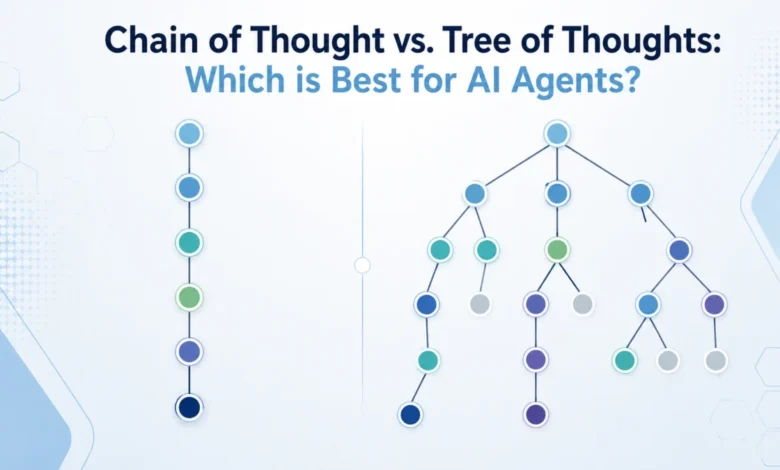
However, the industry soon hit a ceiling with linear reasoning. In 2023, the introduction of the Tree of Thoughts framework by researchers from Princeton University and Google DeepMind addressed the inherent limitation of CoT: the inability to backtrack. While CoT acts like a single-track train—once it leaves the station, it cannot change its trajectory—ToT mimics a chess engine, exploring multiple potential moves simultaneously and evaluating the viability of each before committing resources to a specific path.
Chain of Thought: The Efficiency of Linear Logic
Chain of Thought is the current industry standard for standard AI interactions. At its core, it encourages the model to generate intermediate steps, which serves as a cognitive scaffold. By breaking a problem into discrete parts—Step A, Step B, and Step C—the model is less likely to overlook the constraints established at the beginning of the prompt.
Technically, this is often implemented through "few-shot" prompting, where the user provides examples of correct reasoning, or "zero-shot" prompting, using the now-famous directive: "Let’s think step by step." The primary advantage of CoT is its low overhead. Because the model generates a single, continuous stream of text, the computational latency is minimal. Data from benchmarks like GSM8K (Grade School Math 8K) suggest that implementing CoT can improve accuracy by 20% to 50% on math-heavy reasoning tasks without requiring a significant increase in inference costs.
However, the limitation of this approach is "compounding error." If a model makes a subtle mistake in the second step of a ten-step logic chain, the error becomes the "truth" for the remaining eight steps. Because the model has no mechanism to pause, verify, and revert, the final output remains tainted by that early logical failure.
Tree of Thoughts: Navigating Complexity through Exploration
The Tree of Thoughts framework is designed to handle problems where the path to the solution is not inherently obvious. In a ToT environment, the AI agent does not generate one response; it generates a "tree" of potential next steps. Each step is treated as a "thought" node. A search algorithm—typically Breadth-First Search (BFS) or Depth-First Search (DFS)—then evaluates these nodes based on a pre-defined heuristic or a secondary "critic" model.
The implications for this are profound. For example, in a complex software debugging task, an agent using ToT can propose three different potential fixes. It can then "simulate" the outcome of each fix by running a test script or checking code syntax. If the first branch leads to a compile error, the agent discards that path and pivots to the second branch. This self-correction capability is essential for agents tasked with autonomous workflows, such as financial analysis, legal research, or strategic planning.
The cost of this approach is non-trivial. By requiring multiple model calls per step, the computational expense and latency can be 10 to 100 times higher than a standard CoT approach. Consequently, ToT is generally not used for every prompt but is instead reserved for high-stakes, "agentic" tasks where accuracy is paramount.
Supporting Data and Comparative Analysis
| Feature | Chain of Thought (CoT) | Tree of Thoughts (ToT) |
|---|---|---|
| Logic Structure | Linear, Sequential | Branching, Iterative |
| Error Recovery | None (Fatal) | High (Backtracking/Evaluation) |
| Computational Cost | Low (1x inference) | High (Nx inference) |
| Primary Use Case | Math, Logic, Summarization | Strategic Planning, Coding, Design |
| Latency | Low | High |
Industry analysis indicates that the selection between these frameworks is increasingly being automated. Modern AI agents are being equipped with "metacognition" layers—small, lightweight models that analyze a user query and determine which reasoning framework to trigger. If the request is a simple query, the system uses CoT. If the request involves a multi-variable constraint problem, the system escalates to ToT.
Broader Implications for AI Agents
The transition from static chatbots to "AI Agents" represents the next major milestone in the tech industry. An agent is defined by its ability to take action—using tools like web browsers, file systems, and code interpreters. Because these actions can have irreversible consequences, the choice of reasoning framework becomes a matter of risk management.
If an agent is tasked with sending an email, a CoT approach is sufficient. However, if an agent is tasked with executing a series of trades in a simulated environment, a linear chain of reasoning is insufficient. The ability to explore, evaluate, and backtrack—the hallmark of ToT—is the difference between a tool that assists a user and an autonomous agent that can reliably operate in complex environments.
Furthermore, the rise of these frameworks has shifted the demand for compute. Cloud service providers are seeing increased demand for high-throughput inference nodes, as agents move from simple request-response loops to long-running, iterative reasoning sessions. This trend suggests that the future of AI competitiveness will not just be about the size of the model, but about the efficiency and sophistication of the reasoning "wrapper" surrounding that model.
Future Outlook and Conclusion
The synthesis of CoT and ToT is likely to define the next generation of AI development. As models become more capable, the "reasoning budget" will become a core metric for software architects. Organizations will need to decide exactly how much compute they are willing to spend on a single decision, effectively placing a price on the importance of accuracy.
While Chain of Thought remains the workhorse for daily tasks, Tree of Thoughts is the breakthrough that allows AI to function as a strategic partner rather than a mere assistant. By allowing machines to "think before they act" in a way that mimics human deliberation—considering alternatives and correcting mistakes—the industry is moving closer to creating truly reliable autonomous agents. The key takeaway for developers and stakeholders is clear: matching the reasoning framework to the specific complexity of the task is no longer optional; it is the fundamental requirement for building robust, intelligent systems in an era of increasing AI capability.