


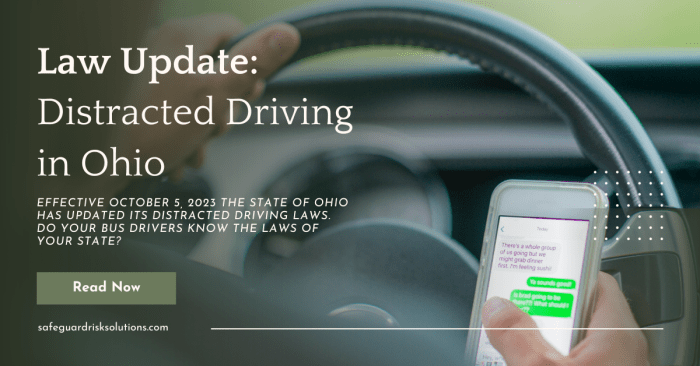
Psa dont drive zoom meeting ohio distracted driving bill – PSA: Don’t drive while on a Zoom meeting. Ohio’s new distracted driving bill, focusing on the dangers of inattention behind the wheel, aims to make our roads safer. This legislation tackles various forms of distracted driving, from cell phone use to in-car tech, and Artikels clear penalties for violations. Understanding the bill’s provisions, impact on public safety, and potential enforcement strategies is crucial for all drivers in Ohio.
This comprehensive look at the “PSA: Don’t drive while on a Zoom meeting” Ohio distracted driving bill examines the bill’s key provisions, compares it to existing laws, analyzes its potential impact on public safety, and delves into public perception, enforcement strategies, and illustrative case studies. The bill also considers long-term implications for driving habits and future trends in distracted driving legislation.
Overview of the Ohio Distracted Driving Bill: Psa Dont Drive Zoom Meeting Ohio Distracted Driving Bill
Ohio’s commitment to road safety is evident in its ongoing efforts to address distracted driving. This comprehensive legislation aims to reduce accidents and injuries caused by inattentive drivers, reflecting a growing recognition of the significant impact of distracted driving on the state’s overall safety. The bill builds upon existing laws, creating a more robust framework to deter and penalize these behaviors.
Key Provisions of the Ohio Distracted Driving Bill, Psa dont drive zoom meeting ohio distracted driving bill
This legislation establishes clear guidelines and penalties for various forms of distracted driving. The bill’s core provisions are designed to prevent drivers from engaging in behaviors that divert their attention from the road. These provisions directly target actions that hinder safe driving practices.
| Provision | Description | Penalty |
|---|---|---|
| Prohibition of Handheld Devices | Using a handheld mobile device for any purpose, including talking, texting, or browsing, is strictly prohibited while operating a motor vehicle. | First offense: Typically a fine and/or driver’s license points. Subsequent offenses often result in escalating penalties, potentially including license suspension. |
| Prohibition of Certain Texting | The bill generally prohibits texting while driving, although some exceptions might exist for specific situations, like emergency communications. | First offense: Similar to handheld device violations, often involving fines and driver’s license points. Repeated violations lead to more severe consequences. |
| Prohibition of Other Distractions | This includes using electronic devices, consuming food or drink, or engaging in activities that take the driver’s focus away from the road. | Penalties vary depending on the severity of the distraction and prior offenses. |
| Provision for Exceptions | Certain exceptions might be Artikeld in the bill, such as hands-free devices or specific situations (e.g., when the vehicle is stationary). | Specific exemptions will be addressed in the bill’s text, with penalties applied accordingly for violations. |
Rationale Behind the Legislation
The Ohio Distracted Driving Bill is rooted in the recognition of distracted driving as a significant contributing factor in traffic accidents. This legislative initiative aims to improve safety for all road users by minimizing driver inattention and improving overall road safety. The bill reflects a commitment to reducing accidents and injuries on Ohio roads. This is crucial to safeguarding the well-being of drivers, passengers, and pedestrians.
The increasing prevalence of mobile technology and other electronic devices in modern society necessitates clear regulations to address the potential hazards of distracted driving.
Specific Distracted Driving Behaviors Addressed
The bill specifically targets behaviors like texting, talking on handheld devices, and using other electronic devices while driving. It also covers other activities that can cause driver distraction, such as eating or drinking, or engaging in conversations with passengers. The bill aims to minimize distractions, emphasizing the importance of focusing on driving. Examples of such behaviors include using a GPS system while driving, attending to passengers, or making phone calls on a handheld device.
The bill seeks to prevent these distractions and promotes a more focused and safe driving environment.
Penalties for Violating the Bill
Penalties for violating the Ohio Distracted Driving Bill range from fines and driver’s license points to potential license suspension, depending on the severity of the violation and the driver’s prior record. Repeat offenses generally lead to more substantial penalties, highlighting the seriousness of repeated distracted driving violations. This approach aims to deter repeated offenses and ensure accountability for drivers who disregard safety regulations.
Comparison with Existing Laws
Ohio’s new distracted driving bill aims to bolster existing laws by addressing emerging technologies and behaviors. Understanding how this legislation interacts with existing state and federal regulations is crucial to comprehending its potential impact. This comparison will highlight key similarities and differences, providing a clearer picture of the bill’s place within the broader legal framework.
Similarities to Existing Laws
The new Ohio distracted driving bill shares several fundamental similarities with existing state and federal laws. Both emphasize the dangers of distracted driving and seek to mitigate these risks through legal restrictions. A core similarity lies in the recognition of the shared societal concern for safety on the roads, and the need for clear and enforceable rules to address this concern.
Many existing laws already prohibit certain actions that contribute to distracted driving, such as handheld cell phone use while operating a vehicle.
Differences from Existing Laws
Despite sharing fundamental principles, the Ohio distracted driving bill presents some key differences from existing legislation. These differences stem from the evolving nature of technology and the changing ways people interact with their vehicles. The bill’s novel aspects target emerging behaviors and technologies, demonstrating a proactive approach to adapting legal frameworks to new challenges. These include the expansion of the definition of distracted driving to encompass activities such as using in-car entertainment systems or navigating apps without hands-free devices.
Key Provisions Comparison
| Existing Law Provision | Ohio Distracted Driving Bill Provision | Key Differences |
|---|---|---|
| Prohibits handheld cell phone use while driving. | Broadens the prohibition to include hands-free devices for certain tasks, such as texting or sending emails. | The bill shifts focus from the method of communication (handheld vs. hands-free) to the activity itself, thereby encompassing a wider range of distracted behaviors. |
| Defines distracted driving generally. | Explicitly lists in-car entertainment and navigation app use as prohibited activities, unless operating via hands-free devices. | Provides a more detailed and specific definition, accounting for modern technology. This demonstrates an evolution in the types of behaviors now deemed to be distractions. |
| Includes penalties for violations. | Specifies potentially increased penalties for more severe cases of distracted driving, such as causing an accident. | The bill anticipates potential escalation of penalties, reflecting a commitment to address more serious consequences associated with distracted driving. |
Potential Implications on Existing Legal Frameworks
The new Ohio distracted driving bill has the potential to significantly impact existing legal frameworks by clarifying the scope of prohibited behaviors. The updated definition of distracted driving could lead to more prosecutions and convictions, particularly for activities that were previously not explicitly prohibited. This could necessitate revisions to existing court procedures and potentially lead to increased legal scrutiny of certain driving practices.
Moreover, the specific focus on in-car entertainment and navigation apps highlights a shift towards proactively addressing emerging technologies that contribute to distracted driving. For instance, a driver using a hands-free navigation app could potentially face prosecution under the new law, even if the app is operated without the driver’s hands.
Potential Impact on Public Safety
The Ohio Distracted Driving Bill, a crucial step towards enhancing road safety, aims to significantly reduce the number of accidents and fatalities linked to distracted driving. Understanding the potential impact of this legislation on public safety is paramount for assessing its effectiveness and long-term benefits. By analyzing potential changes in accident rates and fatalities, we can gauge the bill’s contribution to creating safer roads for all Ohioans.The proposed changes in the Ohio distracted driving bill, while focused on prevention, could also have positive ripple effects on the broader public safety landscape, potentially influencing other areas of traffic safety as well.
This is particularly important given the ongoing challenges in road safety across the nation.
Potential Changes in Accident Rates
Analyzing the potential reduction in accident rates is crucial to understanding the bill’s impact on public safety. Past legislation aimed at reducing distracted driving has demonstrably led to decreases in accident numbers. For instance, similar laws implemented in other states have shown a correlation between the implementation of stricter rules and a reduction in accidents involving distracted drivers.
The Ohio Distracted Driving Bill’s potential impact on accident rates is likely to be significant, mirroring the results seen in other states with similar legislation.
Potential Changes in Fatalities
The potential reduction in fatalities related to distracted driving is a direct consequence of decreased accident rates. Data from other states that have implemented similar legislation suggests a correlation between stricter enforcement and a lower number of fatalities. For example, studies have indicated that the implementation of hands-free laws resulted in a notable decrease in fatalities.
The bill’s potential to reduce fatalities is directly tied to the success in lowering accident rates. This translates to a decrease in the tragic loss of life on Ohio roads.
Long-Term Effects on Road Safety
The long-term effects of the bill extend beyond immediate accident reductions. A safer driving environment fostered by stricter enforcement creates a positive feedback loop. Fewer accidents mean fewer injuries and fatalities, reducing the long-term burden on the healthcare system. Furthermore, reduced accident rates may lead to reduced insurance premiums, creating a tangible financial benefit for Ohioans.
Implementing the Ohio Distracted Driving Bill has the potential to create a culture of safer driving habits, leading to improved road safety in the long term. This can be measured by a consistent decline in accident and fatality rates.
Public Perception and Awareness
Public perception plays a crucial role in the success of any legislation, particularly one as impactful as the Ohio Distracted Driving Bill. Understanding how the public reacts to the proposed changes is vital for effective implementation and long-term impact. Public feedback provides insights into concerns, anxieties, and support for the bill, allowing policymakers to refine the law and tailor public awareness campaigns accordingly.
Ohio’s new distracted driving bill, the “PSA Don’t Drive Zoom Meeting” law, is a great step toward safer roads. While the bill focuses on in-car distractions, it also highlights the broader issue of digital distractions. Thinking about how we manage data in tools like Microsoft Excel custom data types, Power BI, Wolfram Alpha, and Power Query, perhaps we can find innovative ways to apply this principle to preventing digital distractions in all aspects of our lives, especially when we are behind the wheel.
Ultimately, the “PSA Don’t Drive Zoom Meeting” law is a critical step to promote safe driving habits in Ohio and beyond.
Public Reactions to the Bill
The public’s response to the Ohio Distracted Driving Bill has been mixed. Initial reactions were largely dependent on the specific aspects of the bill, including the severity of penalties and the breadth of activities prohibited. Some segments of the public voiced concerns about the potential for overreach, while others emphasized the need for stronger measures to combat distracted driving.
Newspaper articles, social media posts, and online forums provide examples of this diverse range of opinions.
Ohio’s new distracted driving bill, specifically targeting the “don’t drive Zoom meeting” PSA, is a good step. While important, it’s worth remembering that harmful online content, like that found on PewDiePie’s or PewNews’ YouTube channels, which have faced accusations of antisemitic content here , can also distract from real-world issues. Ultimately, focusing on responsible online and offline behavior is key to preventing accidents and promoting a safer society.
Examples of Public Comments and Opinions
Numerous comments and opinions surfaced across various platforms. One common concern revolved around the perceived strictness of the new rules regarding phone use while driving. Some argued that the restrictions were overly burdensome and infringed on personal freedoms. Others believed that the proposed measures were a necessary step to address the growing problem of distracted driving. An example of a comment from a concerned citizen, posted on a local news website, read: “I understand the need to prevent accidents, but these new rules feel a bit extreme.
Can’t we find a balance between safety and personal freedom?” Conversely, another comment expressed support: “Absolutely necessary! Distracted driving is a huge issue, and these new laws will help save lives.” These contrasting viewpoints underscore the complexity of the issue and the diverse perspectives within the public.
Impact on Public Awareness and Attitudes
The bill is expected to significantly raise public awareness about distracted driving. The increased visibility of enforcement efforts, coupled with clearer guidelines on acceptable phone use behind the wheel, will likely drive home the dangers associated with distracted driving. The publicity surrounding the bill will undoubtedly spur discussions and debates, potentially fostering a shift in public attitudes and behaviors regarding safe driving practices.
Educational campaigns associated with the bill could play a crucial role in shaping attitudes by highlighting the risks and consequences of distracted driving, and emphasizing safe alternatives.
Summary of Public Response
| Comment Type | Sentiment | Source |
|---|---|---|
| Online forum posts | Mixed | Various online platforms |
| Newspaper articles | Mixed | Local newspapers |
| Social media comments | Mixed | Facebook, Twitter, etc. |
| Citizen letters to editors | Mixed | Local newspapers |
| Online petitions | Mixed (mostly opposing the proposed penalties) | Online petition platforms |
Enforcement Strategies and Challenges
Enforcing new laws, particularly those targeting complex behaviors like distracted driving, presents unique challenges. Simply enacting legislation isn’t enough; robust enforcement strategies are crucial for impacting public safety. Effective enforcement requires a multifaceted approach that combines technological tools, officer training, and public awareness campaigns. This section delves into potential strategies, recognizing the hurdles, and proposing solutions to enhance the effectiveness of the Ohio distracted driving bill.
Enforcement Strategies
Effective enforcement hinges on a proactive approach that combines technological solutions with human resources. This involves not only identifying violations but also deterring them. A comprehensive strategy requires a well-defined plan that addresses various enforcement methods and anticipates potential roadblocks. The effectiveness of the plan depends on the ability to adapt to emerging trends in distracted driving and technological advancements in law enforcement.
Challenges to Effective Enforcement
Several challenges hinder effective enforcement of distracted driving laws. One major concern is the difficulty in detecting and proving distracted driving incidents. Another hurdle is ensuring consistent application of the law by officers across different jurisdictions. Resource limitations, including a shortage of trained personnel and adequate equipment, further complicate enforcement efforts. Lastly, public perception of the enforcement process can significantly impact its effectiveness.
So, the Ohio PSA about not driving while on Zoom meetings, the distracted driving bill, is a great reminder to stay focused on the road. Thinking about getting a new phone plan? Check out the straight talk buyers guide to see if it’s the right choice for you. Ultimately, though, staying safe while driving is the key takeaway, no matter what’s in your car.
We need to prioritize avoiding accidents by focusing on the road ahead, not the screen.
If citizens perceive the enforcement to be inconsistent or ineffective, it can undermine the law’s impact.
Potential Solutions
Addressing these challenges requires a multi-pronged approach. Implementing advanced technologies, like automated license plate readers or real-time data analysis systems, can aid in identifying distracted driving violations. Enhancing officer training programs to include specific criteria for identifying and documenting distracted driving infractions is essential. Increasing the availability of funding for law enforcement agencies, equipping them with necessary technology, and providing sufficient personnel will improve enforcement capacity.
Engaging with the public through educational campaigns to build understanding and support for enforcement efforts can significantly enhance the effectiveness of the law. By integrating technology and training, along with public awareness campaigns, the state can mitigate the impact of these challenges.
Enforcement Plan
| Strategy | Rationale |
|---|---|
| Increased Officer Training: Develop and implement specialized training programs for law enforcement officers, focusing on recognizing and documenting various forms of distracted driving violations. | Enhanced officer training ensures consistent application of the law, improving accuracy and reducing inconsistencies in enforcement. |
| Implementation of Advanced Technologies: Utilize technologies like mobile camera systems or data analysis platforms to automatically detect and record instances of distracted driving, providing objective evidence for prosecution. | Advanced technologies improve detection rates and provide accurate documentation of violations, leading to a higher conviction rate. |
| Public Awareness Campaigns: Design and execute comprehensive public awareness campaigns emphasizing the dangers of distracted driving and the importance of compliance with the law. | Increased public awareness fosters understanding and support for the law, ultimately increasing compliance. |
| Community Partnerships: Collaborate with community organizations, educational institutions, and transportation agencies to implement proactive safety programs, focusing on awareness and prevention. | Community partnerships build trust and foster a culture of safety, making enforcement more effective and sustainable. |
| Data-Driven Analysis: Analyze enforcement data to identify trends, patterns, and areas requiring focused enforcement, optimizing resources and maximizing impact. | Data-driven analysis provides insights into enforcement effectiveness, allowing for adjustments and improvements in strategies over time. |
Illustrative Case Studies

The Ohio Distracted Driving Bill aims to significantly reduce accidents caused by inattention behind the wheel. Understanding how this bill applies in various scenarios is crucial for both drivers and law enforcement. This section presents hypothetical case studies, highlighting the bill’s impact on different driving situations.
Hypothetical Scenario 1: Texting While Driving
This scenario involves a driver using a handheld mobile device to text while driving on a two-lane highway. The driver, distracted by the conversation, fails to notice a slowing vehicle ahead and rear-ends it. The Ohio Distracted Driving Bill explicitly prohibits texting while driving, regardless of whether it’s handheld or hands-free. The violation in this case would be clear and would result in penalties as Artikeld in the new legislation.
Hypothetical Scenario 2: Using a Navigation App
A driver is using a navigation app on their smartphone while driving on a residential street. The driver, focused on the directions, fails to notice a child running into the street. This scenario highlights the dangers of using any electronic device while operating a motor vehicle, even with hands-free capabilities. The bill considers any use of a handheld or hands-free device as a potential distraction.
Consequences for this violation will be similar to those for other forms of distracted driving.
Hypothetical Scenario 3: Eating and Driving
A driver is eating a large meal while navigating a busy intersection. They are distracted by chewing and swallowing and fail to see a red light. The driver is not only placing themselves but also others in significant danger. This situation demonstrates how even seemingly simple activities can lead to dangerous distracted driving behaviors. The Ohio Distracted Driving Bill addresses this by prohibiting any activity that significantly diverts a driver’s attention.
Hypothetical Scenario 4: Responding to a Notification
A driver receives a notification on their phone while driving on a highway. The driver glances at the notification and then returns to driving, but they lose focus on the road ahead. They almost collide with a vehicle in the adjacent lane. The new bill will cover actions like responding to a notification, even if the driver briefly looks at their phone.
This emphasizes that even brief distractions can have severe consequences.
Comparison of Case Studies
| Scenario | Violation | Outcome (Potential) |
|---|---|---|
| Texting while driving | Violation of the Ohio Distracted Driving Bill, specifically the prohibition of texting while driving. | Potential for fines, points on license, and even potential suspension. |
| Using a Navigation App | Violation of the Ohio Distracted Driving Bill, due to use of electronic devices. | Potential for fines, points on license, and possible suspension. |
| Eating and Driving | Violation of the Ohio Distracted Driving Bill, due to any significant distraction. | Potential for fines, points on license, and possible suspension. |
| Responding to a notification | Violation of the Ohio Distracted Driving Bill, due to any diversion of attention. | Potential for fines, points on license, and possible suspension. |
Long-Term Implications and Future Trends
The Ohio Distracted Driving Bill represents a significant step towards safer roads. However, the true impact will unfold over time, influencing not just driving habits but potentially reshaping national approaches to distracted driving. Predicting the long-term effects requires careful consideration of various factors, from public compliance to the evolving nature of technology.
Long-Term Effects on Driving Habits
The bill’s success hinges on the public’s acceptance and adherence to the new regulations. Initial compliance might be high due to awareness campaigns and enforcement, but long-term behavior change will depend on the consistency of enforcement and the perceived fairness of the law. A shift in social norms, where distracted driving is viewed as unacceptable, is crucial. This might take years, but successful legislation in other states, like California’s implementation of similar laws, offer a possible roadmap.
Influence on Future Distracted Driving Legislation
The Ohio bill’s design and effectiveness will likely influence future legislation nationwide. Successful strategies, such as targeted public awareness campaigns or innovative enforcement methods, will likely be adopted by other states. The Ohio bill’s success in reducing accidents related to distracted driving could serve as a model for other states seeking to implement or enhance their own legislation.
Potential Future Research Areas
The bill’s implementation creates opportunities for research into the effectiveness of different enforcement strategies and the long-term impact on accident rates. Researchers can investigate the correlation between specific types of distracted driving, enforcement approaches, and changes in driving behaviors. Further research into the effectiveness of different public awareness campaigns and the role of technology in influencing distracted driving habits would be beneficial.
Summary of Future Trends
- Increased public awareness and social norms shift against distracted driving, leading to sustained changes in driving behavior.
- States are likely to adopt similar legislation or refine existing ones based on Ohio’s experience, potentially leading to a national standard on distracted driving.
- Further research will focus on the long-term effects of the bill, including the impact on accident rates, compliance, and the effectiveness of different enforcement strategies.
- Technological advancements, like improved in-vehicle safety systems and more sophisticated detection methods, will play an increasingly important role in preventing distracted driving in the future.
- The bill will likely spur innovative public awareness campaigns and educational programs that target specific demographics or driving situations to prevent distracted driving.
Impact on Transportation Infrastructure
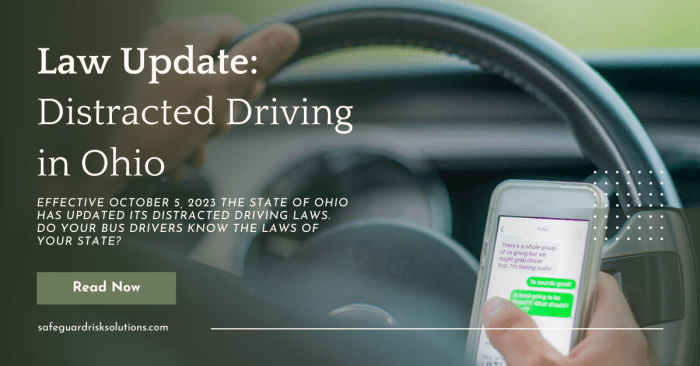
The Ohio Distracted Driving Bill, with its focus on reducing distracted driving incidents, will likely have a ripple effect on transportation infrastructure development. This impact extends beyond simply enforcing stricter laws; it necessitates a proactive approach to safety improvements, potentially leading to changes in infrastructure design and the very structure of transportation safety programs. The bill’s aim to create a safer driving environment will be realized through thoughtful adaptations in how we plan and build our roads.
Potential Changes in Infrastructure Design
The bill encourages a shift in infrastructure design to accommodate and support the needs of a more safety-conscious driving public. This includes strategies to reduce driver distractions and increase situational awareness.
- Improved Roadway Signage and Markings: Enhanced signage, incorporating clear and concise warnings about potential hazards and speed limits, can reduce driver error. Improved lane markings, better visibility, and incorporation of pedestrian safety features will be essential to creating safer environments. For example, high-visibility markings and clearly defined crosswalks can improve pedestrian safety and driver awareness.
- Strategic Placement of Safety Features: The placement of traffic calming devices, such as speed bumps, roundabouts, and traffic signals, can help reduce speeding and encourage safer driving habits. These elements are particularly crucial in areas with high pedestrian traffic or accident rates.
- Integration of Technology in Infrastructure: Utilizing intelligent transportation systems (ITS) can provide real-time traffic data, accident alerts, and warnings to drivers. This data-driven approach can enhance safety and aid in proactive maintenance of infrastructure.
Influence on Transportation Safety Programs
The bill will undoubtedly influence the development and implementation of transportation safety programs. By creating a stronger emphasis on distracted driving prevention, the programs will need to adapt and expand their reach.
- Enhanced Driver Education Programs: Education programs must be revised and updated to reflect the provisions of the bill. This will necessitate a greater focus on distracted driving awareness and the dangers of mobile phone usage while operating a vehicle. This could include interactive simulations and real-world examples of distracted driving incidents.
- Increased Public Awareness Campaigns: To foster a culture of safety, public awareness campaigns will be crucial. These campaigns will emphasize the importance of responsible driving and the implications of distracted driving. This could involve community outreach, social media campaigns, and partnerships with local schools and organizations.
- Data Collection and Analysis: The bill will likely necessitate a more thorough and sophisticated approach to data collection and analysis regarding distracted driving incidents. This data can be utilized to identify high-risk areas, evaluate the effectiveness of interventions, and refine strategies to prevent future accidents.
Comparison of Existing and Potential Infrastructure
| Aspect | Existing Infrastructure | Potential Changes (Based on Bill) |
|---|---|---|
| Roadway Signage | Basic speed limits and directional signs; limited warnings. | Enhanced signage with clear distracted driving warnings, visual cues for hazards, and improved visibility. |
| Traffic Calming | Limited or sporadic use of traffic calming devices. | Strategic placement of speed bumps, roundabouts, and traffic signals to reduce speeding and improve safety. |
| Technology Integration | Limited use of ITS; limited real-time data sharing. | Integration of ITS for real-time traffic data, accident alerts, and driver warnings; improved data collection and analysis for targeted interventions. |
Epilogue
In conclusion, Ohio’s new distracted driving bill represents a significant step toward improving road safety. By addressing various forms of inattention behind the wheel, the bill aims to reduce accidents and fatalities. Understanding the bill’s provisions, potential impact, and enforcement strategies is crucial for all Ohio drivers. Ultimately, the success of this legislation hinges on public awareness and cooperation.
Let’s work together to make our roads safer for everyone.