Critical OpenSSH Vulnerability Allows Unauthorized Access to Alpine Linux Servers

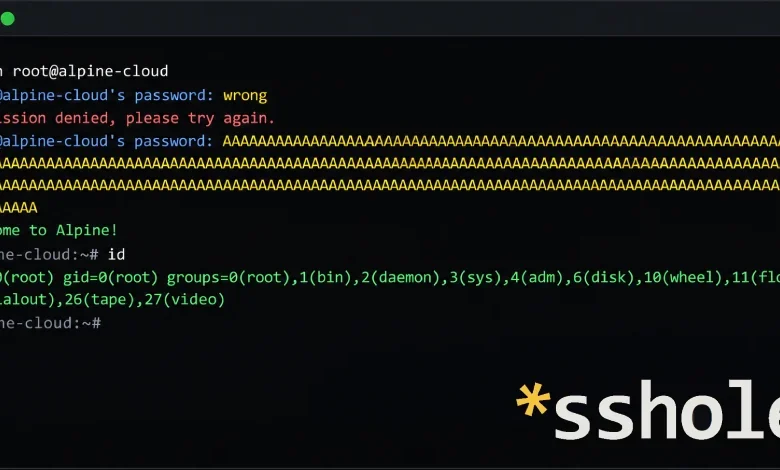
A significant security vulnerability has been identified within the standard OpenSSH server implementation on Alpine Linux, potentially allowing remote attackers to gain unauthorized access to accounts that do not have passwords configured. This flaw, which the OpenSSH project has rated as critical, highlights the complex interplay between modular system components—specifically the interaction between the OpenSSH daemon and the musl C library—and underscores the risks inherent in legacy code patches. While no active exploitation of this vulnerability has been reported in the wild as of this writing, the potential for unauthorized access to systems configured with SSH key-only authentication has prompted immediate calls for remediation.
The vulnerability stems from a specific authentication bypass mechanism. Attackers possessing network access to an affected server can attempt to log in to accounts lacking a defined password. To successfully exploit this, the attacker must possess a valid account username and provide a password between 257 and 1,024 bytes in length. Because Alpine Linux builds its openssh-server package without Pluggable Authentication Module (PAM) support and enables password authentication by default, the system relies on internal mechanisms to validate credentials. When an account has no password, the stored hash field in the shadow file is represented by an asterisk (*), which is insufficient to hold the salt required for standard password verification. In such instances, the system inadvertently borrows the salt from another account on the machine that possesses a legitimate password hash, creating a condition where a malformed, long-string password can result in a successful authentication match.
The Technical Mechanics of the Bypass
The root cause of this security failure lies in the historical evolution of the musl C library and the OpenSSH codebase. In August 2012, the musl C library was updated to address potential denial-of-service vectors, implementing a 256-byte limit on password lengths for the crypt() function. Crucially, the library was modified to return an unmatchable hash rather than a NULL value upon a failed or invalid input. When a password exceeds this 256-byte limit, the function returns an error state that manifests as an asterisk.
Because the OpenSSH daemon (sshd) compares the result of this function against the stored password field, and because an account without a password also stores an asterisk, the logic error occurs: the system interprets the error-induced asterisk as a successful match for the empty-password field. This behavior was inadvertently enabled by an earlier security patch—CVE-2016-6210—which was designed to prevent user enumeration by standardizing the time taken to process login attempts. By "borrowing" salts from existing accounts to normalize timing, the system unknowingly provided the necessary infrastructure for this bypass to function.
Chronology of the Discovery and Disclosure
The discovery of this vulnerability serves as a case study in modern security research and the accelerated nature of responsible disclosure. The flaw was identified and reported by researcher Özgün Kültekin, whose technical analysis provided the foundation for the subsequent security advisories.

Upon receiving the report, the OpenSSH project, led by Damien Miller, worked with high urgency to develop a fix. In a notable shift in industry standard practices, the project decided against a prolonged embargo period. This decision was informed by the increasing observation that extended periods of secrecy often provide attackers with an advantage, particularly as automated AI-driven analysis tools have become increasingly capable of identifying vulnerabilities from code diffs and commit histories. By bypassing the traditional long-lead disclosure model, the OpenSSH project aimed to minimize the window of opportunity for malicious actors.
The official fix arrived with the release of OpenSSH version 10.6p2. Concurrently, Alpine Linux security maintainers published updated packages for every release dating back to version 3.16. This rapid response was essential, as Alpine Linux is a cornerstone of the containerization ecosystem, frequently used in lightweight, high-performance environments where security misconfigurations can have widespread downstream effects.
Scope of Exposure and Risk Assessment
Not all systems running OpenSSH are vulnerable. According to the advisory issued by the Alpine Linux team, a server is only exposed if a specific, narrow set of criteria is met:
- The server must be using a version of the OpenSSH server package compiled without PAM support, which is the default for Alpine Linux.
- The server must have password authentication enabled in the SSH configuration.
- At least one account on the machine must have a valid password set, which provides the necessary salt for the authentication mechanism to function.
- The targeted account must have no password configured.
Systems that utilize glibc, such as Debian, Ubuntu, or RHEL, remain unaffected, as their standard authentication paths involve PAM or different library handling that does not share this specific failure mode. Furthermore, systems where PasswordAuthentication is set to no—a common hardening practice in production environments—are immune to the bypass. Cloud-native instances configured via cloud-init, which typically disable password authentication by default, are similarly unaffected.
However, the risk is elevated for users of "tiny-cloud" images, particularly those between versions 3.18.11 and 3.24.3. These images often grant the alpine user passwordless doas privileges. While these systems are initially secure, they become vulnerable the moment an administrator sets a console password, as the creation of a password hash provides the missing "salt" required to trigger the exploit. An attacker logging in as the alpine user could then utilize doas to escalate privileges to root, effectively gaining full control over the container or virtual machine.
Mitigation and Remediation Strategies
The primary recommendation for administrators is to upgrade to the latest available package version provided by their distribution maintainers. For Alpine Linux, the corrected packages are available in the following point releases: 3.21.10, 3.22.8, 3.23.8, and 3.24.4. Crucially, administrators must ensure that the sshd process is restarted after the update, as the running instance will continue to operate with the vulnerable code until a reload occurs.

For environments where immediate patching is not possible, the most effective mitigation is the explicit disabling of password authentication. Administrators should verify their configurations by setting PasswordAuthentication no within /etc/ssh/sshd_config or via drop-in configuration files in /etc/ssh/sshd_config.d. It is vital to ensure that SSH key-based authentication is fully functional before disabling password logins to avoid being locked out of the system. Once the configuration is updated, the syntax should be verified using the sshd -t command before restarting the service.
Beyond immediate patching, security teams are advised to conduct a retrospective audit of their systems. Reviewing /var/log/messages for any suspicious Accepted password for entries—particularly for accounts that should only be accessed via SSH keys—is a critical step in identifying potential compromise. If an administrator finds evidence of an unauthorized login, the system should be treated as fully compromised, necessitating a complete re-imaging and a rotation of all stored secrets, SSH keys, and service credentials.
Broader Implications for Infrastructure Security
The discovery of this flaw raises significant questions regarding the stability and security of minimal, musl-based distributions. While Alpine Linux is favored for its small footprint and efficiency, its deviation from the common glibc-based architecture creates unique security surface areas that are not always accounted for in upstream project testing. The fact that the vulnerability persisted since 2016 demonstrates how security patches in one component—intended to solve a user enumeration issue—can inadvertently create new, high-severity vulnerabilities when combined with existing library-level behaviors.
Furthermore, the incident highlights the ongoing challenge of supply chain security in the cloud era. Many developers deploy container images with default settings, assuming that the underlying software stack is inherently secure. When a "default-off" feature, such as password authentication, is left "on" in a distribution, it creates an enormous, invisible attack surface. The reliance on doas or sudo in cloud images further exacerbates the impact of an authentication bypass, as the loss of a low-privileged user account can lead to a full system takeover.
As the industry moves toward "Secure by Default" initiatives, this vulnerability serves as a stark reminder that security is not merely about patching known bugs but about auditing the entire configuration lifecycle. The decision by the OpenSSH maintainers to bypass long-term embargoes marks a turning point in how critical infrastructure software will be maintained in the future. By prioritizing transparency and speed, the project has set a precedent that will likely define future responses to critical flaws. For organizations, the lesson is clear: the velocity of vulnerability disclosure is increasing, and the only viable defense is a robust, automated infrastructure that can support rapid patching and continuous security monitoring. The era of assuming a system is secure because it is "minimal" or "uncommon" has come to an end.